

Plan an event transit-container arrangement around the units that actually return and become available for the next move. Owning eight containers does not establish that eight are ready for every event. Separate returned condition, held units, replacement needs and route costs before comparing repeated use with a new-container option.
The arrangement must suit the actual products and transport conditions. A box surviving one trip does not establish its suitability for repeated loads, and a proposed return arrow does not prove the return service exists.

Follow the fleet across two events
Consider a hypothetical brand needing eight qualified transit containers per event. Eight are available before the first event. After they return, two remain on hold for a condition review. No real containers, completed trips or qualification results support these inputs.
Scroll horizontally if columns extend beyond the view.
| Event state | Ready containers | Other identified containers | Immediate decision |
|---|---|---|---|
| Before event 1 | 8 | None in this example | Allocate the stated eight |
| After the return and review | 6 | 2 held | Keep hold separate from readiness |
| Before event 2 requires eight | 6 | 2 still held unless released | Confirm two qualified replacements or another supported route |
The two held units still exist physically. They cannot be counted among event-2 ready stock until a responsible decision establishes their next use. A message saying the van has returned does not supply that disposition.
Record containers that do not return separately from returned but held units. Their replacement and next-route questions may differ.
Compare costs for the same number of usable moves
Assume, solely for illustration, a qualified new container costs $20 and the defined return-and-preparation work costs $3 per returned container. These amounts are invented and exclude transport, review, storage and other actual cost lines.
A repeated-use comparison must include the initial containers, each completed return route and qualified replacements where needed. In the second-event scenario, counting only eight times $3 would omit the gap created by the two held units.
Check whether a quoted return cost applies to each unit, each trip or a whole vehicle movement. The denominator matters when comparing with individual new-container costs. No lifetime or completed-trip count should be assumed from a material description.
Keep internal event logistics distinct from customer reuse
The organized packaging-return explanation identifies the route, receiving responsibility and next-use preparation needed for a business-managed system. This article applies a quantity and budget model to brand-internal event moves; it does not establish a customer return program.
The UPS US packing guidance addresses shipment preparation within its scope. It provides no qualification of a repeated event container or evidence of a reuse lifetime.
An environmental comparison would require its own appropriate basis. A favorable hypothetical cash comparison cannot establish lower environmental impact.
Confirm the next event’s ready quantity
Return the required container count, actual ready stock, holds, missing returns and qualified alternatives, with their dates. Record who decides each held unit and who arranges the actual return movement.
Packrivo can organize the sourcing and configuration questions through a packaging project inquiry. Public guidance was checked on 14 October 2026. No container fleet, return rate, saving or transport performance is reported by this example.
Compare two events with the readiness gap included
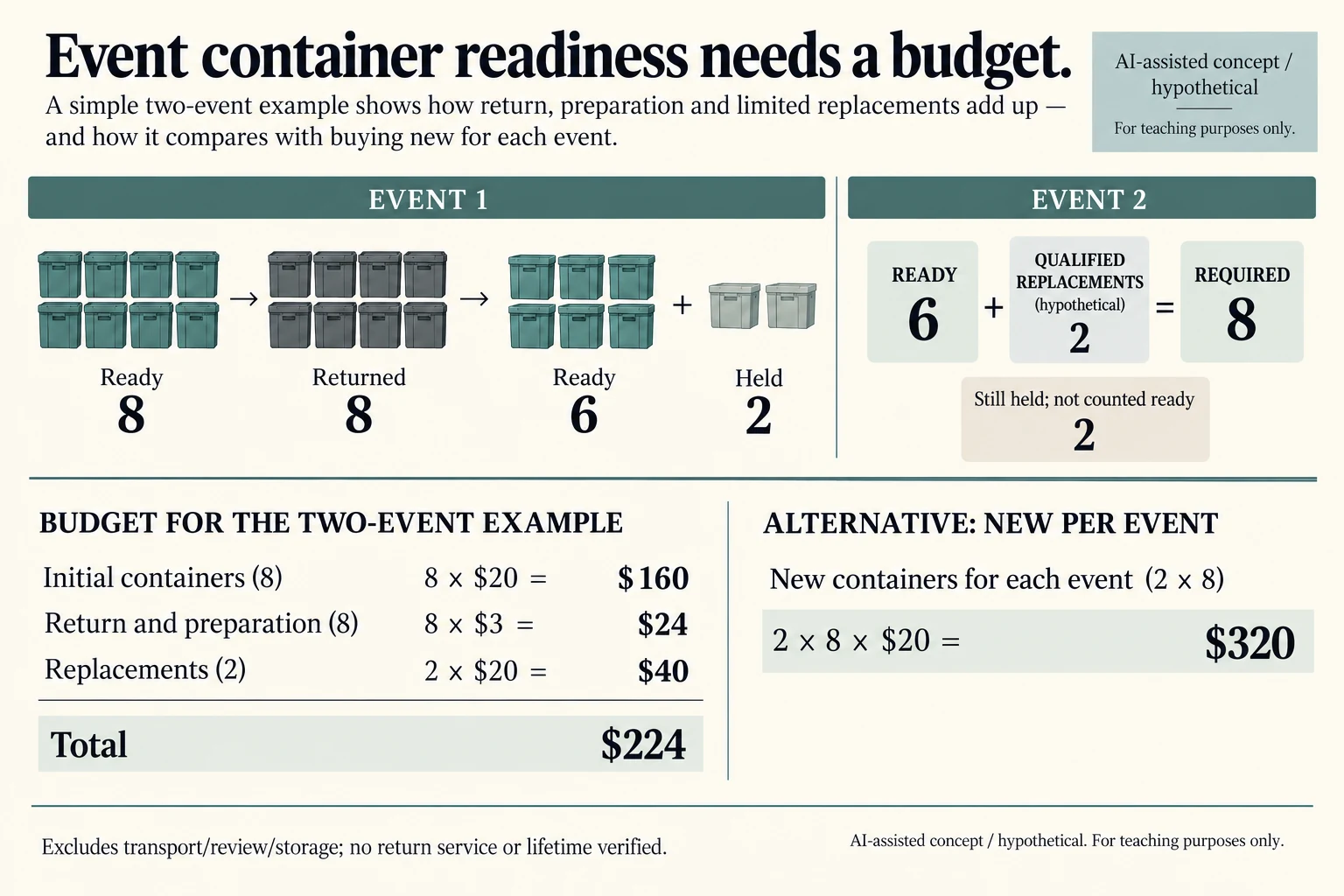
Extend the original eight-container example across two events. Assume all eight return, six are ready, two remain held, and two qualified new containers are bought for event two. Keep $20 per new container and $3 per returned container solely as invented costs.
Scroll horizontally if columns extend beyond the view.
| Scenario scope | Exact object or route | Hypothetical input or output | Calculation or record boundary |
|---|---|---|---|
| Two event cost | BUDGET18 | 160 USD | 8*20 |
| Two event cost | BUDGET18 | 24 USD | 8*3 |
| Two event cost | BUDGET18 | 40 USD | 2*20 |
| Two event cost | BUDGET18 | 224 USD | 160+24+40 |
| Two event cost | BUDGET18 | 320 USD | 2*8*20 |
| Two event cost | BUDGET18 | 96 USD | 320-224 |
| Hypothetical ready fill | FLEET18 | 2 containers | Six ready plus 2 qualified replacements reaches 8; actual qualification unknown |
| Hold unchanged | FLEET18 | 2 containers | Two original held units remain held, not assumed discarded |
The defined repeated-use route is $160 initial purchase plus $24 return/preparation plus $40 replacement, totaling $224. Buying eight new containers for each of two events totals $320. The limited difference is $96 before transport, review, storage and other actual costs; it is not an observed saving.
The two original held containers still exist and are not silently discarded or released when replacements are added. Missing returns, return dispatch, return receipt, condition review and next-ready dates have distinct rows. A provider’s per-trip or per-vehicle charge must not be multiplied as though it were the assumed per-container $3.
Download the reusable event transit containers record (.csv). It covers the original scenarios and this added comparison. HYPOTHETICAL rows are invented planning examples. Actual quantity, value, configuration, method, owner, observation, condition, decision, evidence and dates are blank because no actual project record has been obtained. Copy a relevant row and replace its type with ACTUAL only when entering permitted project evidence; keep the example and actual record separate. ACTUAL_BLANK is an empty starting row. A blank is unknown, never approval.
The related Returning Gift Packaging for Reuse Needs a Working System guide concerns a separate requirement. Use this record for the specific comparison above rather than treating that guide as evidence of a completed result.
When corrective work is proposed, compare accepted output with the accepted recovery cost model. A surviving first fold is not lifetime evidence; see the finished-hinge evidence distinction.
Source scope checked 16 October 2026: the original public references remain within their stated general guidance or manufacturer-example scope. The new numbers and task records are original hypothetical analysis, not observed supply, trials, inventory, prices or performance.
What this changes in a packaging enquiry
Keep reusable event transit containers separate from the presentation packaging consumed per gift. For the next event, calculate the purchase shortfall as required usable containers minus returned containers actually accepted and available for that event, with a minimum of zero. A modeled return rate does not establish damage tolerance, a working return network or supplier replacement stock.
Discuss this packaging specification with Packrivo. We coordinate independent suppliers. MOQ: 500 pieces per product/design; illustrative quantities are not production offers. Confirm materials, samples, price and timing for your project.