

Prepare a new complete shipment description when a retailer removes some units from a wholesale case and sends the remainder onward. The same outer carton now contains a different load. Empty positions, changed support and a new unit count need a defined repacking route rather than automatic reliance on the original full-case arrangement.
In this guide
First establish what is actually being sent. Identify the remaining retail units, their packaging versions and the intended route. A quantity written on the original case label no longer describes a partly emptied shipment.

Show the remaining load before choosing the outer pack
Assume a hypothetical twelve-unit case contains twelve individually packed gifts in a named divider arrangement. A retailer removes seven units, leaving five. Neither arrangement has been developed or transport-tested for this example.
Scroll horizontally if columns extend beyond the view.
| Configuration field | Original full case | After seven units are removed |
|---|---|---|
| Retail-unit count | 12 | 5 |
| Occupied divider positions | All twelve | Five named positions |
| Empty positions | None | Seven positions |
| Complete packed mass | Original defined input | Must reflect the remaining configuration |
| Further dispatch route | Original route | New intended movement to identify |
Record which five positions remain occupied. Five units in one corner and five units distributed across the case can create different relationships even though the total is identical.
The loaded carton orientation map provides the top and side views for that record. Preserve the part-case state rather than presenting the earlier twelve-unit drawing as its evidence.
Compare explicit next routes
One option is an already qualified five-unit dispatch arrangement, if it exists for those contents and the intended route. Another is a revised proposal using the original outer carton with an identified new internal arrangement. A third is an actual regrouping or later-dispatch route the business permits.
Do not assume any of those options exists. Ask the responsible packing and shipping owners what can be supported, including material availability and the new complete configuration.
The UPS US packing guidance concerns outer packaging, internal preparation and closure. It does not approve an arbitrary amount of void fill or establish that the partly occupied divider remains suitable.
Recheck the evidence at the changed scope
An evaluation of a full twelve-unit system cannot silently become evidence for the five-unit arrangement. Changes in contents, support, mass or route need the responsible technical reviewer to determine the relevant evidence.
The distribution-evaluation scope guide keeps that system and route explicit. A part-case photograph documents the arrangement shown; it is not a transport result.
Keep identity and quantity labeling consistent with the repacked contents. If the resulting shipment is an orderable trade item or part of a specific logistics process, its applicable identification requirements need separate review.
Return the remaining-contents proposal
Provide the five unit identities, occupied positions, proposed support and outer-pack route. Mark which evidence exists, which configuration it covers and which questions remain open. Retain the original full-case reference as history rather than overwriting it.
Packrivo can coordinate those configuration and supplier questions through a packaging project inquiry. Public carrier guidance was checked on 14 October 2026. This hypothetical comparison supplies no approved five-unit pack, transport pass or universal repacking method.
Name the five positions before asking for a repack proposal
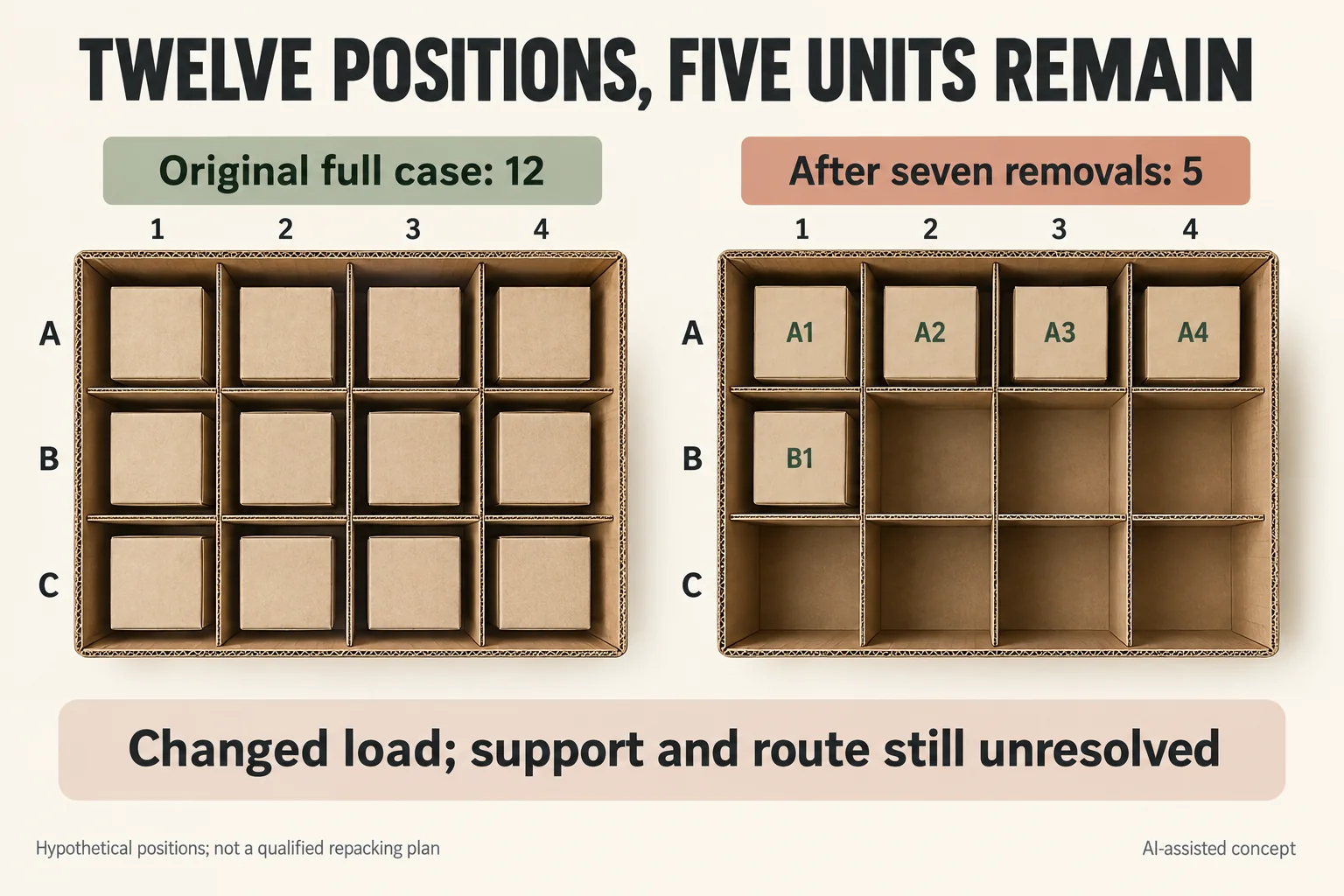
A partial-case record needs the actual occupied positions, not just the remainder count. In the new diagram, the fictional case has three rows A, B and C and four columns. After seven removals, A1, A2, A3, A4 and B1 remain occupied. That is one possible five-unit arrangement, not a recommendation.
Scroll horizontally if columns extend beyond the view.
| Fictional configuration field | Record to retain | Next request |
|---|---|---|
| Original case | All twelve positions; original divider and outer references | Keep as history, not evidence for the changed load |
| Remaining units | A1, A2, A3, A4 and B1; actual pack versions to identify | Confirm complete contents and their positions |
| Empty positions | B2 to B4 and C1 to C4 | Ask which support relationships the changed load leaves unresolved |
| Further dispatch | New complete packed mass, outer, support and route | Responsible source proposes a suitable complete arrangement |
Do not translate an empty position into an arbitrary filling quantity. The source needs to assess the actual support, divider and movement relationships. Likewise, turning the five units to make a photograph look balanced changes the configuration and should be recorded before it is evaluated.
Keep the resulting contents label and dispatch instruction aligned with five retail units. An old twelve-unit label cannot describe the new shipment merely because the outer carton is unchanged. Applicable trade-item or logistics identification remains a separate specialist question.
The distribution evaluation scope guide defines the system and route for evidence review. The wholesale case multiple comparison decides replenishment quantities earlier. This record concerns what happens after a case has actually been broken and an onward shipment is proposed.
Download the partial case repacking record (.csv). This file contains field definitions, clearly fictional teaching entries and a blank actual-project row. Keep unknown evidence open rather than copying the example as an approval.
Bring the specific open question to the project brief
For a broken-case proposal, send the five occupied positions, retained divider/outer versions, contents, complete mass and onward distribution route. Send the current configuration, actual records available, quantity by design, destination and the unresolved question through Packrivo’s packaging inquiry. Packrivo coordinates sourcing and project questions with independent suppliers; the responsible parties confirm materials, service, methods and commercial terms.
What this changes in a packaging enquiry
When part of a wholesale case is removed, describe the remaining units and new shipment arrangement before ordering a replacement outer or divider. Ask which physical support and closing steps the revised case needs. The original full-case configuration cannot automatically support the partial shipment. A relevant configuration to compare is the Regular Slotted Shipping Cartons: Size Around the Inner Pack; it is a concept reference, not confirmed suitability.