
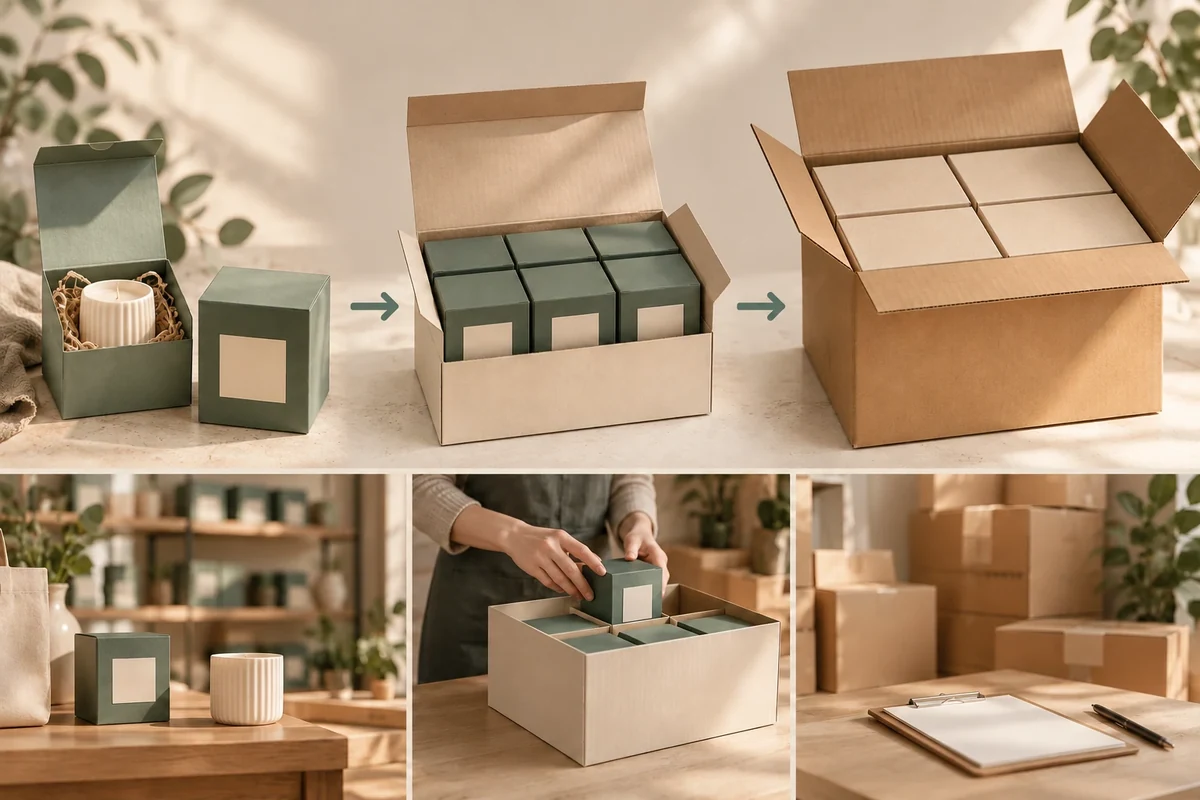
Add wholesale inner packs only when they perform a defined handling job between the retail unit and master carton. Determine what the store moves, separates and stocks after opening the case. An additional layer needs a purpose and a complete materials-and-work comparison; it does not automatically improve protection.
Keep the three potential levels named: the individually sold gift, an independently handled inner group and the transport case. Their counts, contents and opening actions should remain distinct.
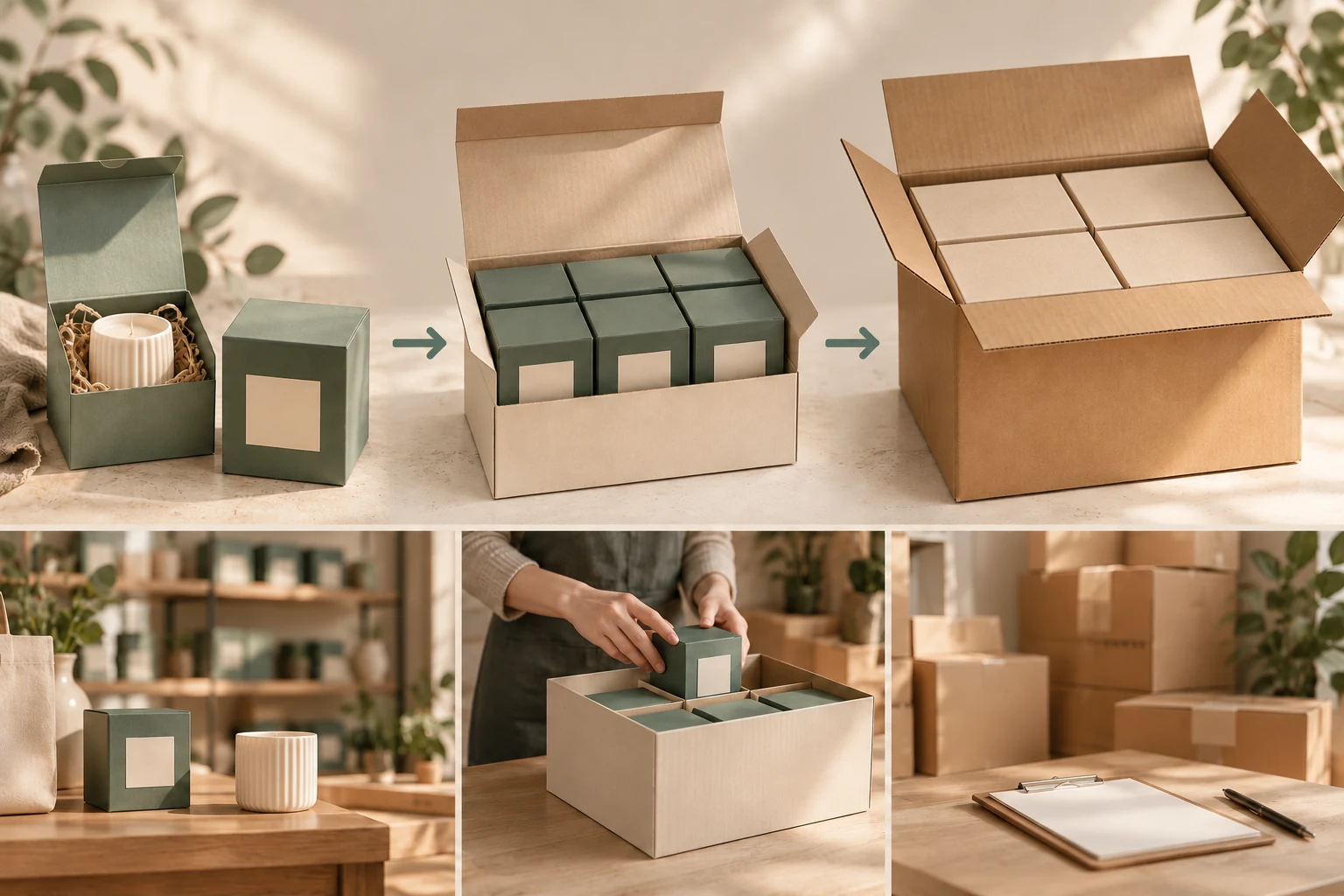
Define the store’s actual handling unit
A retailer might send groups to separate departments, refill one fixture by an agreed bundle or store the retail units individually. Those operations create different reasons to consider an inner pack.
Ask what the store receives as a whole case and what it expects to handle after opening. Confirm whether it permits the proposed inner wrapper or box and whether staff remove it before presenting the individual gifts.
The shipping-carton data method records outer counts and dimensions. It cannot decide whether an intermediate handling layer has a useful store operation.
Compare a hypothetical department allocation
Assume a store receives 24 identical retail gifts and has four departments each needing six. These quantities and handling arrangements are invented.
Scroll horizontally if columns extend beyond the view.
| Packing architecture | Receiving action to define | Additional material and work |
|---|---|---|
| Retail units directly in one master case | Open the case and assign six units to each department | Sorting and transfer of individual units |
| Four identified six-unit inner packs in one master case | Assign an accepted inner pack to each department | Four inner components and their forming/loading operations |
The second proposal can preserve the intended grouping during a store transfer if its actual construction and identification support that job. That possibility is not a measured labor saving or a transport qualification.
If departments later request uneven quantities, the six-unit grouping may require splitting. Compare that credible scenario before assuming the initial allocation remains useful for every receipt.
Count the complete architecture
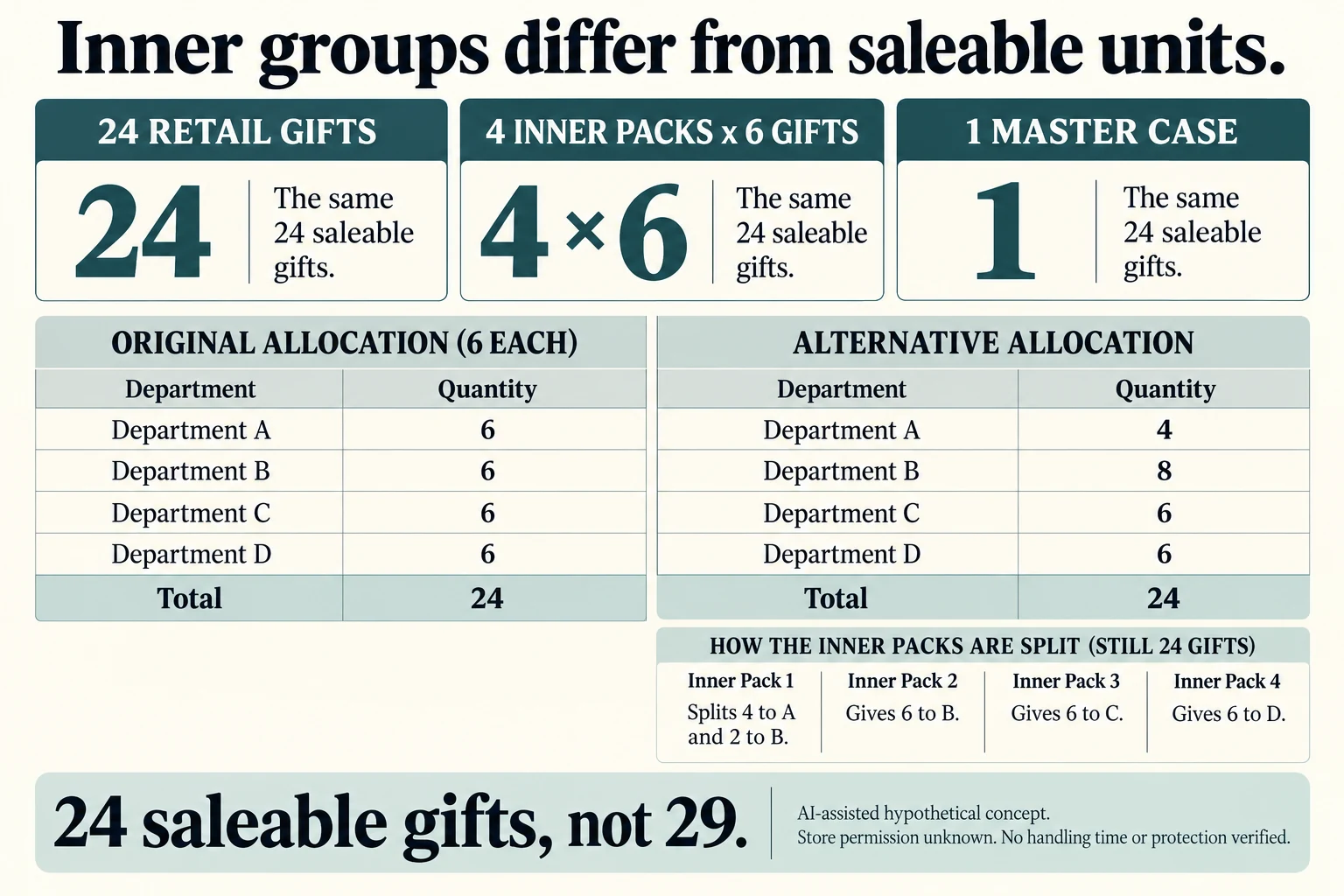
Write the quantity at each level. In this example, 24 retail units form four inner packs and one master case. They are not 29 saleable gifts. Define whether the inner pack itself is ordered or handled as a trade item, without inventing identifiers.
List the added inner component, any identification material and the operations required before master-case loading. A quoted empty inner box may leave its assembly and loading with another party.
Smurfit Westrock’s retail-ready description illustrates packaging serving transport and retail operations. It establishes no particular inner-pack service or benefit for this proposal. The middle layer’s actual function must come from the retailer’s requirements.
Review protection at the complete-system level
An inner pack can change clearances, contacts and how the retail gifts share the outer carton. Develop and review the proposed loaded system rather than assuming another wall always supplies better protection.
Keep the intended store action separate from transport evidence. A staff member successfully moving an inner group does not establish its performance through a distribution route.
Return the two-level and three-level diagrams, department demand, material counts and unresolved work to a packaging project inquiry. Packrivo can coordinate the supplier questions. Public manufacturer information was checked on 14 October 2026; no actual handling trial, availability or protective result is reported.
Test the inner group against an uneven department request
A new hypothetical receipt still contains twenty-four retail gifts in four six-unit inner groups. Change the department demand to four, eight, six and six. The total stays twenty-four, but two departments no longer match a whole six-unit group.
Scroll horizontally if columns extend beyond the view.
| Scenario scope | Exact object or route | Hypothetical input or output | Calculation or record boundary |
|---|---|---|---|
| New alternative demand | DEPT18_1 | 4 gifts | Separate uneven receipt scenario |
| New alternative demand | DEPT18_2 | 8 gifts | Separate uneven receipt scenario |
| New alternative demand | DEPT18_3 | 6 gifts | Separate uneven receipt scenario |
| New alternative demand | DEPT18_4 | 6 gifts | Separate uneven receipt scenario |
| New split | INNER18_1 | 6 gifts | 6 splits 4 to D1 and 2 to D2; actual permission unknown |
| New redistribute | INNER18_2 | 6 gifts | 6 to D2 combine with 2 from I1; may need opened transfer |
| New allocation | INNER18_3 | 6 gifts | 6 to D3 |
| New allocation | INNER18_4 | 6 gifts | 6 to D4 |
| New receipt total | DEPT18_2 | 8 gifts | 2 from I1 + 6 from I2 |
One possible redistribution opens the first group into four for department one and two for department two; the second group supplies department two’s remaining six. The other two groups remain six each. This requires a permitted split and transfer operation; the original four intact group handoff no longer describes the work.
The worksheet names the retail unit, each inner group and the master case separately, then keeps forming, loading, identification, store permission and complete-system protection as separate scopes. Twenty-four gifts plus four inner packs plus one master case are still twenty-four saleable gifts. Actual time and benefit remain unknown.
Download the wholesale inner packs record (.csv). It covers the original scenarios and this added comparison. HYPOTHETICAL rows are invented planning examples. Actual quantity, value, configuration, method, owner, observation, condition, decision, evidence and dates are blank because no actual project record has been obtained. Copy a relevant row and replace its type with ACTUAL only when entering permitted project evidence; keep the example and actual record separate. ACTUAL_BLANK is an empty starting row. A blank is unknown, never approval.
The related Packaging Carton Data Makes Freight Inquiries Easier to Compare guide concerns a separate requirement. Use this record for the specific comparison above rather than treating that guide as evidence of a completed result.
Resolve variant quantities before selecting inner groups with the mixed-case assortment comparison. Then follow quantities over time in the receiving-cycle stock model.
Source scope checked 16 October 2026: the original public references remain within their stated general guidance or manufacturer-example scope. The new numbers and task records are original hypothetical analysis, not observed supply, trials, inventory, prices or performance.
What this changes in a packaging enquiry
Specify the store's handling unit before requesting inner packaging: units per inner, variant grouping and the receiving or shelf task it serves. Compare additional material and assembly with that precise task. An inner pack is not automatically useful merely because the outer case is large. A relevant configuration to compare is the Regular Slotted Shipping Cartons: Size Around the Inner Pack; it is a concept reference, not confirmed suitability.
Discuss this packaging specification with Packrivo. We coordinate independent suppliers. MOQ: 500 pieces per product/design; illustrative quantities are not production offers. Confirm materials, samples, price and timing for your project.