
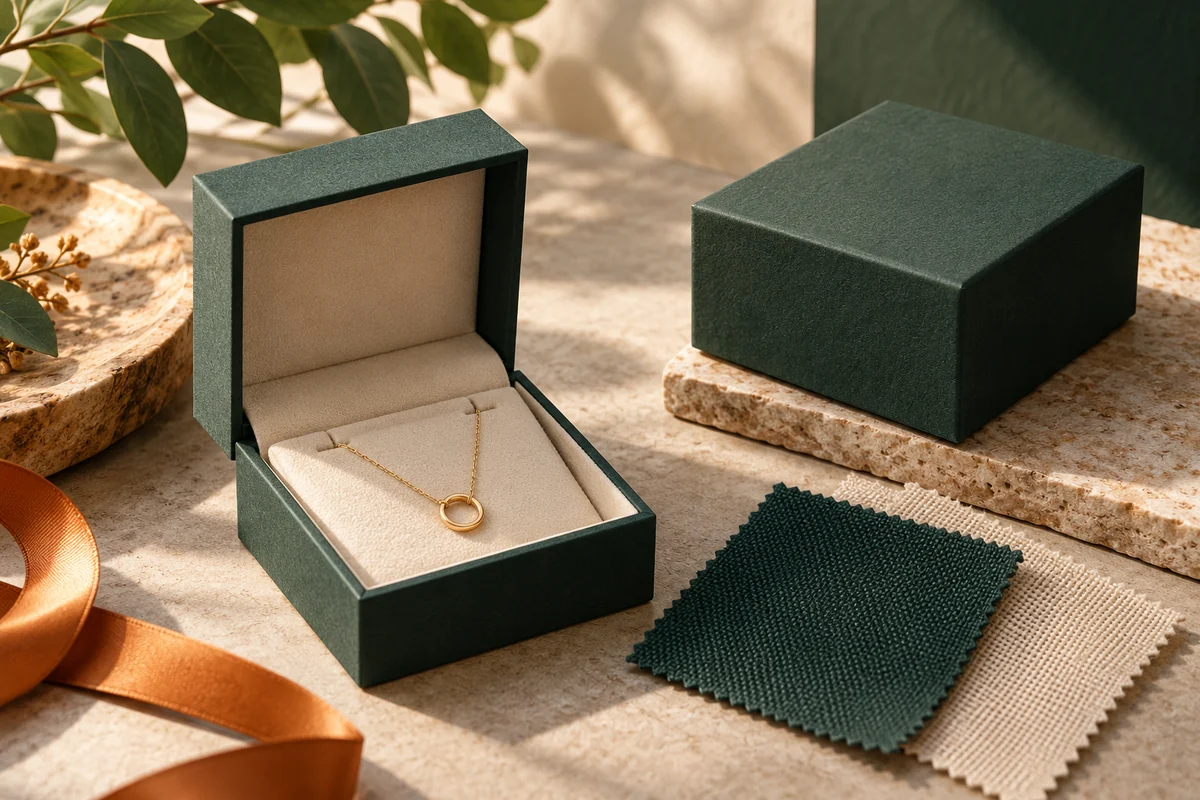
Choose a rigid jewelry box cover as a complete material and decoration system. Paper and paper-backed book cloth create different surfaces, cut edges and wrapped corners. Compare the named grades on the intended box, with the proposed logo process, before choosing by texture or a matching screen color.
A swatch can establish the look you want. The next decision is whether that material can form the box and carry its artwork in a way you accept. A woven surface that feels right in the hand can still leave an unsuitable logo or corner detail.
Paper and book cloth describe different constructions
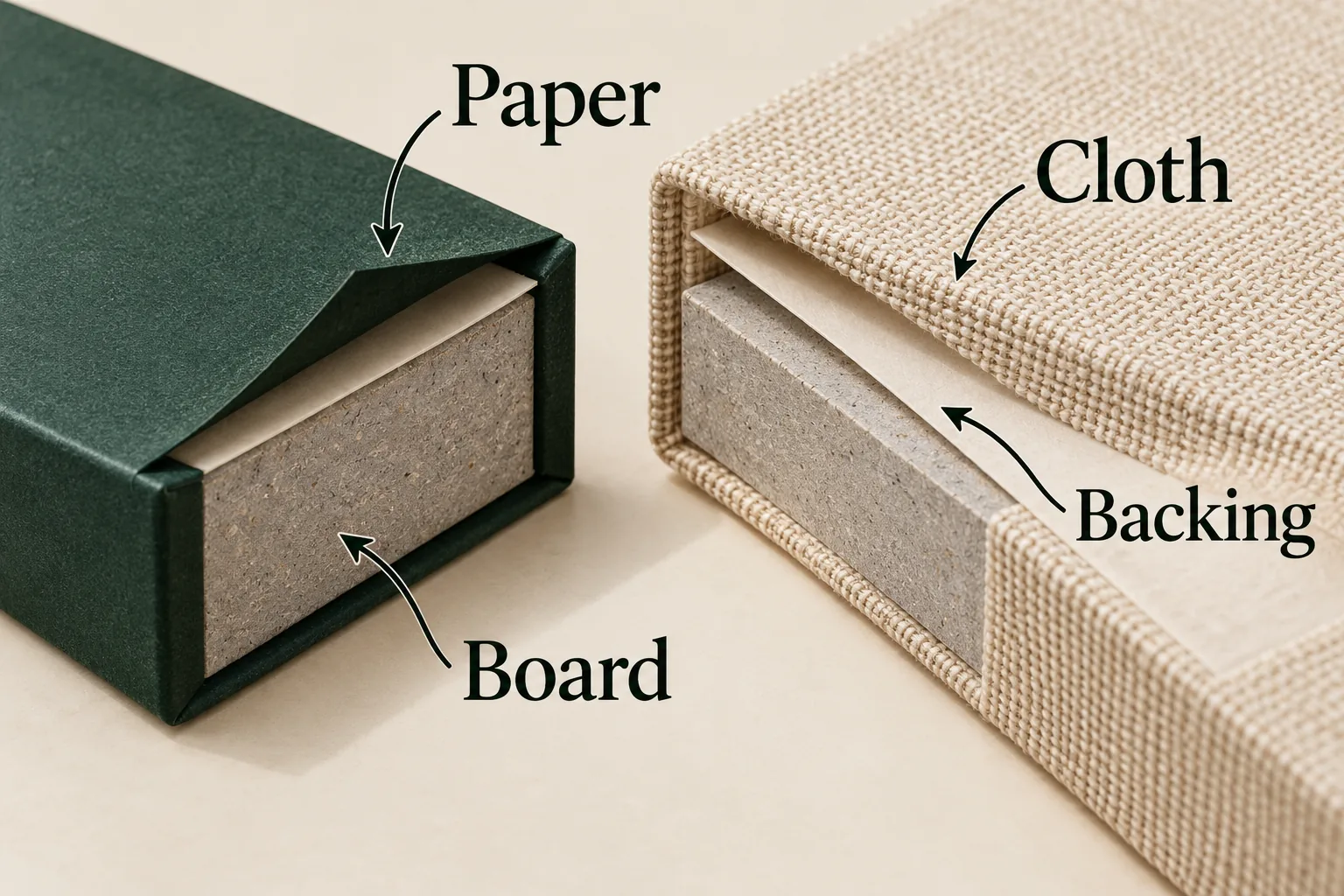
In a paper-covered rigid box, the cover sheet wraps around a separate structural board. The cover’s finish might be smooth, embossed or coated. An embossed textile pattern remains a paper surface; its appearance alone doesn’t make it woven cloth.
Paper-backed book cloth has a textile face bonded to a paper backing. That backing belongs in the construction description alongside the fabric. Request the complete product reference rather than a label such as linen effect, which could describe several materials.
Two manufacturer examples make the distinction concrete. Winter & Company’s Wicotex Brillianta technical sheet describes a dyed woven viscose surface on lining paper. Peyer’s Surbalin description presents a pulp-colored cover paper with smooth and embossed options. These are named product examples, not specifications for every cloth or paper wrap.
Ask whether the proposed structural board, inside lining and closure remain the same between options. Otherwise, a comparison presented as paper versus cloth may also change the box underneath.
Choose the logo process with the surface
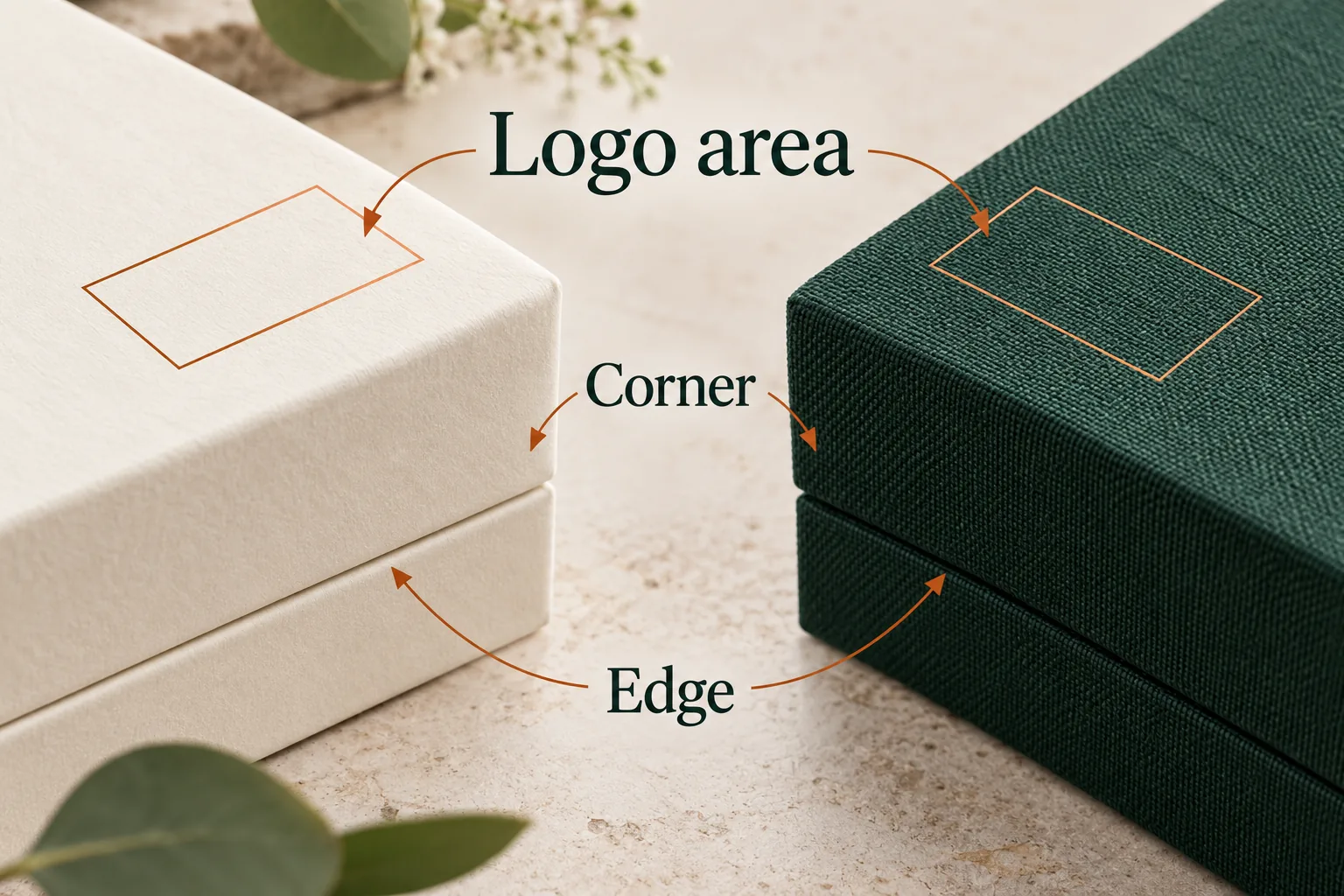
A tiny logo has to work with the cover’s texture. Compare its narrowest lines, enclosed spaces and small letters on the actual material. A clean digital file doesn’t demonstrate how an image will appear across a woven face or deep embossing.
Brillianta’s sheet lists several decoration processes, including foil, blind stamping and printing, and explicitly makes use subject to testing. Surbalin’s sheet lists offset and screen printing and describes its embossing characteristics. Neither document selects your ink, foil, pressure or artwork size.
Send the same artwork with both material proposals, while allowing the converter to identify an appropriate process for each. If one option requires larger lettering or different artwork, show that revision openly. Comparing a large mark on paper with a smaller mark on cloth would hide a design difference.
The small packaging type guide explains why process-specific file requirements matter. For a cloth-covered box, add the texture and exact decoration face to that discussion. Include a clear view and an oblique view of any proposed physical decoration sample.
Review a formed corner and the finished opening
A flat cover sample leaves the corner construction unseen. Request a formed corner representing the intended rigid box, including cut edges, overlaps and the inside turn. Identify which face carries the main logo and which seams a customer will see.
Look for the actual location of loose fibers, visible backing, exposed board or unwanted ridges if they occur. These are observations to make on a sample, not defects this article predicts for either material. A neat straight edge doesn’t establish the appearance of a three-dimensional corner.
Include the lid and base together. A material change can alter the finished layer arrangement at their meeting surfaces even when the underlying board drawing is unchanged. The turned-edge lid-fit review addresses that interface in detail.
Keep the opening action consistent when comparing proposals. Note where the lid meets the base and whether the wrap changes the intended grip. Don’t enlarge every dimension to correct an unidentified local contact.
Work through one hypothetical necklace-box choice
Suppose a jewelry brand wants a dark cover, a small light logo and an ivory interior for a pendant box. It is considering a dyed paper P and a paper-backed cloth C. These fictional references identify alternatives, not actual available materials or completed samples.
The buyer keeps the pendant card, structural box drawing and intended opening unchanged. It requests a decorated flat piece and a formed lid-and-base proposal for each cover. The following filled planning record shows what each item is expected to answer.
Scroll horizontally if columns extend beyond the view.
| Feature | Paper P proposal | Cloth C proposal | Decision to make |
|---|---|---|---|
| Customer-facing surface | Named dyed paper, smooth option | Named paper-backed woven cloth | Choose the intended appearance and touch |
| Light logo | Converter proposes print process | Converter proposes print or foil process | Compare actual lettering at final size |
| Rear lid corner | Formed paper wrap requested | Formed cloth wrap requested | Compare overlap, cut edge and visible backing |
| Lid and base | Finished pair requested | Finished pair requested | Review opening with each complete layer stack |
If the buyer later prefers C’s texture but dislikes its proposed logo, the useful response is a specific artwork or decoration revision. It needn’t reject all cloth covers or approve the first logo merely to retain the texture. Likewise, selecting P’s printed face doesn’t settle the rear corner or complete lid fit.
Match the cover to its intended handling
A gift box used once at presentation and a jewelry box opened repeatedly have different use briefs. State whether the buyer expects long-term storage, frequent handling or display. Include surfaces that the cover may touch, such as a pale sleeve or another box in a master carton.
Where transfer, scuffing or light exposure matters, ask for evidence addressing that actual material and use. Avoid treating cloth as inherently longer-lasting or a paper appearance as proof of weakness. The dye-transfer and light-fading comparison separates two questions that a single durability label can obscure.
Also keep maintenance instructions specific. A supplier’s advice for one cover cannot establish that an assembled box tolerates wiping, moisture or cleaning products. The adhesive, board and interior remain part of that assembled object.
Send the selected material route with the box brief
A useful cover request identifies the box drawing, material maker and grade, finish or texture, direction of any visible weave, decoration artwork and intended handling. Add the specific corner and opening views you want represented by the sample. Those details let a quotation address a buildable combination.
When an option changes, name the change. Replacing the cover while keeping the board drawing is different from changing the lining, closure or logo process as well. Retain a sample reference for the combination you eventually accept.
Manufacturer sheets support their named product descriptions. They don’t establish Packrivo stock, prices, certification, production timing or permission to print an environmental claim. Their published dates also belong with the references: the Brillianta sheet reviewed here is updated February 2025; the Surbalin description is dated July 2020. Obtain the current specification for any proposed order.
Discuss the cover and decoration route with Packrivo, including the jewelry-box drawing, material candidates and the finished details still needing a sample. Packrivo coordinates independent suppliers; the actual construction and commercial terms require project confirmation.
Sources checked 18 October 2026: Winter & Company, Wicotex Brillianta technical sheet; Peyer, Surbalin product description. The comparison method and scenario are original editorial planning, with no physical trial or customer outcome reported.