
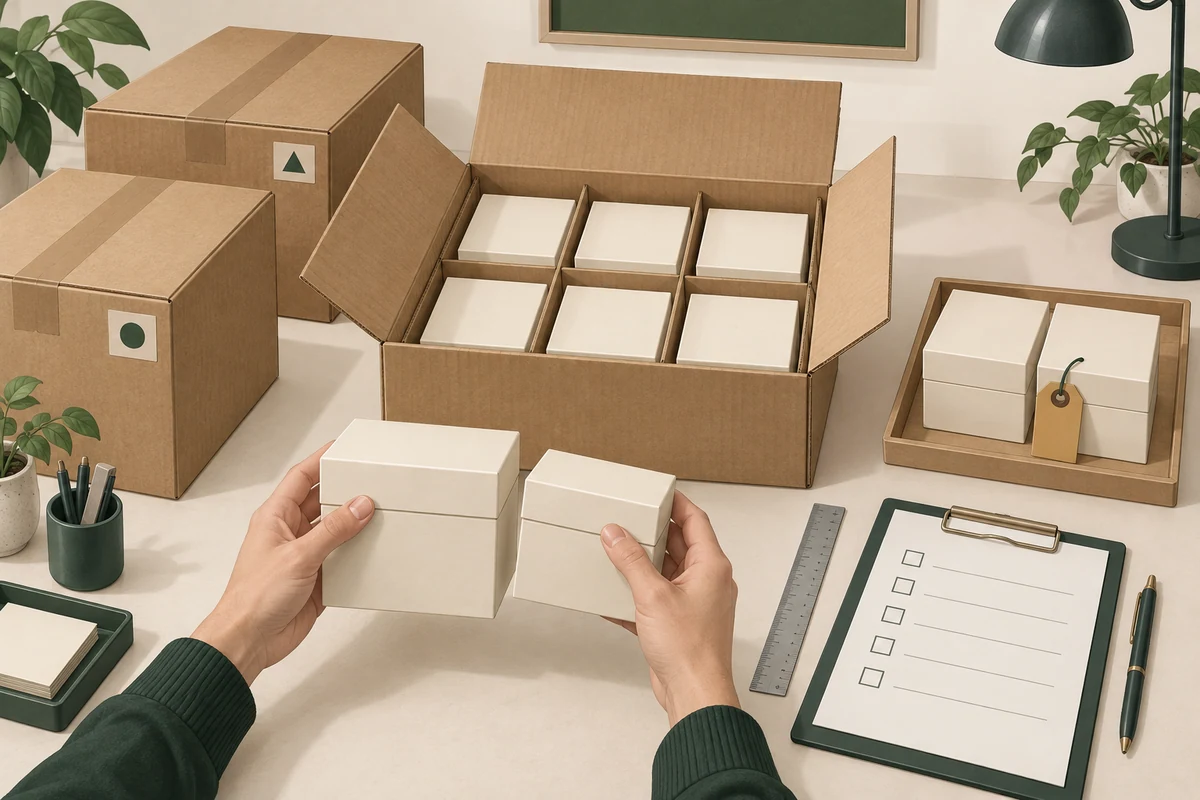
Inspect incoming packaging against the configuration selected for the order, then record which received units the observations cover and who decides their use. Keep the delivery identity, inspection basis, exceptions and disposition together. A signed receipt, an earlier approved sample or a photograph of one good item cannot substitute for that batch decision.
In this guide
- Establish what arrived and what it should match
- State the inspection basis before extending a finding
- Separate identity, requirement and disposition
- Compare three receiving decisions against the same requirement
- Return a usable decision to the packing team
- Attach one located view without extending it to the delivery
- Bring the specific open question to the project brief
This guide begins after packaging has been delivered. Its output is an acceptance, rejection or continued-hold record for identified received goods. For changes between pre-production samples, use the sample-version comparison guide.

Establish what arrived and what it should match
Record the order and delivery references, component, quantity and available lot or carton identities before mixing the goods with earlier stock. Mark missing identity or quantity information as unresolved rather than inferring it from familiar artwork.
Bring the current order specification, drawing, artwork and relevant approved references to the receiving check. State which features each reference controls. A sample accepted for outside artwork may not establish the selected insert or the loaded closing arrangement.
Keep outer-carton condition and the condition of the packaging inside as separate observations. A crushed delivery carton can justify a closer check, but it does not identify the cause of damage to a gift box. Likewise, an intact carton does not prove that every unit inside matches the order.
State the inspection basis before extending a finding
Name the inspection method agreed for the actual order, who performs it and which requirements are checked. Define the lot or grouping the decision will cover and the inspection unit: a lid, a component or an identified complete set. Keep different revisions or unidentified groupings separate unless the agreed plan provides a basis for combining them.
If an acceptance sampling plan applies, retain its selection method and decision rules with the receiving record. State the agreed rules before evaluating the findings, rather than choosing a more convenient rule after seeing them. This article supplies neither a universal sample size nor an AQL threshold.
NIST’s explanation of acceptance sampling describes using information from a selected sample to decide a lot’s disposition. Its overview of sampling plans shows that the selection and decision rules belong to a specified plan. Checking whichever box is easiest to reach is not enough to claim a statistically representative result.
For each observation, name the carton or grouping, the reviewed item and its state during the check. Keep the number inspected and the number of nonconforming units separate. Also record whether the agreed rule counts units or individual nonconformities: one lid with two marks is not automatically two nonconforming lids.
Observation counts do not by themselves establish the delivery’s defect rate or acceptance. NIST distinguishes a lot disposition decision from an estimate of lot quality. Use the actual agreed plan to determine what the observations permit you to conclude.
If a project has no agreed basis for a needed acceptance decision, record the missing requirement and assign the next review. Do not invent a pass limit on the receiving bench.
Separate identity, requirement and disposition
Use the main acceptance record to combine the receipt evidence with the agreed requirements. Detailed item-to-carton tracing belongs in the supporting incoming lot reference record.
| Part of the record | Entry needed before a batch decision |
|---|---|
| Received grouping | Order/delivery reference, component, available lot/carton IDs and quantity |
| Required configuration | Checked feature, agreed requirement and controlling reference |
| Inspection basis | Lot boundary, inspection unit, actual method, reviewed quantity and responsible person |
| Decision rules | Pre-agreed acceptance/rejection rules and their reference, where applicable |
| Observations | Located condition, nonconforming unit count, separate nonconformity count if relevant, and evidence |
| Unresolved extent | Unchecked units, missing identity or an open requirement |
| Proposed response | Further inspection, sorting, replacement or another project-specific action |
| Disposition | Accepted, rejected or continued hold, with scope, decision owner and date |
| Packing handoff | Which identified goods may be used, under the recorded decision |
The table distinguishes what was observed from what is authorized for use. Receipt staff can document a condition while the named acceptance owner decides whether it meets the requirement.
Compare three receiving decisions against the same requirement
In this hypothetical example, the selected order calls for artwork revision A-03. The table shows how different evidence leads to different next decisions. It gives no numerical inspection limits and describes no actual Packrivo delivery.
| Receipt evidence | Requirement and rule to apply | Decision scope |
|---|---|---|
| Reviewed artwork matches A-03, and the recorded checks satisfy the agreed rule | Use the current requirement and documented acceptance basis | The authorized owner may accept the identified grouping for the reviewed scope; unreviewed requirements remain visible |
| Reviewed artwork shows superseded A-02 | Record the version mismatch and apply the agreed nonconformance/disposition rule | Record rejection or another authorized action only for the scope established by the evidence and rule |
| Artwork appears to match, but selection, lot identity or the decision-rule reference is missing | The evidence needed to support the required decision is incomplete | Continue the identified hold while the named owner resolves the missing basis; do not invent acceptance or rejection |
The distinguishing output is the reason for disposition: the required configuration, evidence obtained, applicable rule and authorized scope. A supplier response can add information, but it cannot erase the earlier observation or replace the responsible decision.
For goods with recorded visible damage that remain on hold, the separate incoming damage hold record retains location, affected extent and use status. Keep that detailed procedure there; link its reference into the acceptance decision. For a version mismatch or a missing inspection basis without observed damage, retain the open status in this acceptance record rather than presenting it as a damage case.
Return a usable decision to the packing team
Write the disposition for a named grouping and the requirements actually reviewed. An entry such as "continued hold pending inspection of the remaining identified cartons" tells the next team what remains open. A generic "supplier says fine" does not identify either the evidence or the person authorized to decide.
Before packing uses accepted goods, communicate their identities and the applicable decision. Keep rejected or held goods distinguishable under the project’s agreed handling process. This is a project-specific acceptance record, not a certification or a claim that an accepted lot contains no defects.
The downloadable receiving worksheet provides separate fields for receipt facts, inspection basis, observed findings and disposition. Replace the hypothetical examples with actual records; the worksheet does not choose your sampling plan or authorize production.
Download the receiving acceptance worksheet (CSV)
Blank template. Enter actual project records; no sample size or acceptance limit is prescribed.
Attach one located view without extending it to the delivery
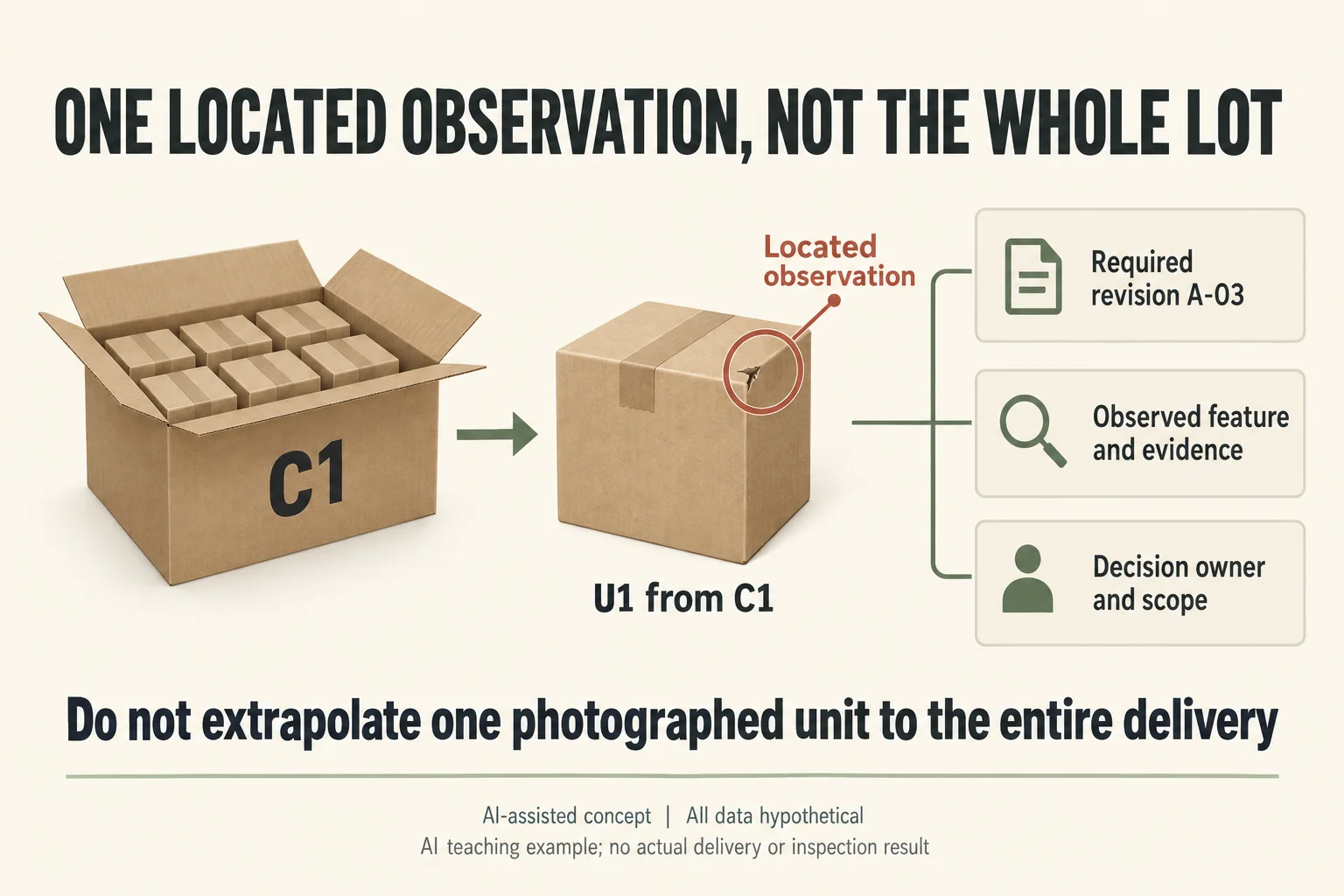
A photograph should identify the unit and state it actually shows. Keep a wider view locating the component within carton C1 and a closer view of the same unit U1. A close crop alone can lose the item-to-carton relationship.
Scroll horizontally if columns extend beyond the view.
| Fictional record field | Teaching entry | Scope limit |
|---|---|---|
| Reference | U1 from carton C1; requirement A-03 | Actual lot, item and requirement references would need confirmation |
| Located observation | Corner mark at the indicated position; no actual photo taken | A mark is not automatically a classified nonconformity |
| Evidence extent | Only the illustrated unit view | No whole-delivery count or defect rate established |
| Next decision | Responsible owner applies the agreed requirement and method | Continue the unresolved scope; do not infer all good or all defective |
The diagram is an AI teaching example, not an H1 photograph of real goods. For actual work, retain the original view, date, sample identity and the conditions relevant to the check. Record whether the observation covers artwork, surface condition or another feature; one view may leave the others open.
If the photo instead shows superseded A-02 against required A-03, keep that mismatch located on the identified unit and apply the actual disposition rule. Do not turn the revision label into evidence about every unexamined piece or use a new convenient acceptance rule after seeing the result.
The incoming damage hold register records known affected extent and held identity. The AQL interpretation guide explains the separate statistical decision limits. This receiving record returns the agreed disposition and its scope to the packing team.
Download the incoming packaging inspection checklist record (.csv). This file contains field definitions, clearly fictional teaching entries and a blank actual-project row. Keep unknown evidence open rather than copying the example as an approval.
Bring the specific open question to the project brief
For incoming acceptance, send the agreed configuration and method, exact carton/unit identity, located observation and evidence extent; ask the responsible owner for a scoped disposition. Send the current configuration, actual records available, quantity by design, destination and the unresolved question through Packrivo’s packaging inquiry. Packrivo coordinates sourcing and project questions with independent suppliers; the responsible parties confirm materials, service, methods and commercial terms.