
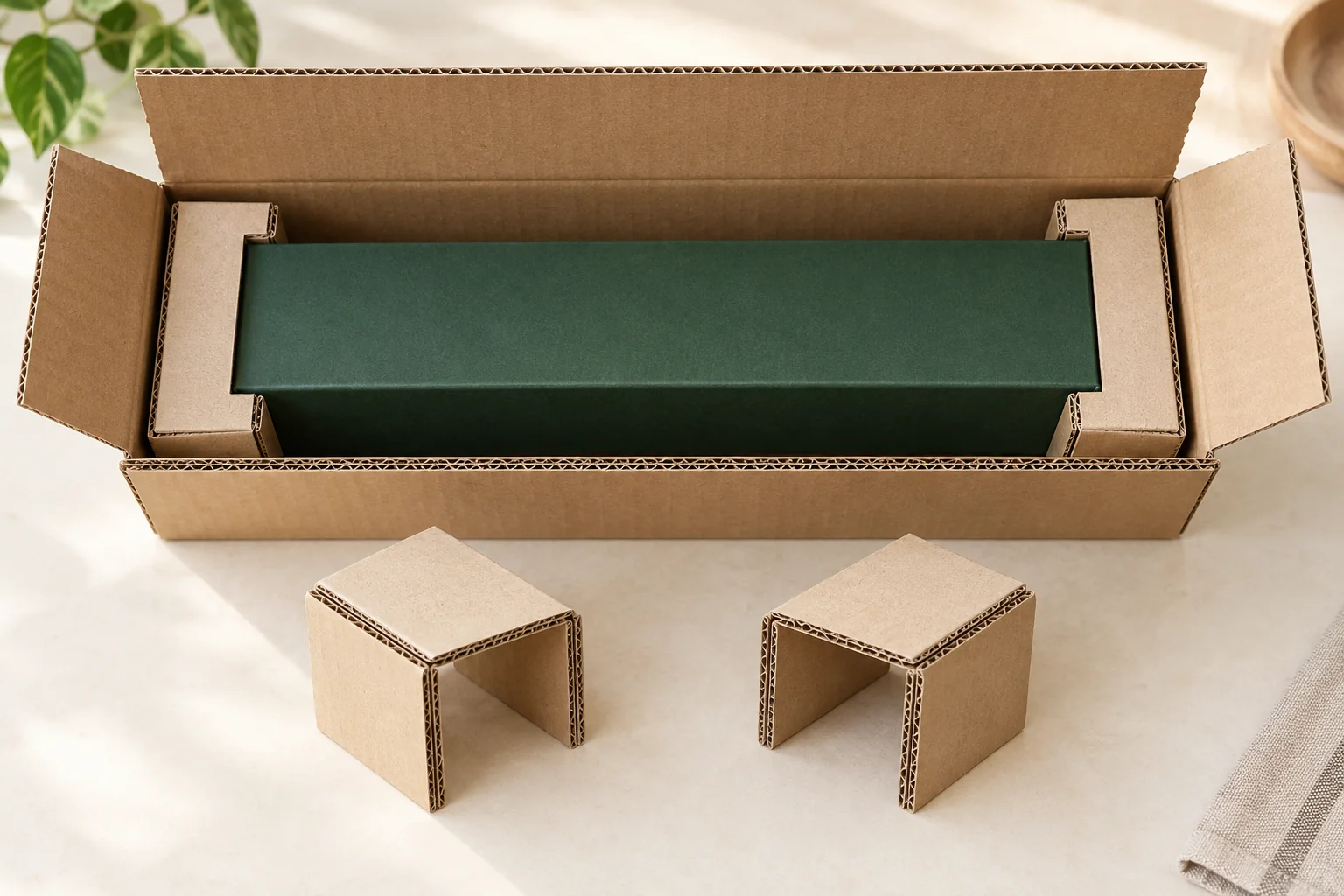
Concept / packaging option. AI-assisted visuals explain the structure; final materials, production details and sample scope are agreed for the project.
Name the ends that can be supported
Describe each product end independently. A handle, connector, lid or delicate edge might need clearance rather than contact. Show the regions the proposed support may touch and any region that should remain open. The relevant surface can be on the product itself or on an existing retail pack.
Ask how each end cap is formed and how it is held during loading. A folded corrugated arrangement can have several panels, locks or layers. The proposal should show the product-facing side and the side facing the outer carton so the two interfaces are clear.
The complete assembly determines the outer packing envelope. End supports can change the space between the inner product and the carton wall, and their positions may affect the room left for accessories. Record the assembled layout instead of measuring an empty carton first and asking the supports to fit whatever space remains.
Compare end support with a complete inlay
A corrugated inlay option can describe a broader internal arrangement. Paired end caps focus the brief on two defined support interfaces. A divider separates multiple items and may not answer the same contact question. Compare the location, loading and removal task for each proposal.
For an illustrative boxed gift with an accessory, the end caps might locate the main inner pack while the accessory sits in a separate space. That space must remain part of the complete layout. It should not be assumed to support the accessory simply because the main item is held at both ends.
Send the two interfaces in one brief
| Input | Record for the paired supports |
|---|---|
| Product ends | Geometry, projections, complete weight and areas permitted to touch. |
| End caps | Formed construction, folds, material proposal and retention. |
| Outer carton | Assembled internal space and contact with each support. |
| Accessories | Separate items, compartments and the complete loading order. |
| Handling | Intended movement, route and evidence needed for the packed system. |
| Project | Quantities, drawing versions, destination and sample questions. |
Identify whether the two pieces are identical or handed left and right. That affects the component list and packing instructions. If one support changes, show which product or enclosure feature prompted the revision so the paired arrangement can be reviewed coherently.
Use visible identifiers in the working record when handed parts could be exchanged during loading.
Review contact, loading and removal
- Form both proposed supports using the intended instructions.
- Place them on the named product or retail-pack ends.
- Load the assembly into the enclosure with all accessories.
- Inspect the support-to-product and support-to-carton interfaces.
- Close the outer pack, then review the intended opening and removal.
- Agree the transport review needed for that complete configuration.
Fit observations and shipping evidence answer different questions. Use the packed-system protection guide to keep the proposed supports, enclosure and route connected. A well-fitted static sample does not establish the result of a transport review.
Agree the paired-component proposal
Packrivo’s order planning policy is 500 pieces per product / design. State the number of end-cap pieces per finished pack and identify any different designs. Final construction, material, pricing, sample work, production conditions and delivery timing are reviewed for the project.
The original corrugated end-cap reference illustrates end-positioned supports. It is a structural example, rather than evidence that this proposed Packrivo configuration has been tested.
Get a Quote with both product ends and the assembled layout. Packrivo helps organize the contact, component and sample questions before a proposal is accepted.