
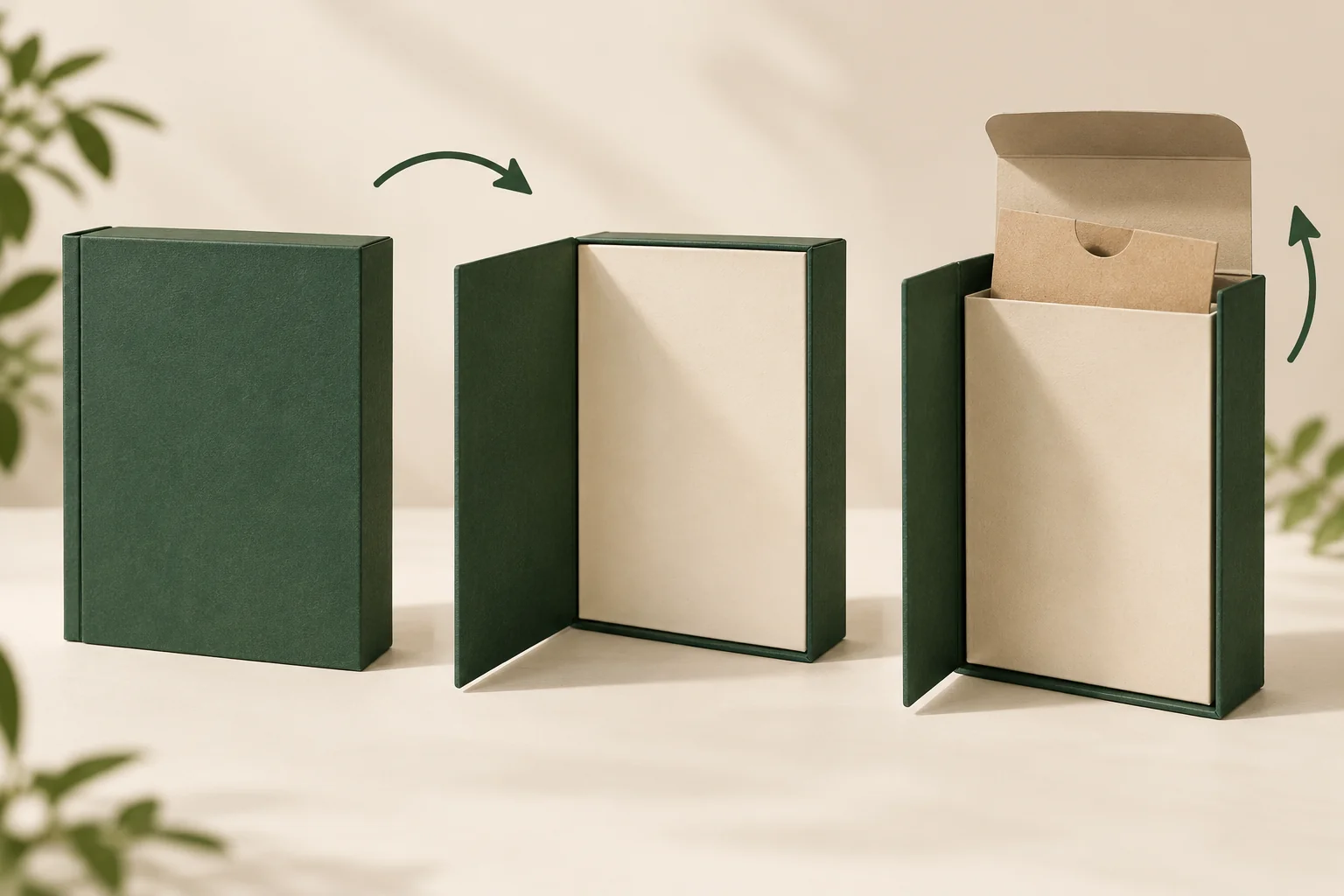
The cover can carry an explanation that appears before the product is removed. That makes panel planning part of the packaging brief. A finished-looking cover should still be checked against shelf space, the user’s grip and the route to the contents.
Separate the cover hinge from the carton closure
PakFactory describes its bookend structure as a tuck-end carton with a hinged front. This reference supports the cover-and-body relationship. Optional windows, materials and finishes need their own proposal; they aren’t assumed features of this option.
Ask for a drawing with the cover, hinge fold and inner front panel identified separately. Label the end through which the product is packed and the end intended for customer removal. The cover’s motion should remain visible in a formed sketch.
For a hypothetical jewelry gift, the front cover could reveal a short care message on the inside face. The inner carton would still retain the jewelry card until its closure is opened. Review that exact sequence instead of showing an illustration where the product floats behind the cover.
Decide what can be read at each stage
Place the closed pack in the intended display position. The outer cover should present the chosen front view. Open it slowly and check whether the inside message faces the reader, whether a window is obscured, and whether the cover needs space beside the pack.
Compare this option with the existing tuck-end gift carton if the extra panel has no defined job. If you need a separate inner and outer reading surface, keep a panel map with the artwork brief.
Do not assume the flap stays open at a particular angle. A resting position is a sample question. If the carton is photographed open, describe that view as a concept or controlled setup rather than a guaranteed retail behavior.
Capture the opening as a short storyboard
Use one row per visible action. Each row should correspond to a photo or marked sketch of the loaded sample.
| Stage | Reader sees | Decision for the sample review |
|---|---|---|
| Closed cover | Main printed face | Display orientation and starting grip |
| Cover moving | Hinge and inside cover | Side clearance and reading direction |
| Inner access | Carton opening or visible product area | Which closure opens next |
| Product removal | Holder and product | Finger space without covering instructions |
This record is different from a flat artwork proof. It follows the customer action through two linked parts of the carton.
Sample with the final holder and printed panels
Confirm the supplied state, prepared seams and packing responsibilities. If the carton arrives flat, request the forming sequence and the step at which the cover is folded. A cover should be handled as part of the carton rather than as a loose decorative card.
On the sample, move the cover through its intended travel and then remove the product. Inspect the hinge area and panel edges afterwards. Record rubbing, obstruction or an unclear next step by stage. Any changes to the holder, product position or added card need another opening review.
If a message must be read before the product is removed, mark its stage on the storyboard. Ask a reviewer to follow the sequence without being coached. Record whether the message is available at that point, then keep any artwork revision tied to the same panel map. This checks the intended information order rather than assuming an extra cover creates it.
Bring the cover’s job to the inquiry
Send the complete product envelope, cover storyboard, desired inside message area, quantity and destination through Get a Quote. Packrivo starts at 500 pieces per design. The cover construction, board, artwork, sample scope, price and timing are settled against the project brief.