
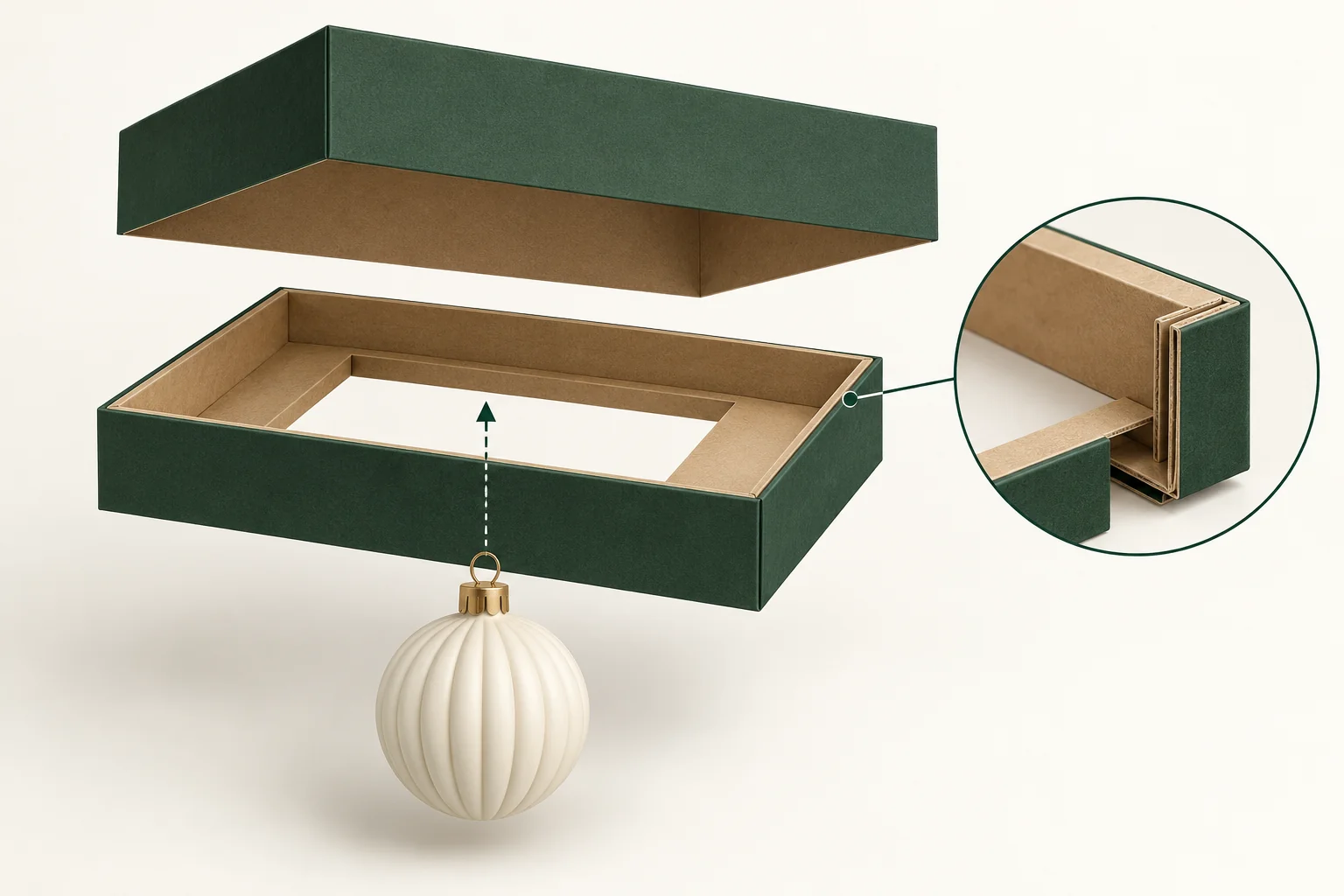
This option adds a visible frame around the tray opening. Keep the frame’s role explicit: presentation, locating a defined inner piece, or another proposed job. The frame alone is not evidence that the product is held securely.
Separate frame geometry from the lid
PakFactory’s frame tray and lid reference identifies a double-wall frame tray paired with a double-wall lid. Its collapsible, prepared form is a catalog reference; your actual folds and prepared joints need a supplier drawing.
Show the tray outside envelope, frame opening and lid inside dimensions as separate records. Ask how each doubled wall is formed and retained. A top view of the frame doesn’t reveal the folded layers underneath.
Use the foldable gift box collection to compare a simpler tray when a frame has no defined purpose. This configuration earns a separate review because the opening, surrounding folds and matching lid create linked interfaces.
Locate the product against the frame
Provide the complete product envelope, including any holder and the part visible above it. State whether the frame may touch the product or should surround another inner component. Mark sensitive surfaces as areas to discuss rather than assuming contact is acceptable.
For a hypothetical gift ornament, a holder could sit below a frame while the ornament is visible through its opening. Show the holder, frame and product in a side section. The visible opening and the product’s widest point may occur at different heights.
After forming the tray, add the holder and product without using the frame as a lever. Photograph their final relationship before placing the lid. That view can reveal a height issue that the closed set would hide.
Use a paired-component review
Record both part revisions together. An approved tray paired later with another lid should reopen the fit check.
| Interface | Drawing input | Loaded observation |
|---|---|---|
| Frame to product | Opening shape and visible height | Contact and access around the edge |
| Double walls | Fold order and final layer position | Walls remain formed after loading |
| Lid to tray | Inside lid and outside tray envelope | Contact at each side during placement |
| Lid to contents | Highest packed point | Clearance when fully closed |
Keep contact with the tray perimeter distinct from contact with the product. Increasing the lid cavity may answer one issue while leaving the other unresolved.
Confirm supplied state and sample scope
Ask how tray and lid arrive, which seams are prepared and who forms the double walls. Include separate packing for the two components if that is proposed. Counts and pairing should be clear before a quotation is compared.
Review the proposed material and caliper with the actual fold sequence. Close the loaded set, lift the lid and remove the product. Inspect the frame and walls afterwards, naming any part that has moved.
These are configuration observations. They don’t establish a protective capacity, material certification or a distribution result. Any handling assessment should use the complete proposed system and an agreed method.
If the frame is intended to conceal the holder edge, show the desired visible boundary on the opening view. Check it before lid placement and again after lid removal. A holder that shifts during closure may reveal a different area afterwards. Name the actual observation without describing the frame as a retaining feature unless that construction is confirmed.
Send the paired set, not two unrelated sizes
Submit the tray, frame and lid drawings, complete product details, quantity and destination through Get a Quote. The minimum is 500 pieces per design. Component grouping, samples, price and timing are confirmed for the project.