
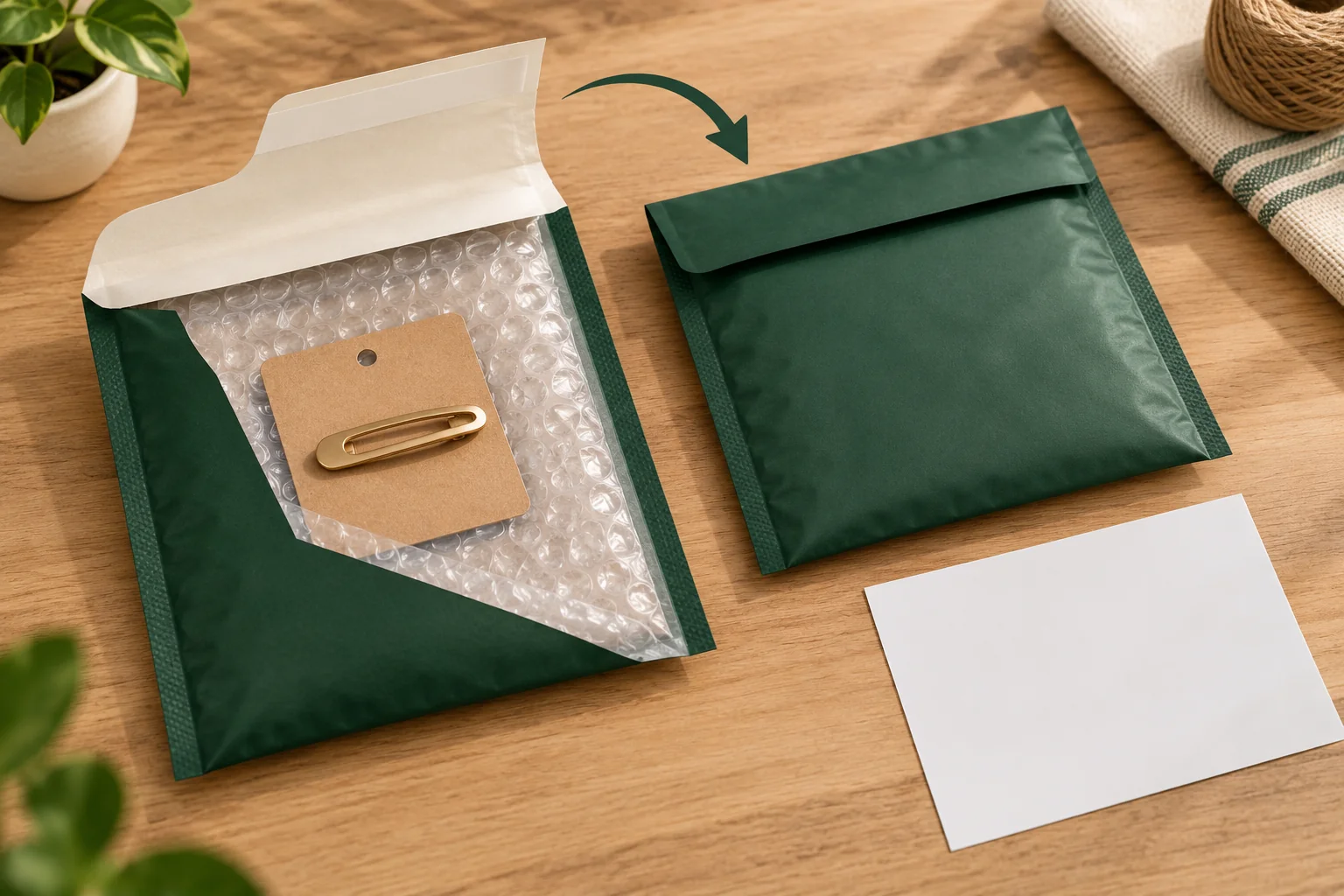
This packaging option needs supplier confirmation of layers, seams and closure. Review the complete packed envelope rather than choosing from the outside appearance alone.
Identify the proposed layer stack
The poly bubble mailer reference names the option. Ask for the outer film, bubble construction and any joining or contact layer in the proposal. Don’t assign a polymer grade or thickness from the catalog name.
Show the seams and usable mouth on a section. Record where the lining ends in relation to the closing area. Compare a kraft bubble envelope by its actual component proposal, not a generic protection or disposal claim.
Review the complete fill and final surface
Provide the product, card and inner wrap envelope in the intended orientation. Load the sample and record the final outside shape before applying a shipping label or closing it.
For a hypothetical accessory on a backing card, inspect the leading corners at the mouth and along the seams. Keep the same inner wrap in the final closure review. A revised wrap can change the filled geometry even when the envelope size stays the same.
Ask the supplier to identify the closing method and receiving area. Photograph the flap reach before it is joined. Separately, use the label surface guide to describe the actual finished film, label position and application conditions.
Use a filled-interface record
Attach one layer proposal and one loaded sample ID. Keep the label’s own candidate identity with the surface row.
| Interface | Layer or interface in the supplier proposal | Evidence |
|---|---|---|
| Outer film | Material and final print surface | Supplier component description |
| Bubble contact | Actual lining and product contact | Section and loaded contact view |
| Mouth/seams | Usable internal boundaries | Entry and first-contact view |
| Seal | Method and receiving area | Filled closing reach |
| Shipping label | Candidate and application surface | Agreed surface trial |
A label that sits neatly in a concept is not adhesion evidence. Keep any label review under its stated conditions and method.
Keep changed layers visible
In the hypothetical record, call the outer film OF1 and label candidate L1. If a supplier changes OF1, reopen the L1 surface question as well as any relevant envelope interface. The same print color doesn’t identify the same receiving surface.
Confirm supplied seams and packing responsibilities. Review opening and removal after the proposed closure. Record visible contact or movement by location without claiming sealing, barrier or cushioning performance.
Any distribution requirement needs the actual contents and a responsible complete-system evaluation. The layer and fit record supplies configuration information rather than a transport result.
Submit the loaded layer proposal
Send component details, full contents, closing and label questions, quantity and destination through Get a Quote. The minimum is 500 pieces per design. Final construction, samples and commercial terms require project confirmation.