

AI-assisted concept cover. Open the cover at full size.

Prepare a print-file manifest that lists the native artwork, accepted output, font state, linked assets and printer requirements. Record missing or changed assets before handoff and assign who creates the final output. A packaged folder helps organize the files, but the receiving printer still needs a named accepted version.
Keep the native file and output roles explicit
The official Adobe Illustrator Package guidance describes collecting linked graphics and necessary fonts with the document and a package report. It also explains missing-asset information and the need to check font-copying permission. That function is useful context, not proof of printer acceptance.
Name the native artwork file, the reference PDF and the intended print output separately. Record their revisions and the drawing used for placement. The receiving printer should know which file can be edited, which shows the accepted appearance and which output is intended for production use.
Give font state its own field: live text, outlined text or another confirmed handoff. Keep the supplied copy and the designer’s responsibility visible when changing that state. Where font files are shared, the font owner should confirm the actual permission to do so.
Review links, assets and the report
List each linked image or supporting asset, its identity and whether the link resolves in the delivered package. Record assets embedded in the artwork separately from linked originals where relevant. A file name alone does not establish that the printer received the intended version.
The Glenroy artwork specification is a printer-specific example requesting supporting files and defined font/output states. Ask the actual selected printer for its own accepted software/output requirements rather than assuming a package report satisfies every process.
Use the package report or another actual preflight record to locate missing links or fonts. Assign the designer to return corrected assets and the output creator to confirm the resulting version. Keep any substitution attached to the file manifest so it is not hidden inside a regenerated PDF.
Use a print-package preflight manifest
The following hypothetical gift-box records are an original handoff aid.
| File or requirement | Example record | Owner and evidence |
|---|---|---|
| Native artwork | BX1_ART_r02.ai linked to drawing BX1_DWG_r02 | Designer supplies editable state |
| Output PDF | BX1_OUT_r02.pdf, accepted appearance reference | Named output creator and buyer approval |
| Fonts | Live/outlined state and missing-font report | Designer confirms state and handoff permission |
| Linked image | Asset IMG1, expected version and resolved link | Designer supplies the actual supporting asset |
| Printer requirements | Selected process/output specification | Printer confirms accepted format/version |
| Receipt | Manifest and files acknowledged by receiving owner | Keep unresolved assets explicitly open |
Resolve an illustrative missing-link handoff
Imagine the reference PDF looks complete but the native artwork report shows a missing linked image. Retain the PDF’s appearance role and the missing native asset as separate facts. The next action is to supply or deliberately replace that asset under a recorded revision.
After the designer returns the package, the output owner should identify the PDF generated from it. The buyer reviews the affected appearance, while the printer confirms the required file state. This keeps an output regenerated from a changed asset from being confused with the earlier accepted reference.
Send the manifest with an output owner
The existing artwork handoff method supplies the broader approval route. Use the drawing-change record when the file package needs a revised structure or layout reference.
The designer supplies the files and actual asset states. The printer defines the accepted technical handoff. The output owner identifies the final generated version, and the buyer records its appearance approval. A filename convention helps find the file but does not replace those roles.
Bring the manifest, selected printer requirements and unresolved asset/output questions to your packaging brief. MOQ is 500 pieces per design; artwork, sample scope and commercial conditions are confirmed for the project.
Retain the old appearance while correcting the native source
Imagine native ART2 has a missing IMG1 link while reference PDF2 still shows the earlier appearance. ART3 and PDF3 are proposed revised identities, not delivered files. A complete-looking PDF does not show that the editable package contains its required source asset.
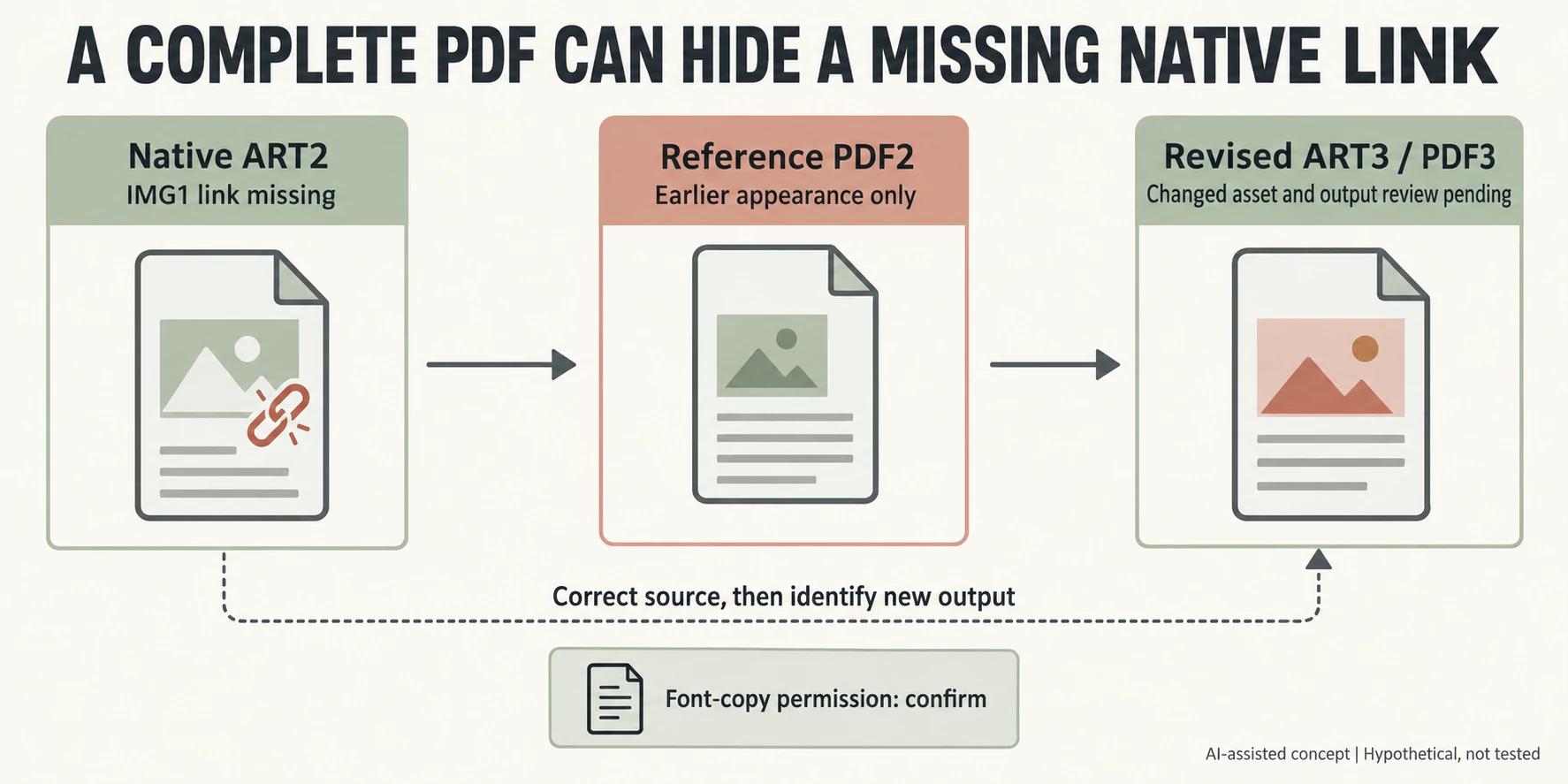
Scroll horizontally if columns extend beyond the view.
| Record | Invented state | Next owner/action |
|---|---|---|
| ART2 native | IMG1 link missing | Designer resolves or records deliberate replacement |
| PDF2 reference | Earlier appearance retained | Keep its original review scope |
| ART3 native proposal | Corrected asset state to document | Designer supplies exact package |
| PDF3 output proposal | Not accepted | Output owner identifies exact generated file |
| Fonts | Copying permission unknown | Owner confirms permitted handoff |
Do not silently replace PDF2 with a regenerated file under the same name. Link ART3's changed asset and the output created from it, then review the affected appearance. A printer's technical acceptance is still a separate response.
The CSV separates file role, source link state, output origin, appearance decision and receiving acknowledgement. Actual file hashes and dates remain blank because no files were exchanged. Adobe's Package function can gather links, fonts and reports, subject to font permissions; it does not guarantee that a specific printer accepts the package. Keep missing assets, proposed corrections and accepted output identities distinct.
Download the packaging print file checklist record (.csv). HYPOTHETICAL rows are invented examples. Use ACTUAL_BLANK for permitted project inputs; replace that row label only when recording actual facts. Empty evidence, observation and date fields mean unknown or not performed, never acceptance. Keep checkpoints and revisions separate.
Send the manifest, real package report, permitted assets and selected printer requirements with one named output owner. Packrivo coordinates independent suppliers. These records establish no supplier offer, service availability or MOQ exception; its published baseline is 500 pieces per product/design.