
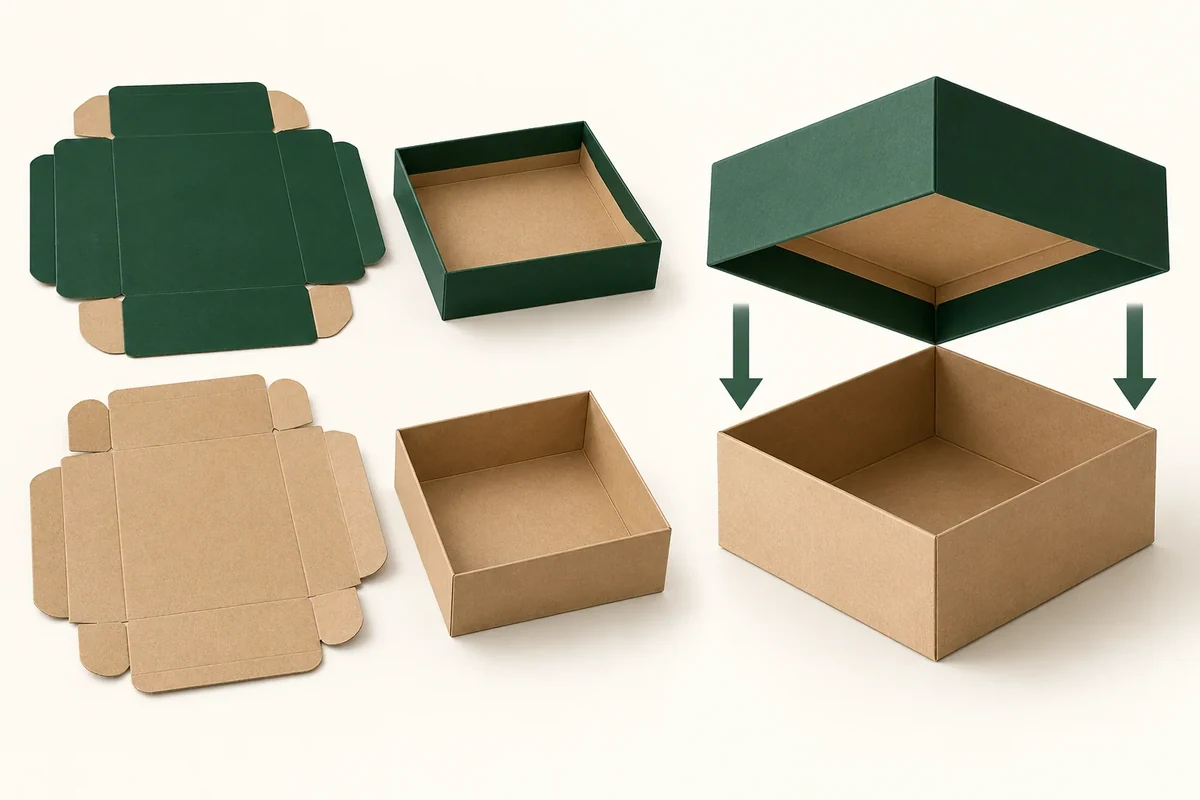
Compare folded wall builds on the formed lid and base before treating their dimensions as a matching pair. Record each blank, its final layer positions and the surfaces that meet during closure. A flat dieline comparison can miss a different finished interface after both parts are assembled.
The useful output is a two-blank record plus a paired section. It lets the buyer distinguish a wall-formation question from a lid-over-base question without inventing a universal allowance.
Identify the two formed parts
The foldable lid and base reference establishes the separate-component direction. Ask the supplier to show the actual wall folds for its proposal. The catalogue does not confirm every wall layer or retaining feature on your drawing.
Name the lid blank LB1 and base blank BB1, or use the supplier’s own stable IDs. Add the formed views beside their flat drawings. Record the material and revision used for each.
Mark the inside and outside wall faces after folding. If a fold creates another layer, show its final position instead of measuring the flat blank as if it were the finished wall.
Use the dimension acceptance method when a recorded measurement will become an acceptance requirement. State whether it refers to the flat part, formed empty component or loaded paired set.
Build a two-blank wall record
Copy the fields below into your project sheet. The rows describe what to collect rather than assigning a particular wall construction.
| Wall-build field | Lid blank | Base blank | Paired question |
|---|---|---|---|
| Identity | Lid drawing and sample revision | Base drawing and sample revision | Are the intended parts paired? |
| Fold order | Confirmed actions | Confirmed actions | Is each part fully formed? |
| Layer position | Inside/outside finished faces | Inside/outside finished faces | Which surfaces meet? |
| Retention | Confirmed wall-retaining detail | Confirmed wall-retaining detail | Does either move during pairing? |
| Formed envelope | Named dimension state | Named dimension state | What fit evidence is needed? |
| Open item | Missing layer or action | Missing layer or action | Owner and next response |
Keep a wall that remains partly formed marked as unresolved. A lid may fit over that temporary shape while leaving the final wall interface unanswered.
Work through a hypothetical two-piece set
Suppose a brand reviews a folding gift tray and lid. The base walls are formed from one blank, while the lid uses a different fold proposal. The buyer records LB1 and BB1 separately and asks the supplier to identify their final inside and outside surfaces.
On the first sample, one base wall needs an additional seating action. The buyer records that step before loading or pairing. A fit photograph taken before the action cannot close the finished pair.
The next review pairs the fully formed parts. Contact along one lid side is recorded as a paired issue with LB1/BB1. The buyer does not add a general clearance to all four walls without a source response.
A frame tray and lid has another paired interface that can use the same recording principle, while keeping its actual frame and wall details distinct.
Use different statuses for wall and pair decisions
In the hypothetical record, the lid fold can be ‘instruction confirmed’, the base fold ‘additional step awaiting response’, and paired fit ‘not yet reviewed’. These statuses prevent one attractive closed view from becoming blanket approval.
Ask the supplier: ‘Please confirm the final BB1 wall position and then review its paired interface with LB1.’ It names the part, action and next relationship. A new lid dimension alone may leave the base question open.
After a revision, retain the original wall records and add the changed field. A new material or fold can reopen the formed envelope even if the outside size label stays the same.
Send formed-wall evidence
Bring both blank records, formed views and the paired section to Packrivo’s enquiry. This original comparison tool helps locate the next construction question. It does not prescribe converting settings, tolerances or protective performance.
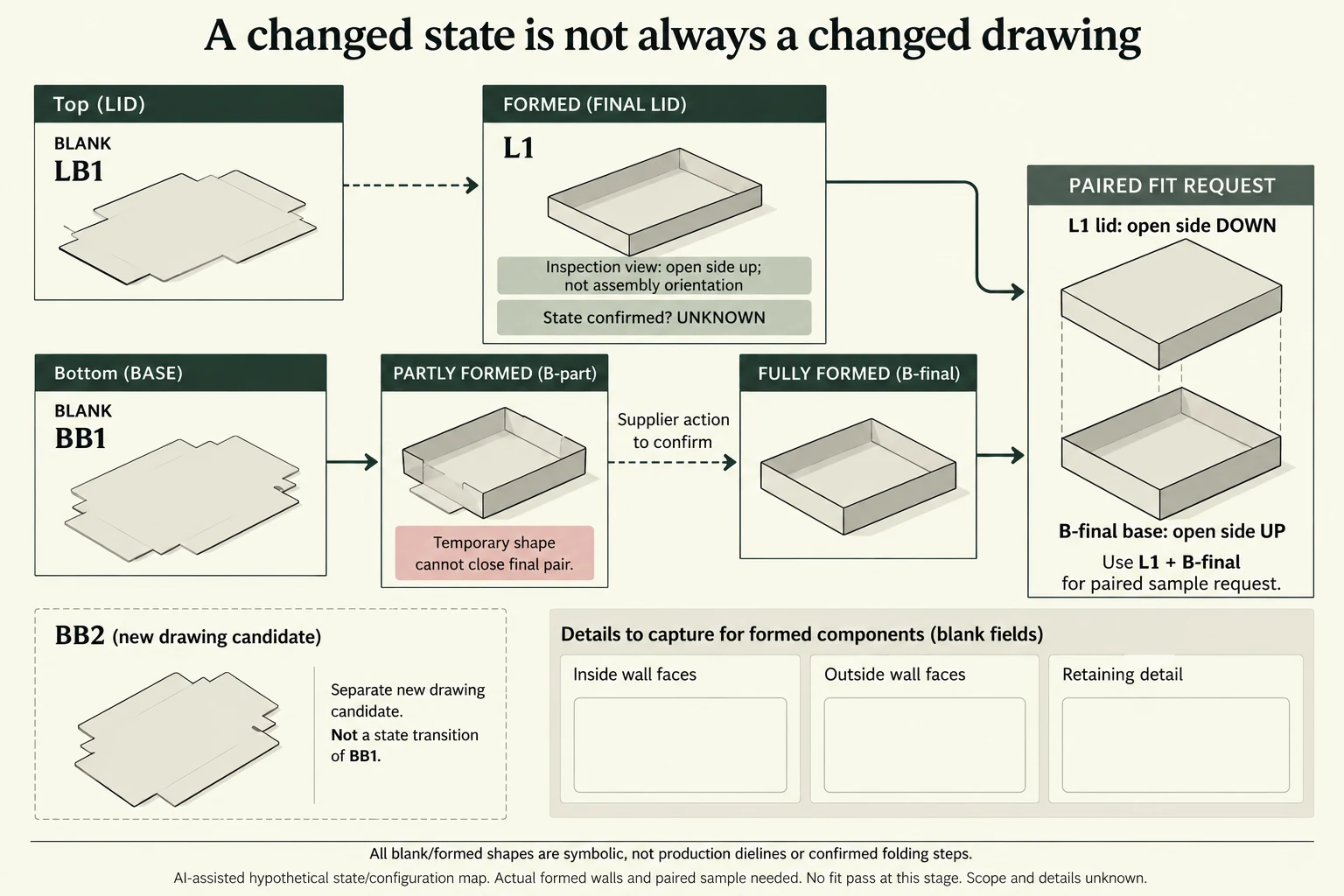
Distinguish completing BB1 from replacing it with BB2
A partly formed base and its completed state can share the same blank drawing. Name BB1_PART and BB1_FINAL separately from a proposed replacement drawing BB2. This avoids calling an unfinished wall a different design, or calling a changed design merely another photograph of the old part. The intended lid still has its own LB1 identity and formed-state evidence.
Scroll horizontally if columns extend beyond the view.
| Hypothetical configuration | Named object | Relationship | Input or next scope |
|---|---|---|---|
| BB1_PART | BB1_PART | uses drawing | BB1 |
| BB1_PART | LB1_FINAL | pair review with | BB1_PART |
| BB1_FINAL | BB1_FINAL | uses drawing | BB1 |
| BB1_FINAL | LB1_FINAL | pair review with | BB1_FINAL |
| BB2_FINAL | BB2_FINAL | uses drawing | BB2 |
| BB2_FINAL | LB1_FINAL | pair review with | BB2_FINAL |
BB1_PART can document the original additional-seating question but cannot close final paired fit. Once the responsible source confirms the actual action and final relationship, BB1_FINAL needs its inside/outside faces, retaining detail and formed envelope recorded. Those are evidence requests here, not instructions that a seating movement has been approved or performed.
A BB2_FINAL proposal is another configuration with its own material and fold references. Pairing it with LB1_FINAL needs a fresh review of the actual meeting faces even if an outside size label is unchanged. Keep a lid-fold instruction decision, a base-forming decision and a paired-fit decision distinct. A familiar lid file cannot establish its relationship to every base state or revision.
The CSV retains the original fictional instruction-confirmed lid, extra-step-pending base and not-yet-reviewed pair as separate statuses, then adds the drawing/state distinction. No wall layer count, retention mechanism, folding order or dimensional allowance is invented. Ask for both final formed parts and the actual paired section before interpreting a closed photograph as evidence of the intended complete interface.
Download the folded lid base wall build pairing record (.csv). It includes the original table fields and scenarios alongside the added relationships. HYPOTHETICAL rows are editorial examples or required review scopes, not actual records. Actual quantity, configuration, component and file identities, materials, process, specification, copy, method, condition, observation, owner, decision, evidence and dates are blank. ACTUAL_BLANK is a separate empty starting row; enter permitted project evidence before using an actual record. A blank means unknown.
Use the Include Turned Paper Edges in Lid-Fit Reviews for its separate question. Use the Agree Packaging Dimensions and Acceptance Methods for its separate question. Use the Packaging Sample Revisions: Compare Versions Before Approval for its separate question.
Source scope checked 16 October 2026. References cover only the named materials, processes or guidance. Added configurations and geometry are hypothetical, not supplier specifications, tests or production approval; they set no universal tolerances or machine limits. Confirm the actual material, process, drawing and formed sample for the project.
Discuss this packaging specification with Packrivo. We coordinate independent suppliers. MOQ: 500 pieces per product/design; illustrative quantities are not production offers. Confirm materials, samples, price and timing for your project.