
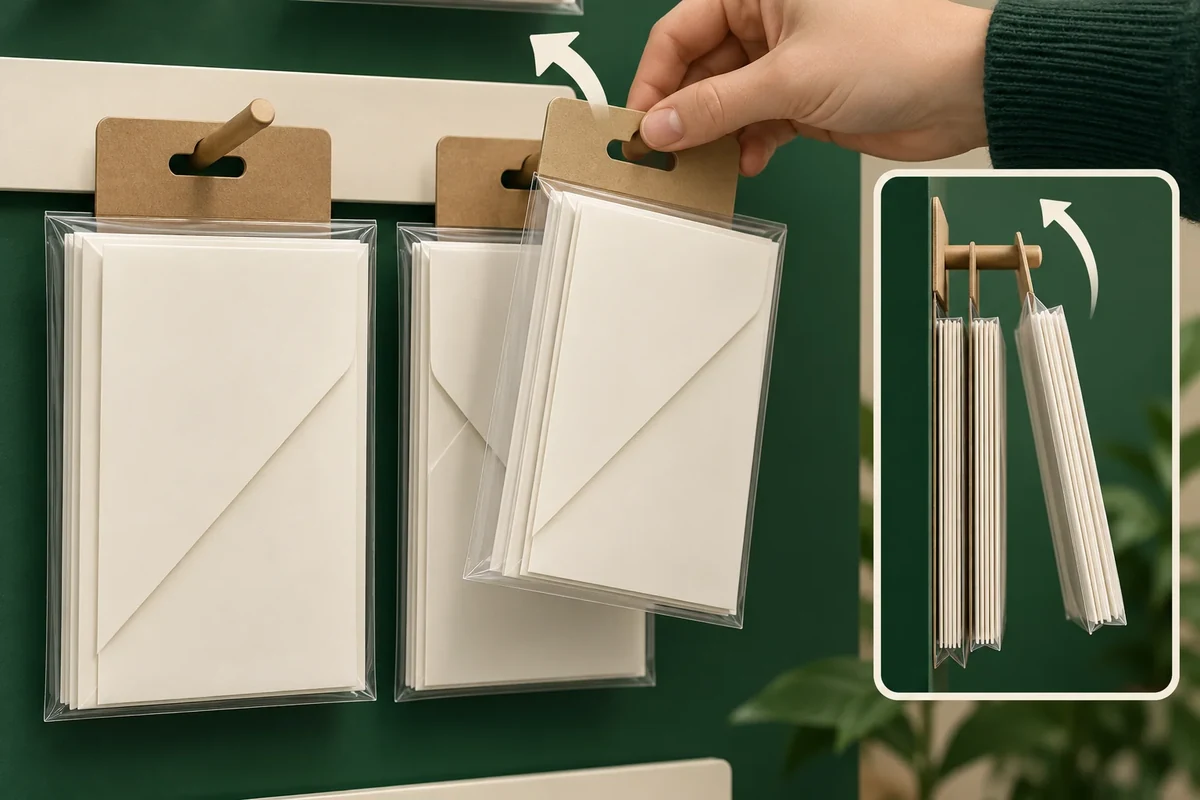
Check a retail fixture with multiple sale-ready packs in their intended positions, then record contact during removal of a selected unit. Keep neighbouring packs present in the action view. A hanging hole that fits an isolated hook doesn’t settle side-by-side or front-to-back interference on the full display.
The useful tool is a multi-pack drawing with a few named collision points. It helps the supplier review fixture spacing and pack geometry without turning a staged photo into a universal clearance rule.
Draw the complete neighbouring layout
The hook display reference identifies hanging-pack use. Request the actual hook geometry and attachment proposal. Include the retaining ends, rows and complete pack envelopes.
Assign each relevant pack a position ID. Show side spacing, front-to-back stock order and any row above or below. Keep the hole and raised hanger panel connected to the full pack body.
Mark the selected unit and its intended removal route. A customer can move the unit through more space than the hole occupies, particularly when lifting it past a retaining end.
Use the counter-hook direction or floor-hook direction for their actual fixture proposal. The collision map stays tied to its own placement and stock pattern.
Record contact by stage and pair
Begin with the full starting layout photographed. Review removal without clearing adjacent stock as an unrecorded aid. Pause at the point where parts meet and name both of them.
A collision pair can be pack-to-pack, pack-to-hook or pack-to-body. Keep those categories as factual location descriptions, not causes or performance judgements. The supplier needs the actual part relationship.
| Collision field | Entry | Evidence |
|---|---|---|
| Selected pack | Position ID and full envelope | Starting layout |
| Neighbour | Adjacent pack or fixture part | Front and side map |
| Action stage | Lift, travel or exit | Located contact image |
| Changed action | Extra turn or cleared stock | Deviation recorded |
| Proposed response | Spacing, pack or route change | Supplier reply |
| Recheck state | Same or revised stock layout | Matched comparison view |
Do not use a single successful hole-fit observation as approval of all rows. A top row and lower row can meet different neighbours during the same customer action.
Follow a hypothetical paired-hook display
Suppose two hooks carry carded ornaments side by side. Each hole fits its hook when reviewed alone. With both stocked, the selected pack meets its neighbour while being lifted over the retaining end.
The buyer marks selected pack P2 and neighbour N2 at the contact stage. The source is asked to assess that pair on the full layout. Enlarging the hole alone may leave the body-to-body contact unanswered.
If the supplier proposes more space or another pack orientation, record the actual change. Review the same selected-unit action with the confirmed new layout rather than removing the neighbour for the next photograph.
Keep useful deviations in the record
A reviewer may tilt the pack or move neighbouring stock to finish removal. Preserve the action and ask whether it should be part of the intended use. A workaround can explain the issue while still leaving the original route unresolved.
Keep a full-stock and reduced-stock map separately if both are relevant. Their neighbours and travel envelopes differ. A favourable reduced state should not erase a collision found in the full state.
The original map documents contact and access. Any stability, load or accessibility evaluation needs a responsible method and actual conditions; no such result follows from a drawing.
Send the collision pair
Bring the front/side layout, selected unit, neighbouring pair and action photos to Packrivo’s enquiry. Ask the next question by location and stage so the response can be reviewed against the same configuration.
Removing a neighbour changes the collision question
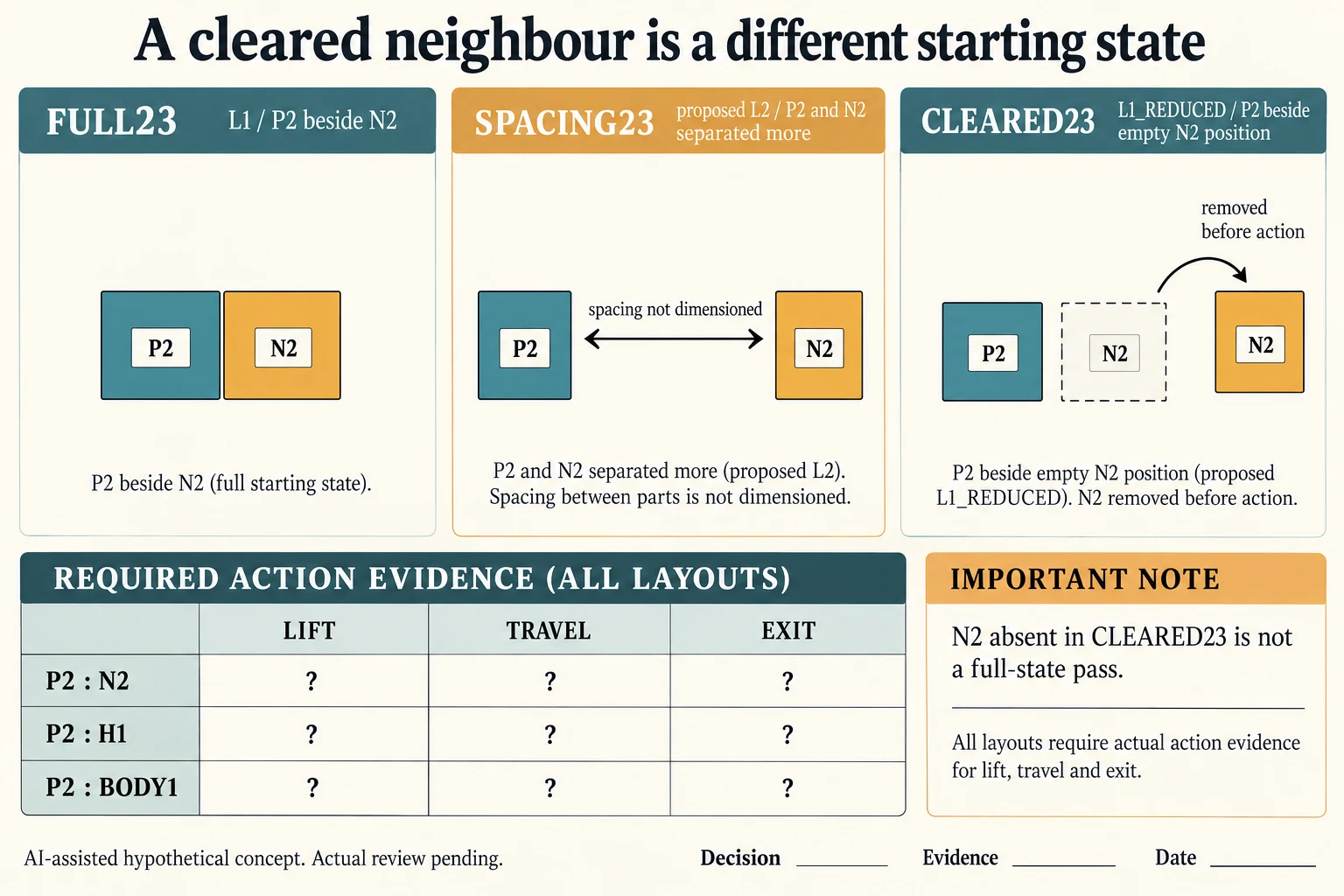
Use three invented layout references for the P2/N2 question. FULL23 uses L1 with N2 present. SPACING23 uses proposed layout L2, also with N2 present. CLEARED23 uses L1_REDUCED after N2 has been removed before the customer action. The first two retain the neighbouring-pack question; the third introduces a separate operation. No spacing, angle or successful removal is assigned to any proposal.
Scroll horizontally if columns extend beyond the view.
| Hypothetical configuration | Named object | Relationship | Input or next scope |
|---|---|---|---|
| FULL23 | FIXTURE | uses layout | L1 |
| FULL23 | N2 | has presence | PRESENT; 1 packs |
| FULL23 | N2 | staff action | RETAIN_DURING_ACTION |
| SPACING23 | FIXTURE | uses layout | L2 |
| SPACING23 | N2 | has presence | PRESENT; 1 packs |
| SPACING23 | N2 | staff action | RETAIN_DURING_ACTION |
| CLEARED23 | FIXTURE | uses layout | L1_REDUCED |
| CLEARED23 | N2 | has presence | ABSENT; 0 packs |
| CLEARED23 | N2 | staff action | REMOVE_BEFORE_CUSTOMER |
The CSV creates separate lift, travel and exit rows for P2 against N2, hook H1 and fixture body BODY1 in each layout. N2 has numeric presence one in the stocked layouts and zero in CLEARED23. A pair marked absent cannot become a no-contact result for the full layout. Likewise, clearing N2 says nothing about whether P2 still catches the retaining end or the fixture body.
A source response proposing more spacing needs an identified L2 layout and its own stocked action views. A response proposing clearance of a neighbour needs an operating owner and permission for that extra action. An isolated hang-hole observation answers neither response completely. Keep the full package body and other front-to-back or above/below neighbours in the actual drawing even if the teaching map concentrates on one located pair.
Record a turn or tilt as a changed action, not invisible help. Keep actual contact, route, fixture, stock pattern and decision evidence blank until reviewed. This pair-by-stage register locates the next supplier question; it supplies no minimum spacing, load rating, accessibility assessment or fixture-stability result.
Download the retail fixture collision pairs record (.csv). It includes the original table fields and scenarios alongside the added relationships. HYPOTHETICAL rows are editorial examples or required review scopes, not actual records. Actual quantity, configuration, component and file identities, materials, process, specification, copy, method, condition, observation, owner, decision, evidence and dates are blank. ACTUAL_BLANK is a separate empty starting row; enter permitted project evidence before using an actual record. A blank means unknown.
Use the Test Retail Hang Slots on the Actual Display Fixture for its separate question. Use the A Counter Display’s Tipping Risk Depends on Its Footprint and Loaded Centre of Mass for its separate question. Use the Retail Packaging Customer Access: See, Touch or Remove for its separate question.
Source scope checked 16 October 2026. References cover only the named materials, processes or guidance. Added configurations and geometry are hypothetical, not supplier specifications, tests or production approval; they set no universal tolerances or machine limits. Confirm the actual material, process, drawing and formed sample for the project.
Discuss this packaging specification with Packrivo. We coordinate independent suppliers. MOQ: 500 pieces per product/design; illustrative quantities are not production offers. Confirm materials, samples, price and timing for your project.