
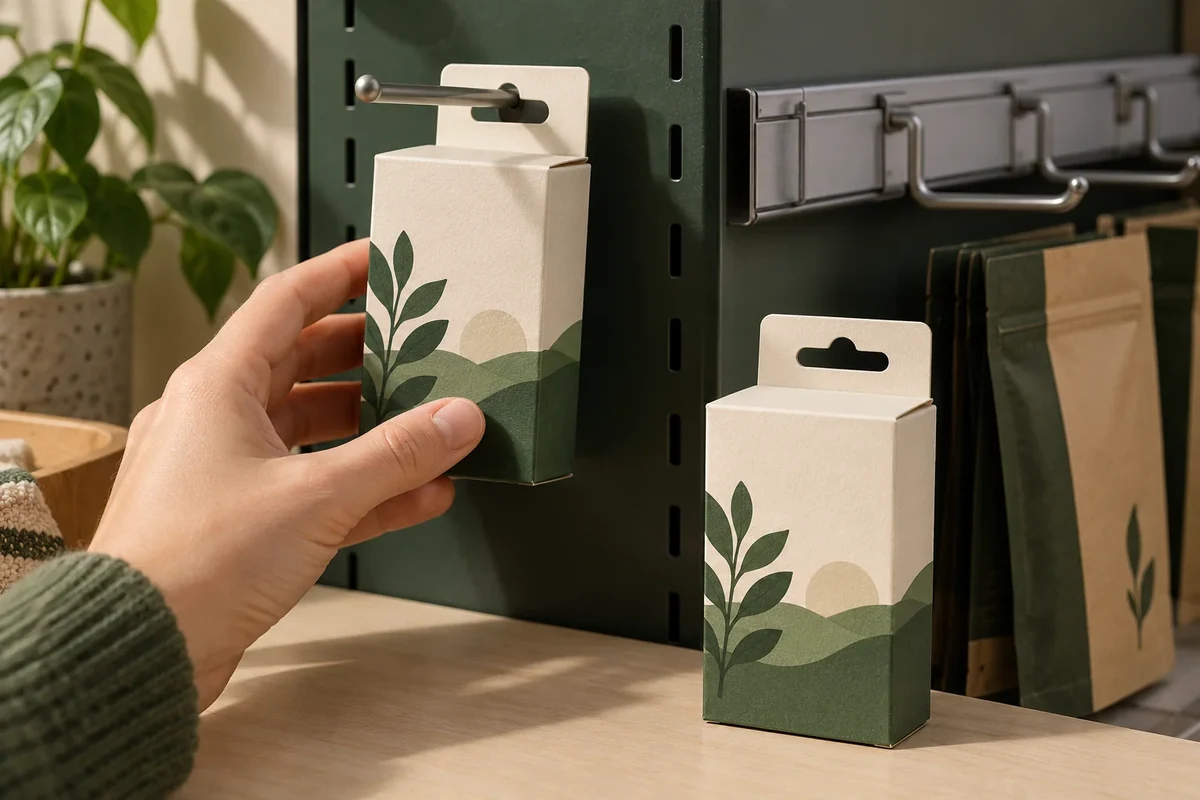
Review a retail hang slot with the intended display fixture and the complete packed product. Check installation, hanging orientation, neighbouring-pack clearance and removal, then record the fixture and package versions used. Agree any load or duration evaluation with the responsible parties rather than treating a hole shape or product photograph as proof of display suitability.
A hanger opening can look familiar while differing from the retailer's actual peg. The package can also rotate or lean when loaded, even though the empty card hangs neatly. Start with the fixture and the stocked arrangement you need to serve.
Get a fixture reference before finalizing the opening
Ask the retailer or display owner for an identified fixture, a representative physical example or sufficient dimensions to discuss a candidate. Record the peg shape, projection, end detail and any nearby price holder or rail. Keep a photograph that shows the fixture in use.
State how the package is supposed to be installed and removed. Some arrangements need the opening to pass over an end feature; others use a different loading approach. Ask the display owner to confirm that movement rather than assuming a standard shop fitting from a catalog name.
Distinguish a slot cut into the packaging from an attached hang tab. 3M's hang tab range includes different opening configurations for display use. That illustrates why the proposed hanger construction and fixture both need identification; it does not establish suitability for your package.
If you are considering an attached tab, ask for its position, material reference and application requirements. If the opening is cut into a card or carton, identify the finished material and the area surrounding the cutout. The complete construction is part of the review.
Record whether the product will hang directly from a card or inside a packed carton. Add the actual product and accessories before discussing its loaded orientation. The supplier brief guide can hold those inputs without converting them into an unverified load specification.
Check the loaded presentation and access
Install the candidate using the agreed movement and observe the complete pack. Record whether it faces forward as intended, tilts, rotates or rests against another display element. Those observations can guide a revision to position or construction after the supplier reviews them.
Look at the same pack from the shopper's approach. Check whether the hanging arrangement hides the product name, covers instructions or presents the back when the front is intended. Keep printed information review separate from the mechanical review so each has an owner.
Place neighbouring candidate packs at the intended display spacing where that can be arranged. Note contact with adjacent products and any difficulty reaching the desired item. A single pack on an empty peg cannot answer how a stocked display is accessed.
Try removal and replacement using the agreed sequence. Record snagging at the opening, contact with a price holder or changes to the candidate's shape. If the construction needs a different removal movement, ask whether that movement is acceptable to the display owner.
This original worksheet records practical display observations. Load limits, test duration and acceptance conditions remain fields to agree for the specific project.
| Stage | Record | Next decision |
|---|---|---|
| Fixture identification | Shape, end detail, dimensions and reference | Which opening candidate to discuss |
| Installation | Movement and contact during loading | Opening or attachment revision needed |
| Loaded display | Product orientation and visible information | Hanger position and presentation |
| Neighbouring stock | Pack spacing and shopper access | Display arrangement to review |
| Removal | Catching, deformation or unclear movement | Revised candidate or instruction |
| Further evaluation | Agreed load, method, duration and owner | Evidence needed for acceptance |
Ask a precise question when the candidate catches
Describe the point and action involved. "The slot catches on the fixture's end detail during installation" gives the supplier a different task from "the loaded pack leans forward." Keep those findings in separate rows even if they appear in the same trial.
Provide the candidate drawing and a marked fixture image. Ask whether the supplier proposes a change to the opening, surrounding material, attachment position or another feature. Record what else that change may affect, including artwork and the pack's closed configuration.
For a hypothetical accessory card, one candidate might pass onto the fixture but leave the jewelry facing sideways. Another proposed hanger location might improve orientation while moving a printed area. The next review should examine both the display task and the affected layout; these are planning examples, not test results.
Use the dieline change impact record when the revised opening changes a structural drawing. A new cutout near artwork deserves a named replacement drawing and review scope, rather than an unrecorded alteration to an old file.
Keep the retail decision attached to the evidence
Ask the display owner which further evaluation is required for the loaded package and intended use. State who performs it, what configuration is evaluated and who accepts the result. The visual trial can help locate questions while leaving wider strength or duration claims unresolved.
Retain the fixture reference, candidate ID, loaded product details and observations together. If the retail fixture or package contents change, review which earlier decisions remain applicable. A different fixture shouldn't inherit approval solely because its general name sounds similar.
Bring those references to Packrivo's packaging inquiry when developing a hanging display direction. The request should identify the fixture, explain the shopper's installation and removal task, and show which candidate feature needs evidence before acceptance.
Keep candidate access and artwork decisions separate
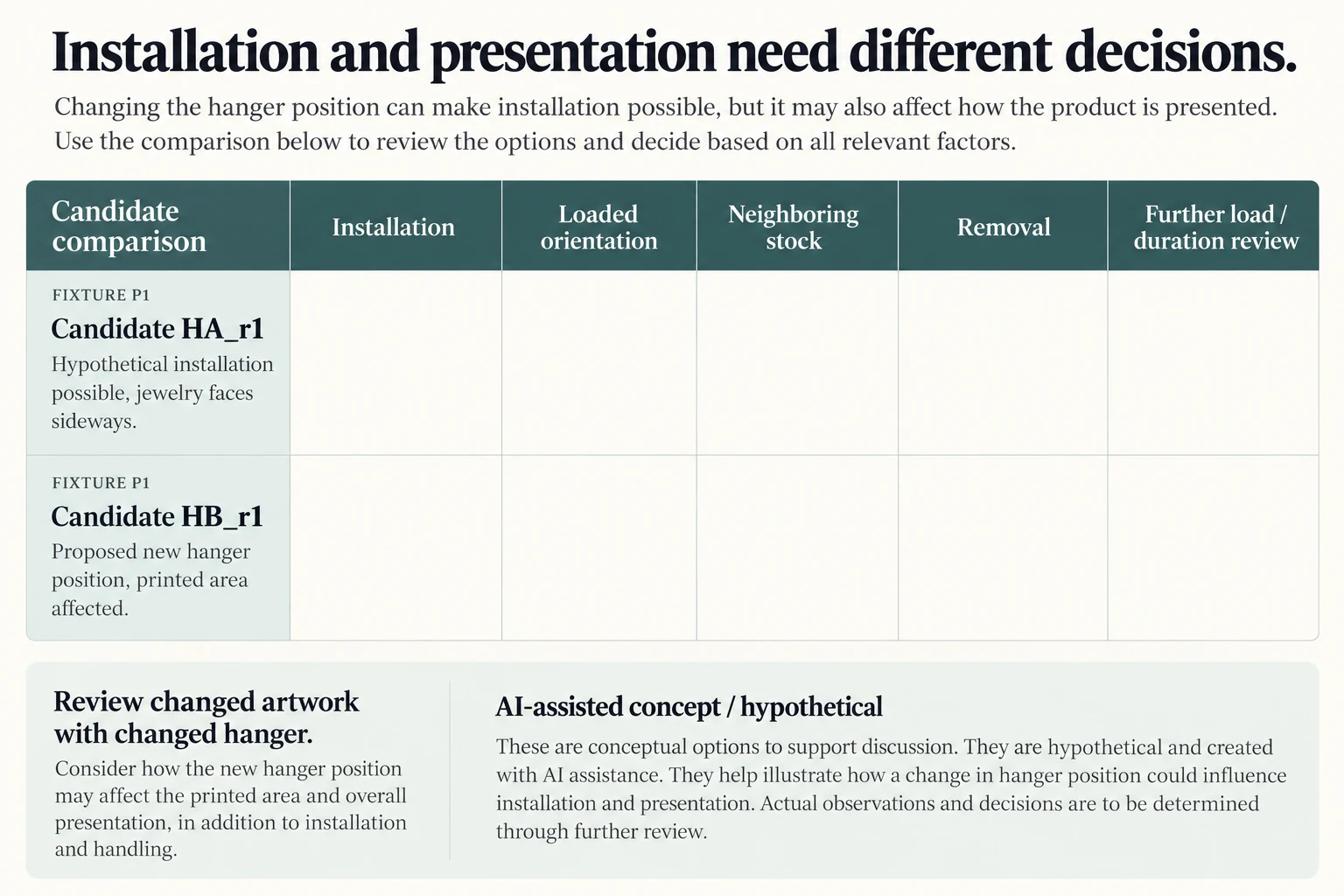
Use new hypothetical candidate IDs HA_r1 and HB_r1 against fixture P1 with loaded product V1. The original example’s first candidate can be installed but presents the jewelry sideways; another hanger-position proposal affects a printed area. Those are explanatory assumptions, not trial findings.
Scroll horizontally if columns extend beyond the view.
| Scenario scope | Exact object or route | Hypothetical input or output | Calculation or record boundary |
|---|---|---|---|
| Install | HA_r1 | Unobserved; actual fields blank | Actual install movement/contact; actual observation and decision blank |
| Orientation | HA_r1 | Unobserved; actual fields blank | Loaded orientation and front/back presentation; actual observation and decision blank |
| Neighbors | HA_r1 | Unobserved; actual fields blank | Neighbor spacing and customer access; actual observation and decision blank |
| Removal | HA_r1 | Unobserved; actual fields blank | Removal/replacement snag/deformation; actual observation and decision blank |
| HA_r1 | Unobserved; actual fields blank | Printed information visibility; actual observation and decision blank | |
| Further review | HA_r1 | Unobserved; actual fields blank | Agreed load/method/duration/evidence and acceptance owner; actual observation and decision blank |
| Install | HB_r1 | Unobserved; actual fields blank | Actual install movement/contact; actual observation and decision blank |
| Orientation | HB_r1 | Unobserved; actual fields blank | Loaded orientation and front/back presentation; actual observation and decision blank |
| Neighbors | HB_r1 | Unobserved; actual fields blank | Neighbor spacing and customer access; actual observation and decision blank |
| Removal | HB_r1 | Unobserved; actual fields blank | Removal/replacement snag/deformation; actual observation and decision blank |
| HB_r1 | Unobserved; actual fields blank | Printed information visibility; actual observation and decision blank | |
| Further review | HB_r1 | Unobserved; actual fields blank | Agreed load/method/duration/evidence and acceptance owner; actual observation and decision blank |
| Hypothetical configuration | HA_r1 | Unobserved; actual fields blank | Fixture P1 with loaded product V1; candidate version specific, actual fixture/product identity and evidence remain blank |
| Hypothetical configuration | HB_r1 | Unobserved; actual fields blank | Fixture P1 with loaded product V1; candidate version specific, actual fixture/product identity and evidence remain blank |
The comparison separates installation, loaded orientation, neighboring stock, removal, print visibility and further evaluation for both candidates. A proposed change that improves presentation still needs its own evidence and cannot quietly inherit the earlier installation or artwork status. Keep actual observations and decisions blank.
Ask the display owner which loaded evaluation, method and duration are required. Record catching at the fixture end separately from a sideways or leaning display. When the opening or tab position changes, retain the corresponding drawing and artwork revisions; neither a catalog hole shape nor one pack on an empty peg establishes the stocked display arrangement.
Download the retail hang slot packaging test record (.csv). It covers the original scenarios and this added comparison. HYPOTHETICAL rows are invented planning examples. Actual quantity, value, configuration, method, owner, observation, condition, decision, evidence and dates are blank because no actual project record has been obtained. Copy a relevant row and replace its type with ACTUAL only when entering permitted project evidence; keep the example and actual record separate. ACTUAL_BLANK is an empty starting row. A blank is unknown, never approval.
The related Packaging Supplier Brief: The First Details to Send guide concerns a separate requirement. Use this record for the specific comparison above rather than treating that guide as evidence of a completed result.
Keep affected physical functions visible in the sample-version comparison. Link the changed printed area to the artwork handoff record.
References retain their stated general-guidance or manufacturer-example scope. Worked figures and records are teaching examples, not observed orders, stock, prices or measured performance.
Discuss this packaging specification with Packrivo. We coordinate independent suppliers. MOQ: 500 pieces per product/design; illustrative quantities are not production offers. Confirm materials, samples, price and timing for your project.