
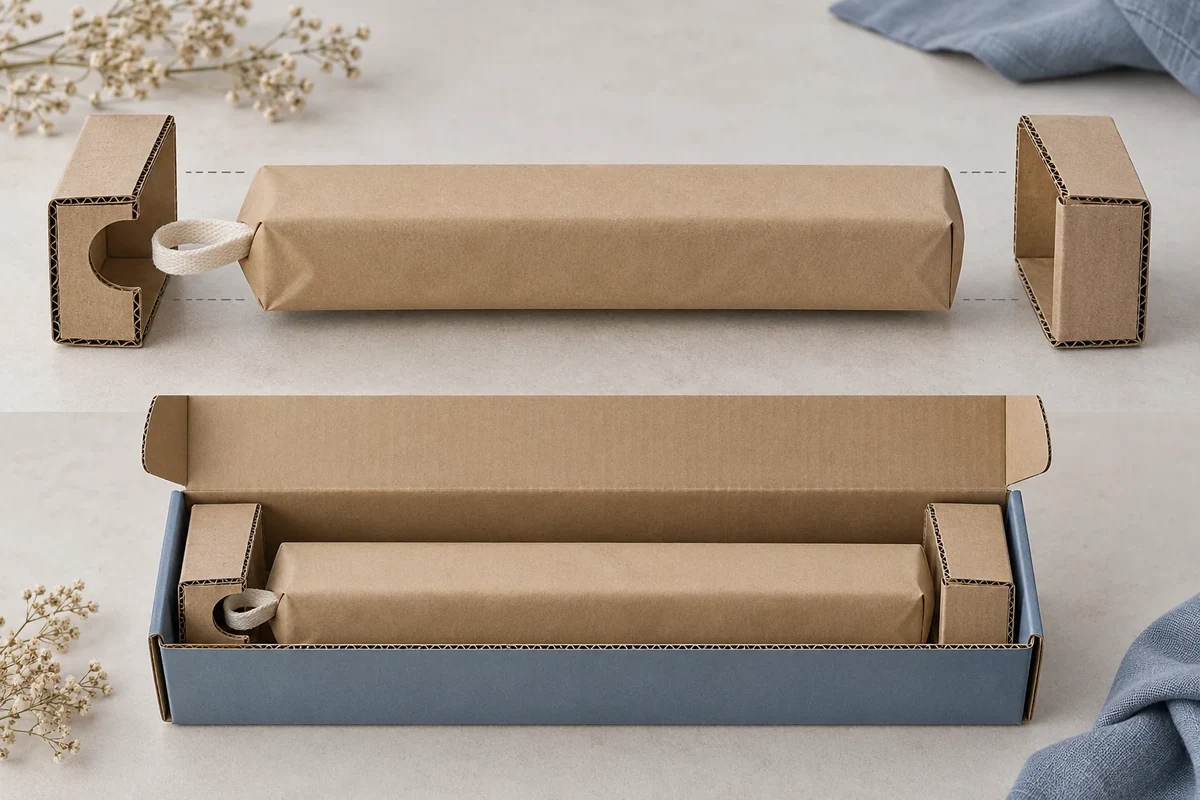
Keep end-cap positions and part identities separate through packing. Record which support goes at each end, whether the parts are identical and which product features they meet. A left/right label can describe installed positions without proving that two different parts exist.
This record is useful when a paired-support proposal changes. It keeps the actual parts, product ends and instruction linked rather than relying on a generic photo of two caps.
Identify both product ends and supports
The corrugated end-cap reference describes supports tailored to product shape and dimensions. That supports asking for the actual end geometry. It doesn’t establish that every pair is handed or carries a verified protective result.
Name the product’s two ends using stable features or reference faces. Add the supplier’s actual part IDs at those positions. If one common cap is confirmed for both, record that explicitly.
Show the installed orientation and any inner wrap. A cap reversed on a product may meet another feature even when its loose silhouette looks similar.
Use the sample revision record for the wider product and packaging trail. This log focuses on the paired end relationship.
Carry the pair through assembly and change
Record how supports are delivered, identified and installed. Keep the point where another outer-pack component hides them in the instruction. Staff need the part reference before that stage.
If the product changes at one end, identify the support and instruction affected. Do not mark the whole pair current merely because the other end still matches the earlier proposal.
| Pair record | First end | Second end | Evidence |
|---|---|---|---|
| Product end | Stable feature/orientation | Stable feature/orientation | Matched product drawing |
| Support part | Actual ID or confirmed shared part | Actual ID or confirmed shared part | Supplier part map |
| Installed face | Reference orientation | Reference orientation | Loaded side views |
| Delivered identity | Part grouping or marking proposal | Part grouping or marking proposal | Supplied-state record |
| Change | Affected product/support field | Affected product/support field | Revision response |
| Instruction | Action and position | Action and position | Current packing sequence |
Keep part equality as a confirmed fact or an open question. An attractive mirrored drawing should not decide it.
Follow a hypothetical long gift product
Suppose a long dry-gift item has a projecting attachment at one end and a plain surface at the other. The proposed paired supports meet those different features. The buyer names the product ends A and B and asks the source to identify the actual cap parts.
If the source proposes different parts, their identities remain in the supply and packing records. If it proposes one shared part, the installed orientations are still recorded. Both arrangements can be discussed without inventing handedness.
Later the attachment changes only at end A. The log links that change to its support interface and preserves end B’s earlier record, while keeping any full-system review dependency open.
Use a position-specific question
Ask: ‘Please confirm the support part and installed face at product end A after the attachment change.’ It gives the source a specific configuration. A reply with the same product length alone may not answer the end feature.
Review the actual revised pair inside the proposed outer pack. Keep wrap and product versions named. Correct cap identification is not a transport-test result or a universal retention claim.
Any required handling or distribution evaluation should use the complete paired system under an agreed method. The log supplies identity and change context without declaring that evaluation passed.
Send the pair and affected end
Bring both end drawings, actual support IDs and the change log through Packrivo’s enquiry. The next supplier response should name which paired relationship remains current and which needs new evidence.
An unchanged second end does not approve the revised pair
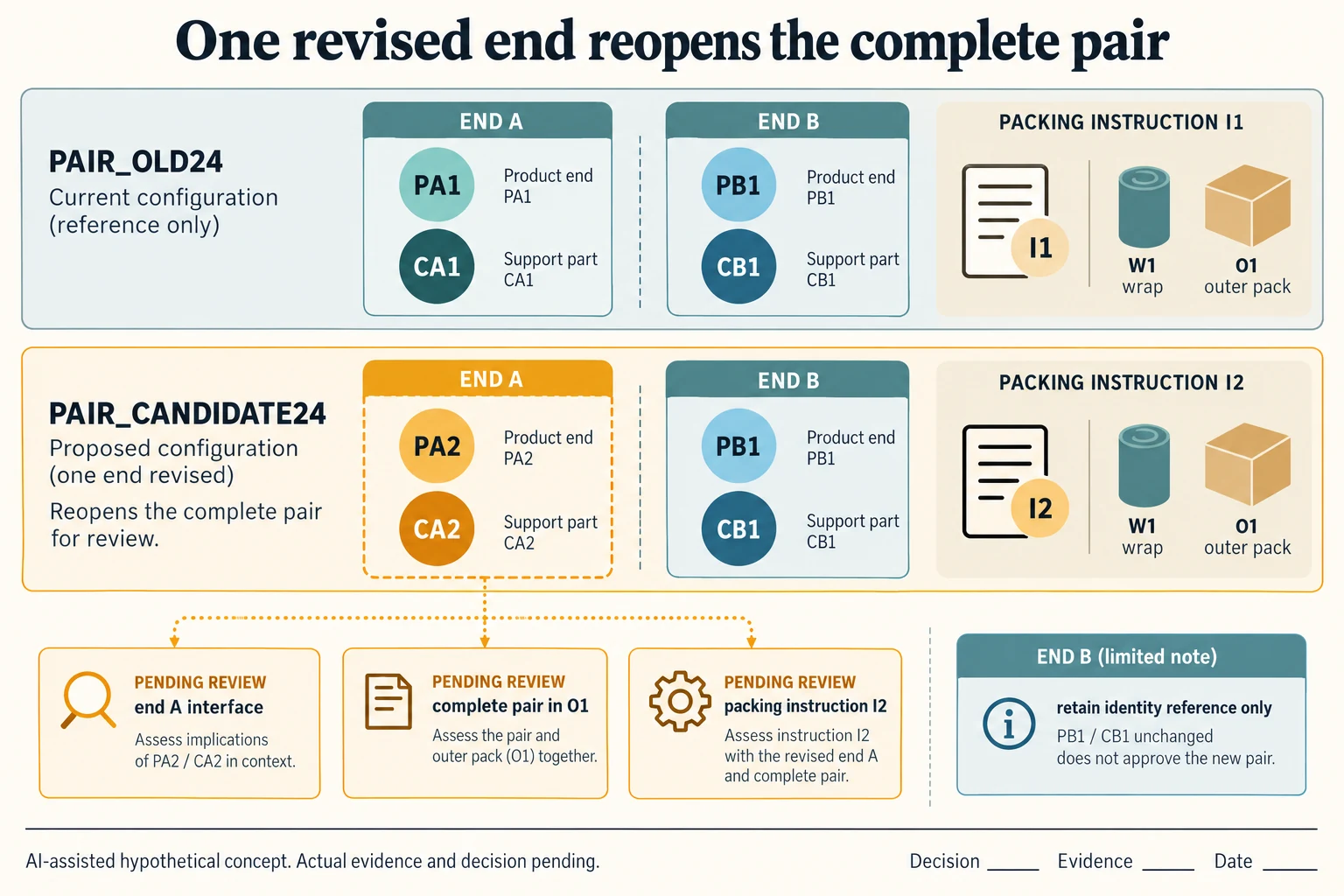
Use an invented paired system to isolate the attachment change. PAIR_OLD24 names product end PA1 with support CA1, and end PB1 with support CB1, under instruction I1. PAIR_CANDIDATE24 proposes PA2 and support CA2 at end A, while PB1 and CB1 remain the named end-B references. Wrap W1 and outer pack O1 are held constant in the example, and the proposed packing instruction becomes I2.
Scroll horizontally if columns extend beyond the view.
| Hypothetical configuration | Named object | Relationship | Input or next scope |
|---|---|---|---|
| PAIR_OLD24 | PAIR_OLD24 | uses product end a | PA1 |
| PAIR_OLD24 | PAIR_OLD24 | uses support a | CA1 |
| PAIR_OLD24 | PAIR_OLD24 | uses product end b | PB1 |
| PAIR_OLD24 | PAIR_OLD24 | uses support b | CB1 |
| PAIR_OLD24 | PAIR_OLD24 | uses instruction | I1 |
| PAIR_CANDIDATE24 | PAIR_CANDIDATE24 | uses product end a | PA2 |
| PAIR_CANDIDATE24 | PAIR_CANDIDATE24 | uses support a | CA2 |
| PAIR_CANDIDATE24 | PAIR_CANDIDATE24 | uses product end b | PB1 |
| PAIR_CANDIDATE24 | PAIR_CANDIDATE24 | uses support b | CB1 |
| PAIR_CANDIDATE24 | PAIR_CANDIDATE24 | uses instruction | I2 |
| PAIR_CANDIDATE24 | PB1_CB1 | retains reference only | OLD_END_B_IDENTITY_RECORD |
The CSV records all seven references independently for each pair. End B’s unchanged identity record can remain available as history, but it does not accept the revised assembly. The complete product can sit differently when end A changes, and the actual paired relationship inside O1 still needs evidence. No such movement or fit result is asserted here; the point is to keep the possible dependency visible rather than extending an old identity decision to a new complete system.
Request separate responses for the changed end-A interface, retained end-B identity scope, complete pair fit, outer-pack relationship and packing instruction. A reply giving unchanged overall product length does not locate the altered attachment. Likewise, a new photograph of CA2 alone leaves its installed face and the other end’s relationship unresolved. Keep delivered grouping and the point where outer packaging hides part identity with the operator’s instruction.
The original common-cap versus different-part alternatives remain open source choices. This extension deliberately does not repeat the divider quantity question or invent mirrored cap geometry. The Smurfit Kappa example describes product-specific end-cap design, not this pair’s protective qualification. Review the actual revised system and define any handling or distribution evaluation separately.
Download the end cap one end revision record (.csv). It includes the original table fields and scenarios alongside the added relationships. HYPOTHETICAL rows are editorial examples or required review scopes, not actual records. Actual quantity, configuration, component and file identities, materials, process, specification, copy, method, condition, observation, owner, decision, evidence and dates are blank. ACTUAL_BLANK is a separate empty starting row; enter permitted project evidence before using an actual record. A blank means unknown.
Use the Identify Handed Divider Parts in the Loading Plan for its separate question. Use the Packaging Sample Revisions: Compare Versions Before Approval for its separate question. Use the Packaging Dieline Changes Need an Impact Record for its separate question.
Source scope checked 16 October 2026. References cover only the named materials, processes or guidance. Added configurations and geometry are hypothetical, not supplier specifications, tests or production approval; they set no universal tolerances or machine limits. Confirm the actual material, process, drawing and formed sample for the project.
Discuss this packaging specification with Packrivo. We coordinate independent suppliers. MOQ: 500 pieces per product/design; illustrative quantities are not production offers. Confirm materials, samples, price and timing for your project.