
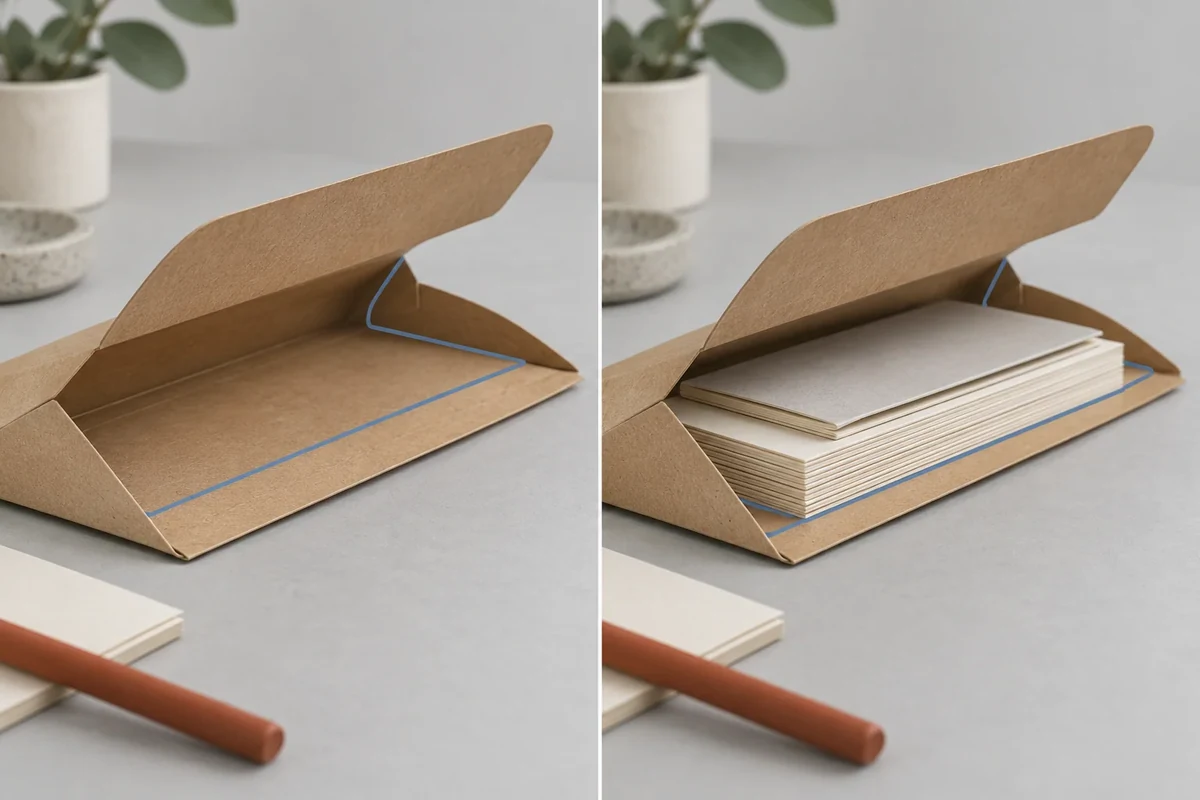
Check an envelope’s flap reach with the complete contents present, using the same proposed flap and receiving area as the empty review. Record the filled shape before joining. An empty closure photo leaves open whether the actual packed thickness changes the closing relationship.
The output is an empty/filled diagram for one envelope and one contents version. It should identify a located closure question before the buyer asks for another size or sealing material.
Name the closing interface
The cardboard-envelope reference establishes the form context. Request the actual flap, seams and receiving area on the supplier proposal. A category page doesn’t prescribe every closing layout.
Mark the flap start and intended final joining position. Record whether the envelope is flat, expanded or formed when dimensions are stated. The source should confirm the closing method rather than the buyer inferring it from a mock-up.
For an expandable parcel bag, the same method can keep gusset expansion connected to closing reach. Its actual construction remains a separate proposal.
Pair empty and filled states
Photograph the empty flap approaching its intended receiving area. Then load the complete contents in the proposed orientation and repeat that view before joining. Keep any inner wrap and added card in place.
If a reviewer compresses the fill or changes a fold, record the action. A successful final closure after an unrecorded change answers a different question.
| Closing-diagram field | Empty state | Filled state | Decision |
|---|---|---|---|
| Flap identity | Same proposed flap | Same proposed flap | Revision confirmed |
| Receiving area | Location marked | Location marked | Available relationship |
| Contents | None | Complete named envelope | Actual thickness/state |
| Extra action | Recorded setup | Compression or changed fold | Supplier confirmation needed |
| Before joining | Approach photo | Approach photo | Located reach question |
| After opening | Empty reference if used | Customer access to contents | Separate opening result |
Use the dimension method if a reach measurement becomes an acceptance requirement. Keep its datum, instrument and sample state explicit.
Follow a hypothetical card-and-booklet envelope
Suppose a brand’s envelope closes neatly with a flat card collection. The next contents version adds a booklet. The buyer records the thicker complete fill and compares the flap against the same receiving area.
If the flap no longer reaches as proposed, the source can discuss geometry, contents arrangement or another construction. The buyer does not immediately prescribe more adhesive without locating the relationship.
A new envelope proposal is reviewed with the booklet fill, not only the earlier thinner set. Keep both state records so the accepted configuration is clear.
Use a filled-state question
Call the flap F1, receiving area RA1 and contents version C2. Ask: ‘Please review F1/RA1 with C2 in the stated packed orientation.’ It gives the supplier a complete interface rather than a vague closing complaint.
Record proposed and observed values separately. A dimension on a drawing and a measurement on a loaded sample can coexist without being described as the same evidence.
This original tool reviews geometry and action. Seal integrity, barrier or transport requirements need their own responsible evaluation; the fact that a flap reaches doesn’t establish those results.
Send the matched pair
Bring empty and filled approach views, the full contents list and open closure question through Packrivo’s enquiry. The next source response should identify what changes and which filled state needs another review.
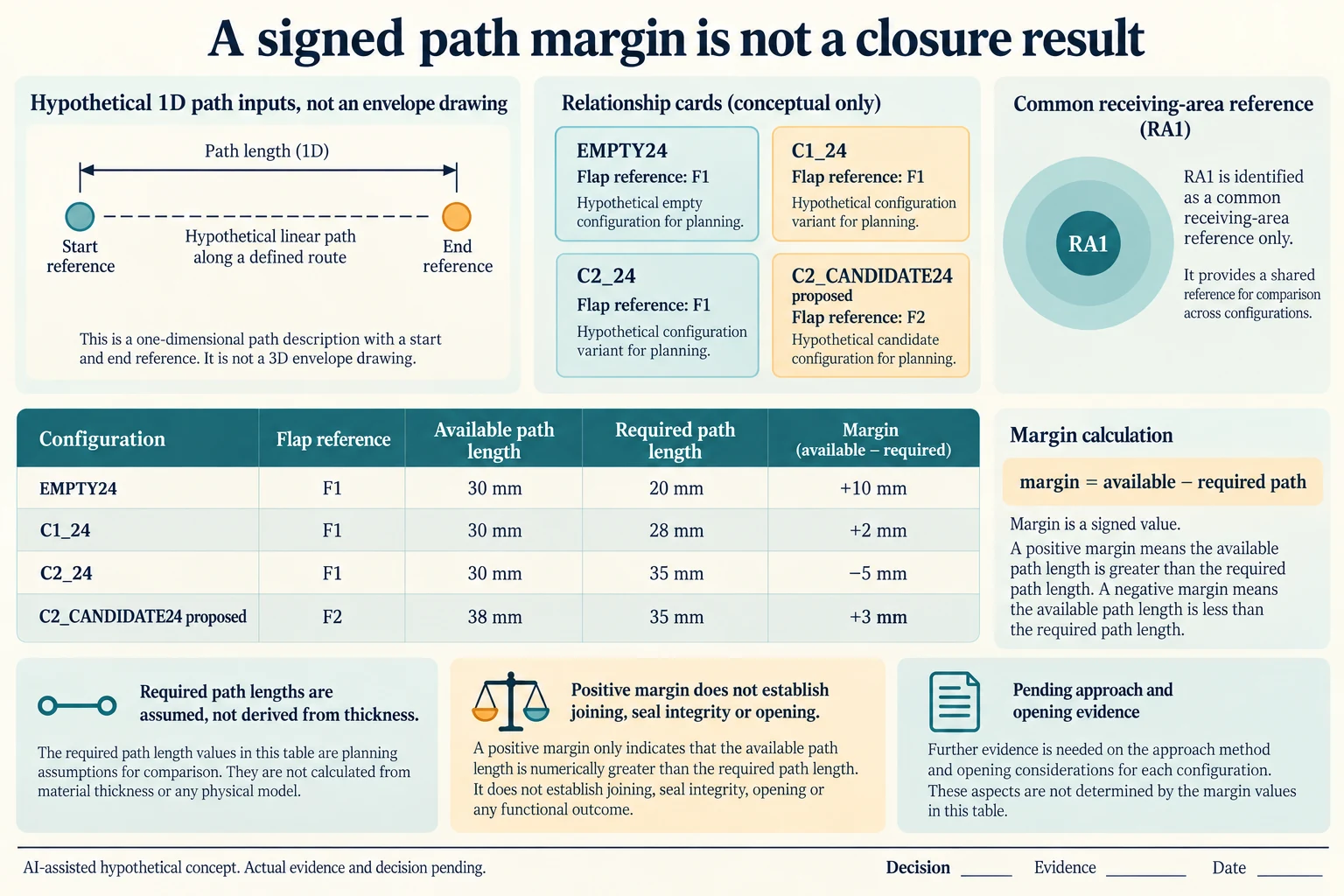
Separate an assumed path margin from a closure result
An invented one-dimensional path model can make the open input visible without pretending to derive flap reach from packed thickness. Assume F1 has 30 mm of available path length from a named reference. Assign hypothetical required paths of 20 mm for EMPTY24,28 mm for C1_24 and 35 mm for C2_24. Subtracting required from available gives signed margins of +10 mm,+2 mm and −5 mm. The required paths are explicit assumptions, not values calculated from a generic envelope formula.
Scroll horizontally if columns extend beyond the view.
| Hypothetical configuration | Named object | Relationship | Input or next scope |
|---|---|---|---|
| EMPTY24 | AVAILABLE | assumed path input | ONE_DIMENSION_PATH_MODEL; 30 mm |
| EMPTY24 | REQUIRED_PATH | assumed path input | ONE_DIMENSION_PATH_MODEL; 20 mm |
| EMPTY24 | SIGNED_REACH_MARGIN | calculated from | AVAILABLE-REQUIRED_PATH; 10 mm |
| C1_24 | AVAILABLE | assumed path input | ONE_DIMENSION_PATH_MODEL; 30 mm |
| C1_24 | REQUIRED_PATH | assumed path input | ONE_DIMENSION_PATH_MODEL; 28 mm |
| C1_24 | SIGNED_REACH_MARGIN | calculated from | AVAILABLE-REQUIRED_PATH; 2 mm |
| C2_24 | AVAILABLE | assumed path input | ONE_DIMENSION_PATH_MODEL; 30 mm |
| C2_24 | REQUIRED_PATH | assumed path input | ONE_DIMENSION_PATH_MODEL; 35 mm |
| C2_24 | SIGNED_REACH_MARGIN | calculated from | AVAILABLE-REQUIRED_PATH; -5 mm |
| C2_CANDIDATE24 | AVAILABLE | assumed path input | ONE_DIMENSION_PATH_MODEL; 38 mm |
| C2_CANDIDATE24 | REQUIRED_PATH | assumed path input | ONE_DIMENSION_PATH_MODEL; 35 mm |
| C2_CANDIDATE24 | SIGNED_REACH_MARGIN | calculated from | AVAILABLE-REQUIRED_PATH; 3 mm |
A proposed F2 candidate uses 38 mm of available length against the same assumed 35 mm C2 path, giving +3 mm. RA1 remains identified. This is an arithmetic alternative, not a request to lengthen every flap by 8 mm or proof that F2 reaches a real receiving area. The CSV records available length, required path, formula, source rows and signed output separately for all four configurations; actual drawing values and sample readings remain blank.
The model omits bend geometry, deformation, joining-area requirements and the behaviour of the actual contents. Even a positive signed result does not show sufficient receiving contact or an accepted sealing operation. Keep the empty and filled approach views before joining, then review the customer opening with the complete contents. Compression or a changed fold creates another stated condition rather than a hidden way to make C2 appear to close.
The Packhelp page supplies the cardboard-envelope category. It does not prescribe F1, RA1, adhesive choice or the proposed numeric paths. A supplier response should identify the actual geometry and scope represented by its drawing or sample. The expandable-bag alternative also needs its own construction. Reaching, joining, seal integrity, barrier and transport questions remain distinct decisions.
Download the envelope flap reach path model record (.csv). It includes the original table fields and scenarios alongside the added relationships. HYPOTHETICAL rows are editorial examples or required review scopes, not actual records. Actual quantity, configuration, component and file identities, materials, process, specification, copy, method, condition, observation, owner, decision, evidence and dates are blank. ACTUAL_BLANK is a separate empty starting row; enter permitted project evidence before using an actual record. A blank means unknown.
Use the Agree Packaging Dimensions and Acceptance Methods for its separate question. Use the Define Flat and Assembled Packaging Delivery Scope for its separate question. Use the Packaging Sample Revisions: Compare Versions Before Approval for its separate question.
Source scope checked 16 October 2026. References cover only the named materials, processes or guidance. Added configurations and geometry are hypothetical, not supplier specifications, tests or production approval; they set no universal tolerances or machine limits. Confirm the actual material, process, drawing and formed sample for the project.
Discuss this packaging specification with Packrivo. We coordinate independent suppliers. MOQ: 500 pieces per product/design; illustrative quantities are not production offers. Confirm materials, samples, price and timing for your project.