
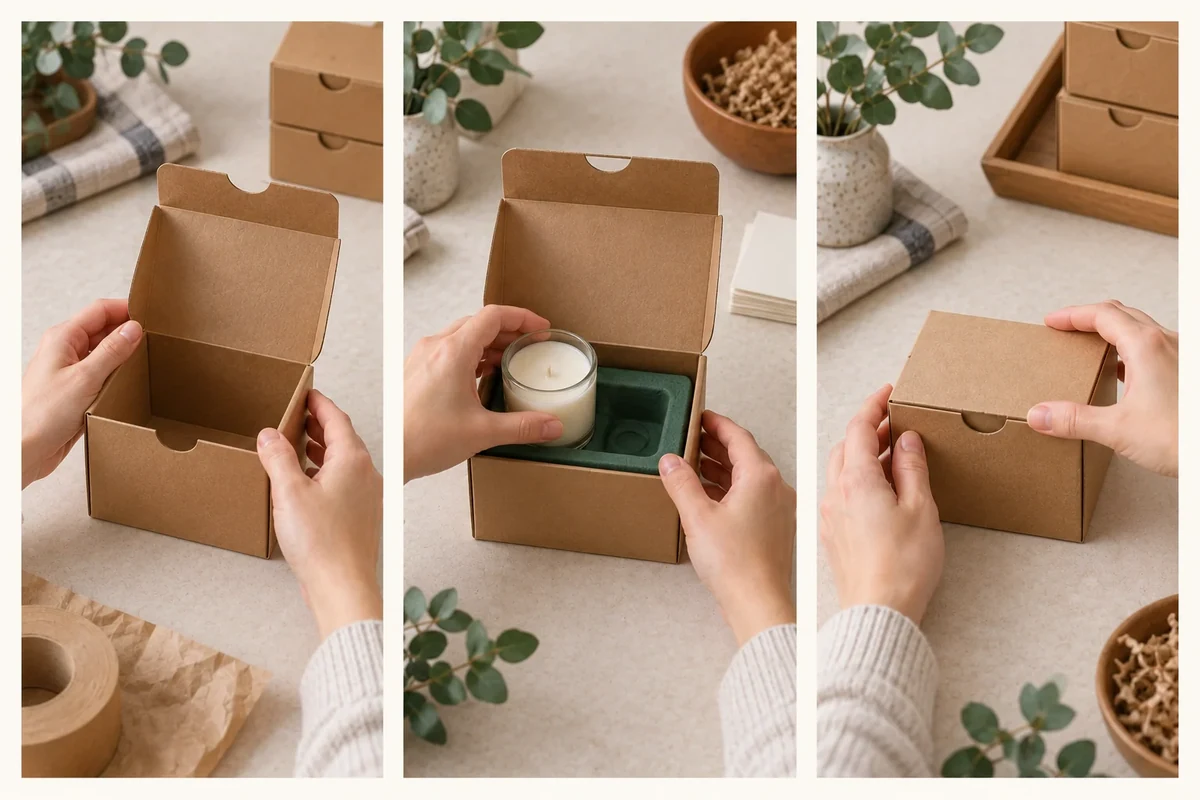
Record a packing trial with a defined start and stop, named contents and all relevant interruptions. Treat the result as an observation of that setup and operator under stated conditions. One timed demonstration does not establish a universal packing speed or a production commitment.
The useful output is a method note beside the observed interval. Without it, two durations may cover different work even when both are labelled packing time.
Define exactly what the clock covers
Choose the starting event and ending event in observable terms. For example, the interval can begin when the operator picks the empty carton and end when the loaded top is closed. Those are project definitions, not a standard timing method.
NIST’s measurement-process discussion explains that variability and scope matter, and notes limitations in characterizing one-time tests. Use that context to avoid presenting a local observation as a validated rate.
Name the complete product and components. Include who forms the box, loads the holder and applies any closing material. Use the supplied-state guide so the timed work corresponds to what the actual packing location receives.
Keep preparation and exceptions visible
Record where components are placed before the trial. A prepared bench and a trial including stock retrieval answer different questions. State which one is being observed.
Log pauses, missing parts, changed instructions and rework separately. Do not silently remove interruptions and call the remaining interval the full process. If another interval is calculated, label its definition and source.
| Timing-log field | Entry | Interpretation limit |
|---|---|---|
| Start event | Observable named action | What occurs beforehand |
| Stop event | Observable named final state | What remains afterwards |
| Configuration | Product, parts and instruction versions | Only this setup observed |
| Operator/bench | Role and component placement | No universal skill assumption |
| Exceptions | Pauses, errors or extra actions | Kept in actual history |
| Observed interval | Recorded start/stop and units | Local observation, not rate promise |
Preserve raw start and stop records where available. A later calculated summary should point back to them rather than replace the observation history.
Follow a hypothetical carton trial
Suppose a brand compares two carton proposals with the same gift set. One trial begins with a prepared side-seam carton, while another begins with a flat blank requiring additional forming. The buyer names those different starting states before comparing durations.
During one trial, a holder is fetched from another bench. That exception remains recorded. The team can decide whether retrieval belongs in the intended process, without erasing it from the original observation.
The local result may inform which operation to examine next. It doesn’t prove that a supplier, another operator or a larger run will achieve the same interval.
Ask a useful process question
Call the start event ST1 and stop event SP1. Ask: ‘Does the proposed packing scope include every action between ST1 and SP1 for configuration C1?’ It helps align the process before interpreting the observation.
If the instruction or component preparation changes, define the new interval clearly. A shorter duration covering less work is not evidence of a faster version of the original operation.
Any repeated study or production commitment needs an appropriate agreed method and responsible evidence. This log can supply the factual setup without claiming statistical confidence or promised units per hour.
Send the method beside the interval
Bring the start/stop definitions, full configuration and exception history through the packaging enquiry. The next response should clarify the operation and evidence scope before a local timing observation is used for planning.
A net interval cannot replace the full trial history
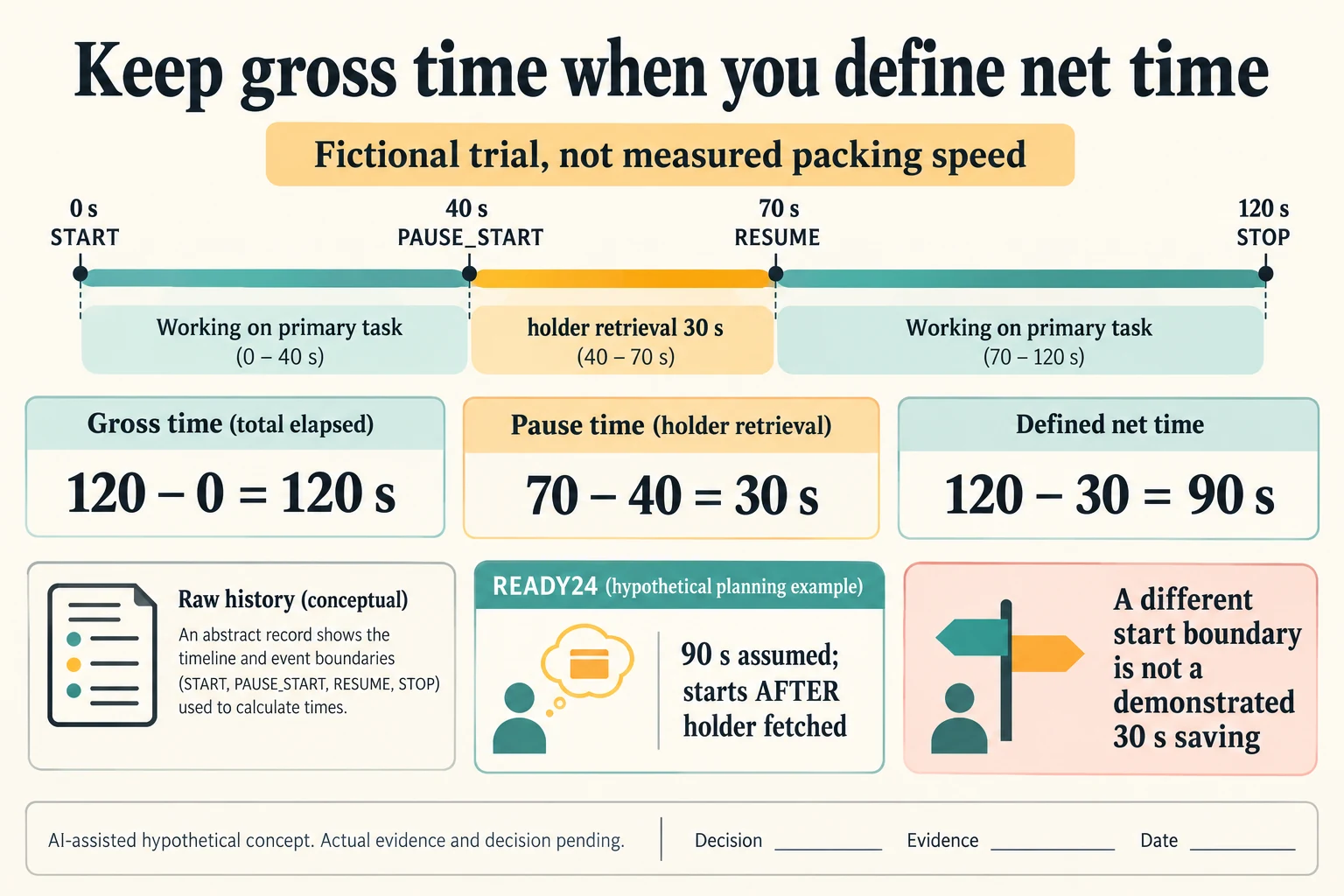
Create an explicitly fictional elapsed-time log, not a real bench trial. Start at 0 s, pause for holder retrieval at 40 s, resume at 70 s and stop at 120 s. The gross interval is 120 s. The assumed non-overlapping retrieval pause is 30 s, so a separately defined net interval excluding that pause is 90 s. Every event, subtraction and source reference appears in the CSV; actual timestamps, operator, observations and dates remain blank.
Scroll horizontally if columns extend beyond the view.
| Hypothetical configuration | Named object | Relationship | Input or next scope |
|---|---|---|---|
| TIMED24 | START | assumed event time | ELAPSED_REFERENCE; 0 s |
| TIMED24 | PAUSE_START | assumed event time | ELAPSED_REFERENCE; 40 s |
| TIMED24 | RESUME | assumed event time | ELAPSED_REFERENCE; 70 s |
| TIMED24 | STOP | assumed event time | ELAPSED_REFERENCE; 120 s |
| TIMED24 | GROSS | calculated from | STOP-START; 120 s |
| TIMED24 | PAUSE | calculated from | RESUME-PAUSE_START; 30 s |
| TIMED24 | DEFINED_NET | calculated from | GROSS-PAUSE; 90 s |
| READY24 | DURATION | assumed interval | DIFFERENT_START_STATE; 90 s |
| READY24 | INTERVAL | has scope | START_AFTER_HOLDER_ALREADY_FETCHED_TO_SAME_STOP |
The 90 s value cannot replace the 120 s gross history. It answers a narrower question because retrieval has been excluded. Keep the exception and the owner’s inclusion decision visible before using either definition for planning. The original example also distinguishes a prepared side-seam carton from a flat blank that requires forming. Calling both measurements ST1 does not align their work unless the observable starting state and included preparation are actually the same.
READY24 is a second invented 90 s interval that starts only after its holder has already been fetched and ends at the same named loaded/closed state. Equal 90 s numbers do not make it the same process as the first gross trial, and the difference from 120 s is not established as a 30 s improvement. Identify the prework instead of quietly treating its disappearance from the clock as faster packing.
NIST discusses measurement-process variability and limits in characterising one-time tests; it does not prescribe a packing-speed study. This small log supplies no statistical confidence, staffing capacity, units-per-hour promise or supplier commitment. Any repeated study needs a suitable agreed method with full configuration, component placement, operator, interruptions and start/stop scope retained.
Download the packing trial gross net interval record (.csv). It includes the original table fields and scenarios alongside the added relationships. HYPOTHETICAL rows are editorial examples or required review scopes, not actual records. Actual quantity, configuration, component and file identities, materials, process, specification, copy, method, condition, observation, owner, decision, evidence and dates are blank. ACTUAL_BLANK is a separate empty starting row; enter permitted project evidence before using an actual record. A blank means unknown.
Use the Define Flat and Assembled Packaging Delivery Scope for its separate question. Use the Agree Packaging Dimensions and Acceptance Methods for its separate question. Use the Packaging Sample Revisions: Compare Versions Before Approval for its separate question.
Source scope checked 16 October 2026. References cover only the named materials, processes or guidance. Added configurations and geometry are hypothetical, not supplier specifications, tests or production approval; they set no universal tolerances or machine limits. Confirm the actual material, process, drawing and formed sample for the project.
Discuss this packaging specification with Packrivo. We coordinate independent suppliers. MOQ: 500 pieces per product/design; illustrative quantities are not production offers. Confirm materials, samples, price and timing for your project.