
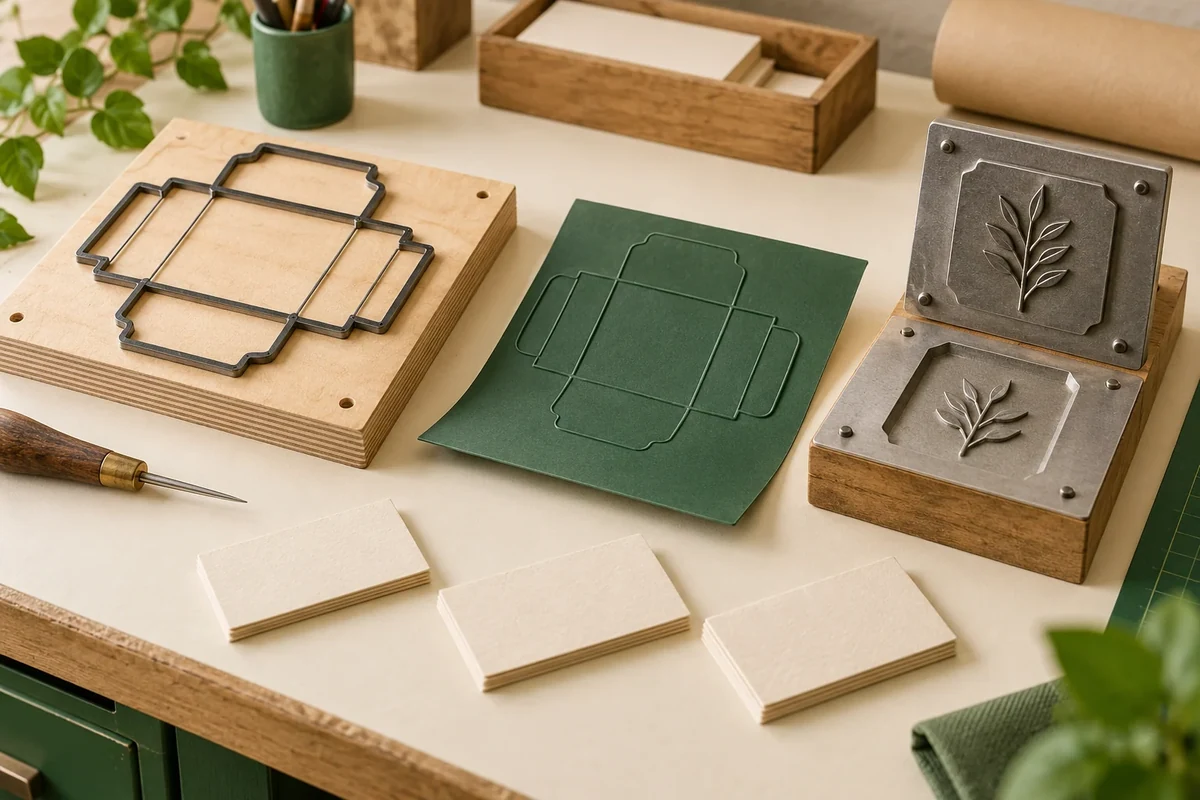
AI-assisted concept cover. Open the cover at full size.
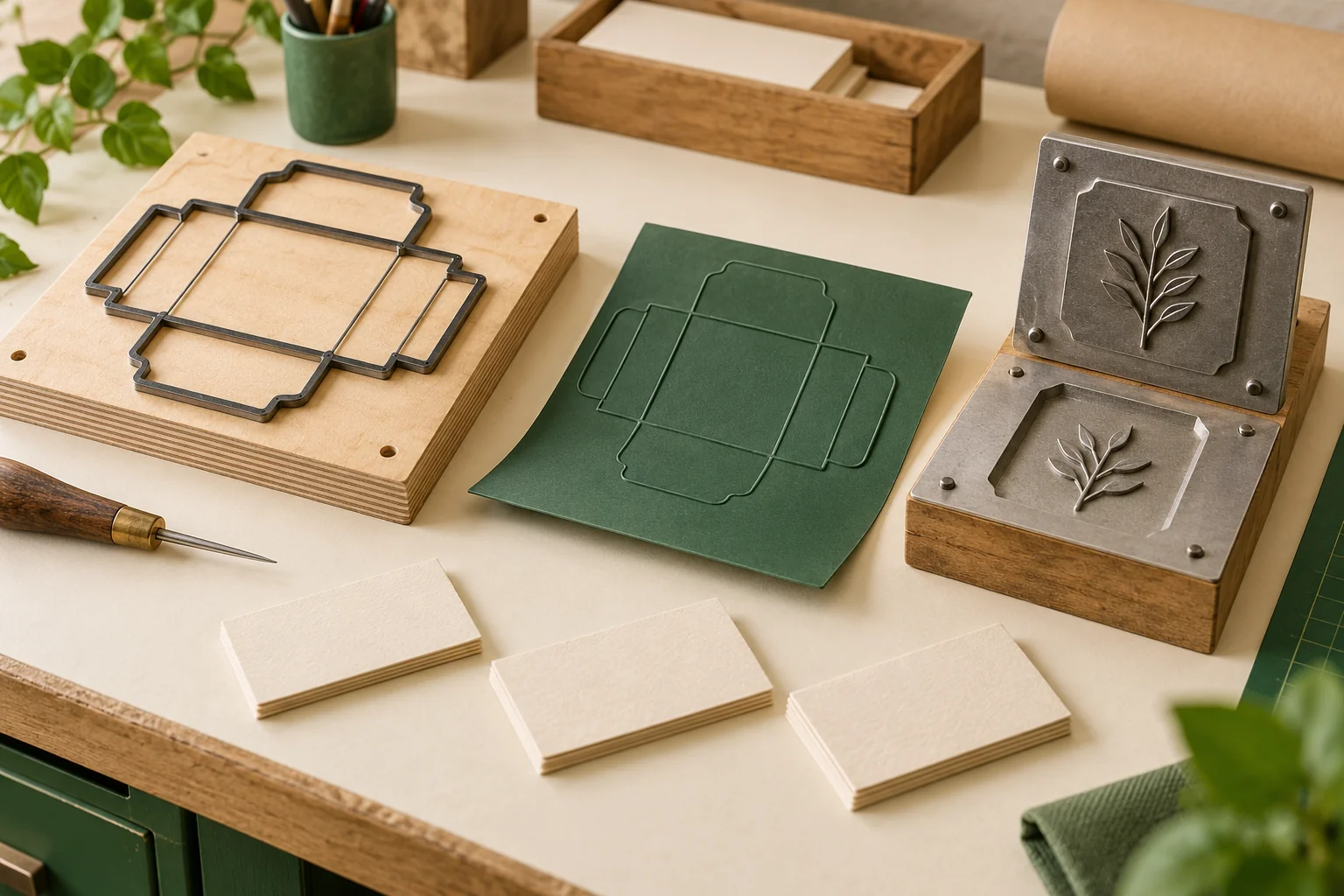
Give every packaging tooling line a tool identity, linked drawing or artwork revision and defined use scope. Keep setup, replacement, storage and ownership questions separate from the shipped component quantity. The buyer should request explicit supplier confirmation rather than assuming a tooling payment grants a particular right.
Identify which physical or process tool the line describes
The original Glenroy printer guidelines discuss plates and artwork relationships, including shared elements in a family of designs. This supports asking which artwork and jobs a plate proposal covers. It does not establish ownership or reuse terms.
The FSEA designer guide distinguishes die/counter and related decorating-tool identities. Keep an emboss tool separate from a cutting die or print plate rather than treating every one-time line as the same resource.
Record the tool type, supplier reference and drawing/artwork revision it serves. Ask which components or production lines use it. A phrase such as tooling charge needs that identity before its scope can be compared with another response.
Separate technical use from agreement questions
List the setup, replacement and change questions for the actual tool. Ask what happens if a structure dimension, artwork object or finishing layer changes. Keep the supplier’s written response with the revised drawing/tool relationship.
Give ownership, storage and later reuse their own confirmation fields. Record the actual agreed terms and responsible party when supplied. Avoid treating a quote-line name, payment or possession of an artwork file as proof of legal entitlement to a physical tool.
Keep the packaging component quantity in a separate field. A tool may relate to more than one component or version under an offered arrangement, but that relationship must be stated. Do not divide an unconfirmed tooling charge across an invented future order to imply a savings result.
Use a tooling-scope confirmation ledger
This original Packrivo table is a hypothetical component/tool relationship, not an actual quote.
| Tool or question | Illustrative record | Required confirmation |
|---|---|---|
| Cutting die D1 | Linked to carton drawing BX1_r02 | Supplier identifies which cut/crease scope is covered |
| Print plate P1 | Linked to artwork A1_r02 | Printer identifies shared versus changed elements |
| Emboss tool E1 | Die/counter proposal for object E1 | Finisher identifies tool and accepted board context |
| Replacement | Drawing or object change proposed | Scope and responsible party in written response |
| Ownership/storage | Open agreement fields | Actual terms confirmed by the relevant parties |
| Reuse | Later configuration or repeat-order question | Confirm scope before assuming transfer or reuse |
Compare an illustrative structure-change response
Imagine a box-height change affects the cutting drawing while the logo remains unchanged. Keep the cutting-tool and print-tool questions separate. Ask which existing tool remains usable under the actual supplier proposal and which line requires a new scope.
If the response says tooling is included, request the linked tool identities and changed fields. The buyer can compare a defined scope while leaving ownership or storage open for written confirmation. A broad commercial phrase should not erase those unanswered questions.
Handoff tool identity with the changed revision
The quote comparison method keeps unit and component scope visible. Use the dieline-change record for linked impacts and the artwork handoff guide for the accepted output.
The printer/converter/finisher identifies its own tool and technical use. The commercial parties confirm the actual ownership, replacement and reuse terms. The buyer retains the accepted relationship and any open agreement question. This is a planning record, not a legal determination.
Bring the tool ledger and unresolved revision/use questions through your packaging brief. MOQ is 500 pieces per design; actual tooling, samples and commercial terms are confirmed for the project.
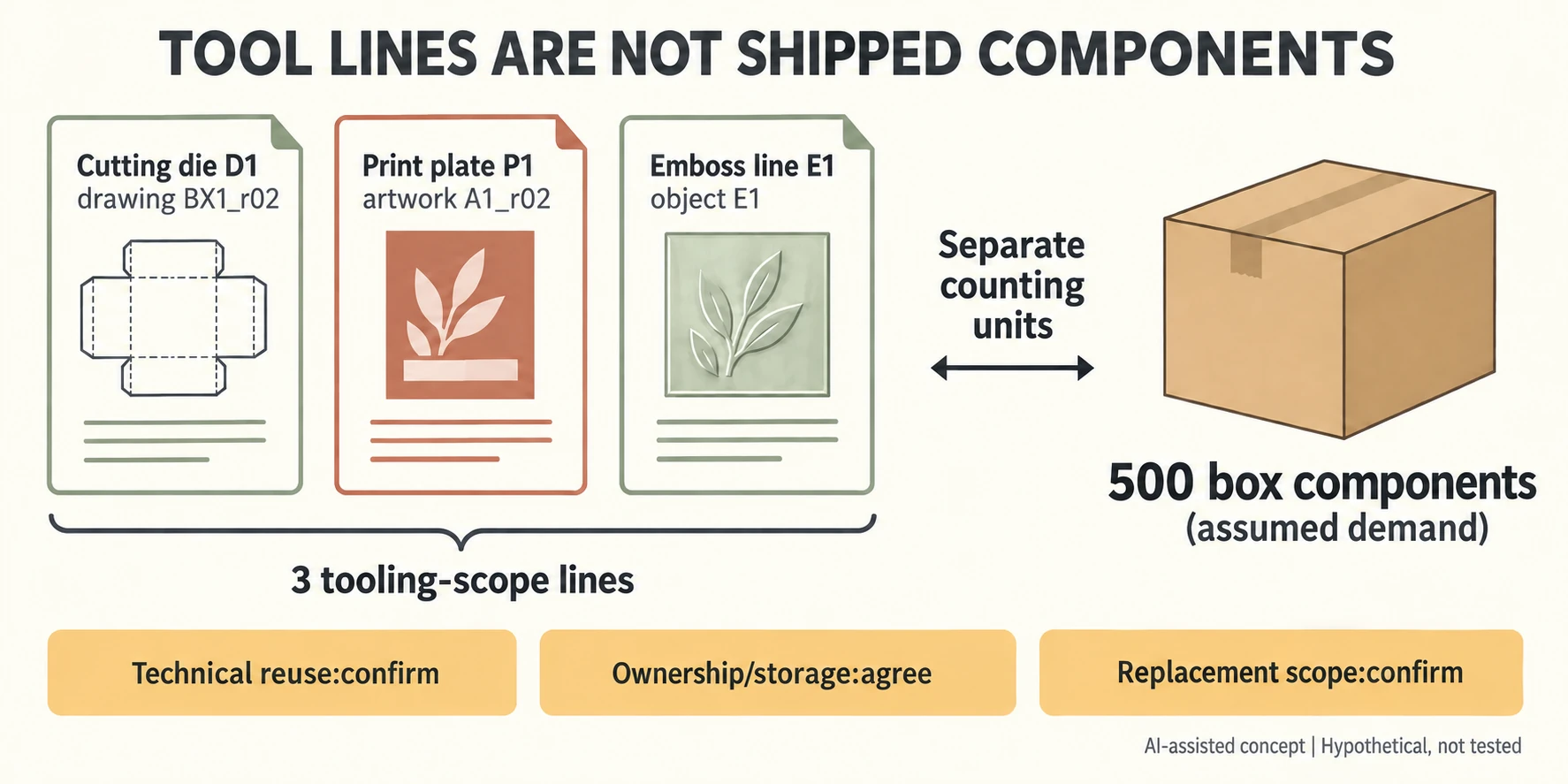
Count tooling-scope lines separately from component demand
An invented ledger has three tooling-scope lines D1/P1/E1 beside assumed demand for 500 box components. The line count is 3; the component demand is 500. Adding them would mix units. An emboss line can describe a die/counter arrangement, so three lines do not establish three physical tools.
Scroll horizontally if columns extend beyond the view.
| Record class | Identity/scope | Change question | Agreement state |
|---|---|---|---|
| Tooling line | D1 / BX1_r02 cutting drawing | Does revised height require another tool scope? | Unconfirmed |
| Tooling line | P1 / A1_r02 print artwork | Which elements remain technically usable? | Unconfirmed |
| Tooling line | E1 / emboss object | Which die/counter and material context? | Unconfirmed |
| Component demand | 500 box components | Actual quantity/design basis | Not a quotation |
| Rights/storage | Separate terms | Ownership, storage and later reuse | No agreed terms supplied |
Do not infer technical reuse from an unchanged logo or legal ownership from a tooling payment. The supplier must identify the actual tool/configuration relationship, while the commercial parties confirm their own agreement. This example contains no payment, fee allocation or entitlement determination.
If box height changes, retain the D1/BX1_r02 history and request the current cutting response. Ask separately whether P1 and E1 remain applicable rather than assigning all three the same reuse status. The CSV separates tooling lines from demand and leaves physical tool count, actual terms and response dates blank. No future-order saving or transfer right is created by the ledger.
Download the packaging tooling ownership and reuse record (.csv). HYPOTHETICAL rows are invented examples. Use ACTUAL_BLANK for permitted project inputs; replace that row label only when recording actual facts. Empty evidence, observation and date fields mean unknown or not performed, never acceptance. Keep checkpoints and revisions separate.
Send the tool identities, changed drawing/artwork relationships and separately stated component demand with actual agreement questions left open. Packrivo coordinates independent suppliers. These records establish no supplier offer, service availability or MOQ exception; its published baseline is 500 pieces per product/design.