
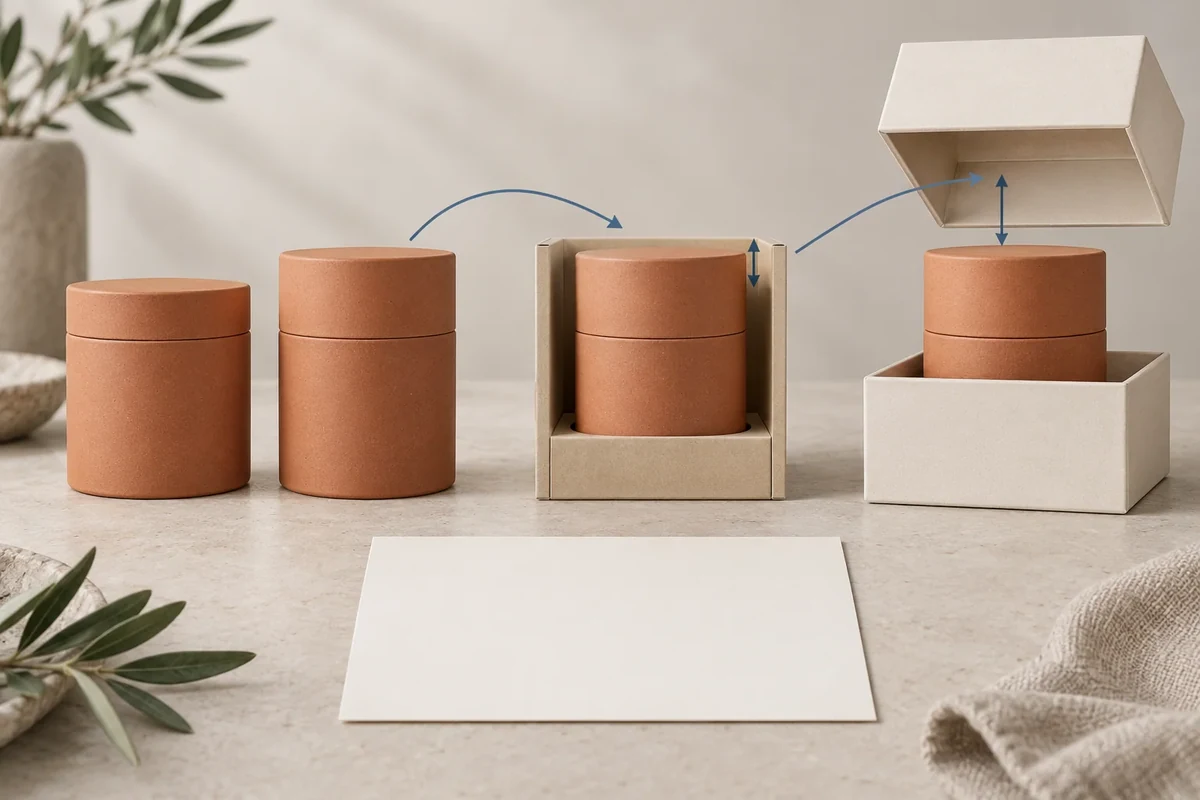
Map a changed product feature to the packaging interfaces that need review before reordering. Record the old and new feature, the affected holder, closure or outer-pack relationship and the evidence required. An unchanged box filename does not establish that the revised product remains the same packed system.
This tool starts from the product change. It helps the buyer identify review triggers instead of reopening every project field without knowing why.
Describe the actual changed feature
Name the product versions and the physical or use difference. Examples include a higher cap, changed clasp, added card or another actual feature. Preserve dimensions and weights with their sources where relevant.
ISTA’s procedure overview uses defined product/package combinations. That supports retaining system identity, not deciding the technical effect of every change from a public overview.
Keep the wider reorder record current. This map adds the link from one product change to the specific packaging relationship it may affect.
Trace the feature to each interface
Ask which holder contact, closing route, removal action or outer arrangement meets the changed feature. Mark those interfaces on the actual drawing. Keep a possible impact as a review question rather than a confirmed problem.
Identify the responsible owner for each question and the needed evidence. A structural sample, artwork proof and distribution evaluation can answer different jobs. Do not replace one with another merely because they share a product version.
| Trigger field | Entry | Review response |
|---|---|---|
| Product change | Old/new feature with source | Actual difference confirmed |
| Interface | Named holder/closure/access relationship | Possible impact to assess |
| Component | Affected packaging revision | Retained or proposed change |
| Evidence | Specific sample/method needed | Responsible review scope |
| Owner | Decision and source roles | Next action assigned |
| Release link | Current system identity | Required reviews retained |
If the response changes a drawing, connect it to the dieline impact record. The trigger map should retain why that drawing change was proposed.
Follow a hypothetical higher product cap
Suppose a gift product receives a higher cap while the box artwork remains unchanged. The buyer records the new complete envelope and maps the cap to the holder display height and lid-closing interface.
The source is asked to assess those relationships on the proposed pack. The map doesn’t immediately declare that the box is unsuitable, nor does it retain earlier fit approval without review.
If the product weight also changes, that becomes another field with its own affected system questions. An unchanged visual render cannot close it.
Use a feature-specific next question
Ask: ‘Please review changed cap feature CF2 against holder H1 and lid interface LI1.’ It gives the source an actual link. A generic request to confirm the old box fits can leave the changed feature overlooked.
After a responsible response, retain the accepted scope and evidence. If another feature is still unreviewed, keep it open rather than giving the revised product a blanket packaging approval.
The map is an original coordination tool. It doesn’t prescribe retesting rules or claim a test result; formal evaluation requirements must be determined for the actual system and use.
Send the changed feature and interfaces
Bring the product difference, affected component map and evidence questions through Packrivo’s enquiry. The next response should identify which previous decisions remain applicable and which specific reviews need reopening.
One higher cap can reopen two different interfaces
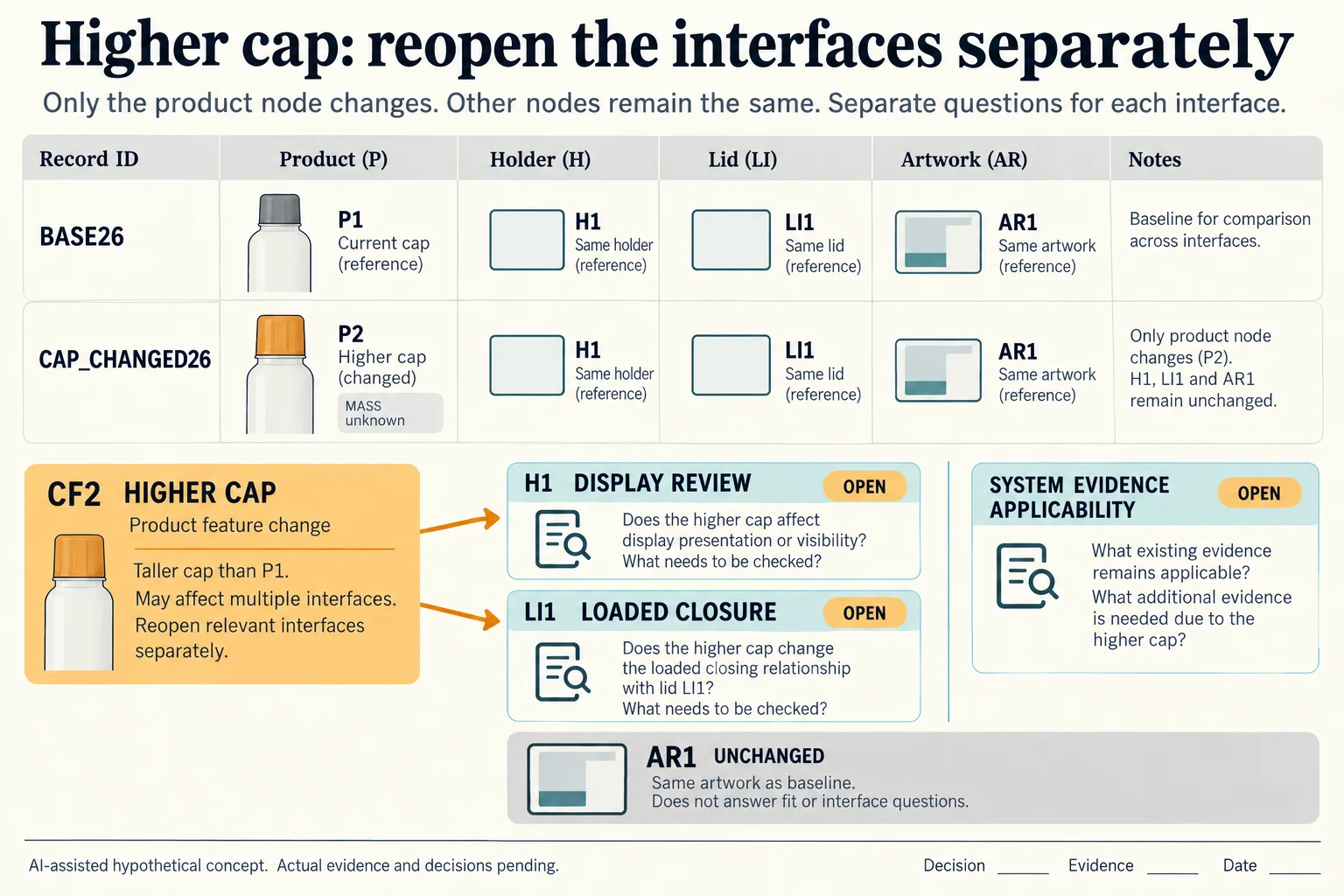
Compare invented BASE26 using P1, H1, LI1 and AR1 with CAP_CHANGED26 using P2 and the same holder, lid and artwork references. Assume only that P2 has the higher cap feature CF2. No dimensions, mass or clearance result is supplied. Holding the packaging identities fixed makes the reopened interfaces visible without pretending that the new product fits.
Scroll horizontally if columns extend beyond the view.
| Hypothetical configuration | Named object | Relationship | Input or next scope |
|---|---|---|---|
| BASE26 | BASE26 | uses product | P1 |
| BASE26 | BASE26 | uses holder | H1 |
| BASE26 | BASE26 | uses lid | LI1 |
| BASE26 | BASE26 | uses artwork | AR1 |
| CAP_CHANGED26 | CAP_CHANGED26 | uses product | P2 |
| CAP_CHANGED26 | CAP_CHANGED26 | uses holder | H1 |
| CAP_CHANGED26 | CAP_CHANGED26 | uses lid | LI1 |
| CAP_CHANGED26 | CAP_CHANGED26 | uses artwork | AR1 |
| CAP_CHANGED26 | P2 | assumed changed feature | HIGHER_CAP_CF2 |
| CAP_CHANGED26 | P2 | reopens | H1_DISPLAY |
| CAP_CHANGED26 | P2 | reopens | LI1_LOADED_CLOSURE |
| CAP_CHANGED26 | P2_MASS | requires | ACTUAL_MASS_AND_CHANGE_STATUS |
| CAP_CHANGED26 | AR1_UNCHANGED | does not close | H1_OR_LI1_REVIEW |
The higher cap reopens H1’s displayed-product relationship and LI1’s loaded closing relationship as separate questions. An unchanged artwork file supplies no answer to either. It may remain a documented visual reference while the changed physical contents require their own evidence. The complete packed envelope includes actual primary packaging and accessories where present; this example does not invent an added card or changed clasp.
Keep mass and change status unknown until measured or otherwise confirmed through the project’s appropriate source. A higher cap does not establish a weight increase, handling performance or a particular retest. Changes to materials, components, closures or distribution scope can affect earlier system evidence, but the responsible procedure and owner determine what fresh evaluation is required.
Use the height-stack guide for a stated geometry model when actual dimensions are available. This dependency map serves a different decision: which reviews must be reopened because the product reference changed? Preserve the old P1 decisions under their original configuration, ask the two interface-specific questions for P2 and leave every actual observation and release decision empty until supported.
Download the changed product packaging review dependencies record (.csv). It includes the original table fields and scenarios alongside the added relationships. HYPOTHETICAL rows are editorial examples or required review scopes, not actual records. Actual quantity, configuration, component and file identities, materials, process, specification, copy, method, condition, observation, owner, decision, evidence and dates are blank. ACTUAL_BLANK is a separate empty starting row; enter permitted project evidence before using an actual record. A blank means unknown.
Use the Set Product Display Height Before Confirming the Neck for its separate question. Use the Link Component Approvals Before Releasing the Whole Set for its separate question. Use the Packaging Reorder Checklist: Control the Version First for its separate question.
Source scope checked 16 October 2026. References cover only the named materials, processes or guidance. Added configurations and geometry are hypothetical, not supplier specifications, tests or production approval; they set no universal tolerances or machine limits. Confirm the actual material, process, drawing and formed sample for the project.
Discuss this packaging specification with Packrivo. We coordinate independent suppliers. MOQ: 500 pieces per product/design; illustrative quantities are not production offers. Confirm materials, samples, price and timing for your project.