
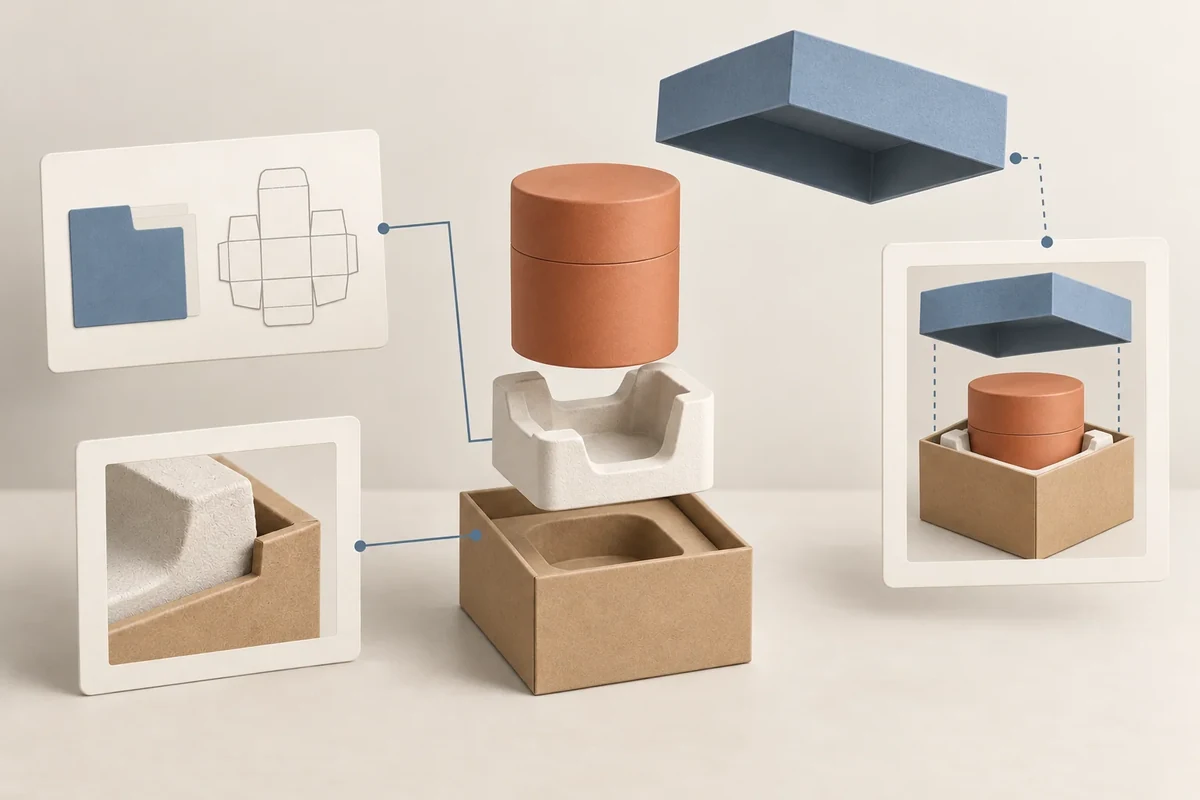
Link component approvals through the actual interfaces of the complete set before treating it as ready. Record the box, holder, lid and artwork identities, then identify which paired relationships have evidence and which remain open. Individually accepted parts can still leave their assembled configuration unreviewed.
This graph is a component decision record. It is different from a project timeline and does not create production authorization merely because its nodes have familiar names.
Name nodes as actual components or files
Give each component and artwork file a current identity. Record the accepted scope on each node, with its evidence link. A holder accepted for one box is not automatically accepted for another cavity.
Adobe’s packaging workflow description notes that finishing elements align with printed graphics. That supports one print relationship, while the physical box/holder links below are an original project method, not an Adobe structural standard.
Use the approval milestones guide for timing and sequencing. This graph focuses on which specific components depend on one another at the assembled interface.
Draw links as reviewable relationships
Connect the holder to the box through installed fit and loading. Connect the lid to the full contents through closing and opening. Connect artwork to the current drawing through panel placement and finish instructions.
Record evidence for each link independently of the component node. A material swatch can support a surface decision without showing holder-to-box fit. A digital proof can show layout without showing physical lid clearance.
| Dependency record | Current identities | Accepted scope/evidence | Open link |
|---|---|---|---|
| Holder to box | Actual holder and cavity revisions | Installed-fit record | Unreviewed pair retained |
| Lid to contents | Lid, holder and product set | Loaded closing/opening record | Changed highest point |
| Artwork to drawing | File and structural revision | Panel placement decision | New fold or cut relationship |
| Finish to print | Actual finish/file scope | Relevant proof/sample | Alignment or surface gap |
| Whole set | Named assembled configuration | Required linked decisions | Responsible release remains explicit |
Use the sample approval guide for the underlying evidence. A graph summary should point to those decisions rather than replace them with a decorative green status.
Follow a hypothetical holder change
Suppose a brand accepts a box artwork and a holder sample separately. The holder is then revised to raise the product. The graph records the new holder identity and reopens the lid-to-contents link.
The box artwork’s accepted placement can remain documented under its scope, while the loaded closure is still open. The set should not be called ready merely because two earlier nodes were accepted.
If the changed holder also shifts a visible product view, another link may need review. The graph makes that relationship explicit instead of reopening every unrelated decision or ignoring the change.
Use an interface-specific next question
Ask: ‘Please review lid L1 against holder H2 and product P1 in the assembled set.’ It names the actual dependency. A statement that L1 and H2 are each approved separately leaves the pair unresolved.
Keep completed nodes, provisional links and final release in different fields. The responsible owner decides which evidence the actual set requires and records that decision.
This original graph coordinates component identities. It does not certify a set, prove performance or replace required technical and commercial authorization.
Send the unresolved links
Bring the component identities, paired interfaces and evidence references through Packrivo’s enquiry. The next response should resolve the actual assembled relationship before the whole configuration is described as ready.
A holder-to-box decision does not close the loaded-lid relationship
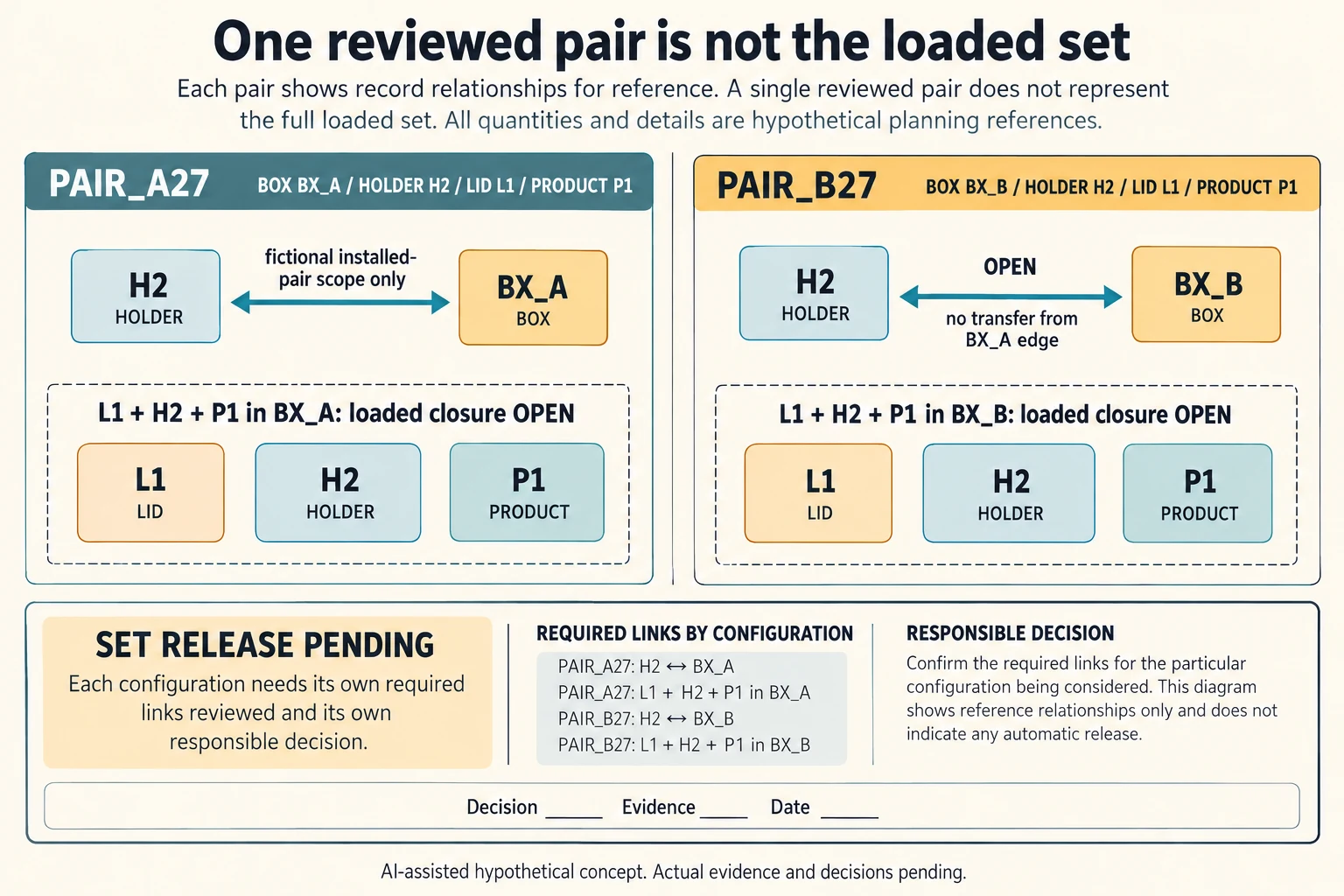
A graph edge needs the identities on both sides. In a separate invented extension, PAIR_A27 uses box BX_A and PAIR_B27 uses BX_B; both retain holder H2, lid L1 and product P1. BX_A and BX_B are box references, H2 is a holder, L1 is a lid and P1 is the complete product reference. None represents an actual measured sample or a selected supplier construction.
Scroll horizontally if columns extend beyond the view.
| Hypothetical configuration | Named object | Relationship | Input or next scope |
|---|---|---|---|
| PAIR_A27 | PAIR_A27 | uses box | BX_A |
| PAIR_A27 | PAIR_A27 | uses holder | H2 |
| PAIR_A27 | PAIR_A27 | uses lid | L1 |
| PAIR_A27 | PAIR_A27 | uses product | P1 |
| PAIR_A27 | PAIR_A27 | requires link review | H2_WITH_BX_A |
| PAIR_A27 | PAIR_A27 | requires link review | L1_WITH_H2_P1_IN_BX_A |
| PAIR_B27 | PAIR_B27 | uses box | BX_B |
| PAIR_B27 | PAIR_B27 | uses holder | H2 |
| PAIR_B27 | PAIR_B27 | uses lid | L1 |
| PAIR_B27 | PAIR_B27 | uses product | P1 |
| PAIR_B27 | PAIR_B27 | requires link review | H2_WITH_BX_B |
| PAIR_B27 | PAIR_B27 | requires link review | L1_WITH_H2_P1_IN_BX_B |
| PAIR_A27 | EDGE_H2_BX_A | assumed review scope | INSTALLED_PAIR_ONLY |
| PAIR_B27 | EDGE_H2_BX_B | does not inherit | EDGE_H2_BX_A |
| PAIR_A27 | EDGE_H2_BX_A | does not close | L1_H2_P1_LOADED_CLOSURE |
| ALL27 | SET_RELEASE | requires | REQUIRED_LINKS_AND_RESPONSIBLE_DECISION |
Assume for teaching that an installed holder-to-box review exists for H2 with BX_A only. That fictional edge scope does not cover H2 with BX_B. It also does not establish how L1 closes over H2 and P1 inside BX_A. The CSV therefore keeps each holder/box pair and each loaded-lid relationship as separate requests instead of attaching one accepted node label to every combination.
The original raised-holder example remains an independent trigger: a revised holder can reopen closure and, if the visible product view changes, a display link. Preserve earlier artwork-placement evidence within its stated scope. A physical fit question cannot be closed by a digital proof, and a surface swatch cannot establish installed holder fit. Those distinctions belong on the edges, beside the evidence they actually describe.
Whole-set release still needs its required linked decisions and a responsible authorization. This graph serves a different purpose from the milestone plan, which assigns input dependencies and timing, and from an approval label, which indexes a particular decision. Do not total familiar node labels as if they were a complete assembled-state decision. Actual reviewed configuration, observations and release evidence stay blank here.
Download the component approval edge and set mapping record (.csv). It includes the original table fields and scenarios alongside the added relationships. HYPOTHETICAL rows are editorial examples or required review scopes, not actual records. Actual quantity, configuration, component and file identities, materials, process, specification, copy, method, condition, observation, owner, decision, evidence and dates are blank. ACTUAL_BLANK is a separate empty starting row; enter permitted project evidence before using an actual record. A blank means unknown.
Use the Packaging Approval Milestones Start With Dependencies for its separate question. Use the Custom Packaging Sample: Approval Checks That Matter for its separate question. Use the Write an Approval Label That Names the Accepted Scope for its separate question.
Editorial scope reviewed 17 October 2026: the component worksheet and related Packrivo method links distinguish a named pair from the complete loaded configuration. The added relationships are hypothetical review scopes, not manufacturer test results or geometric calculations. Evidence for H2 with BX_A does not transfer to BX_B or establish loaded closure for L1/H2/P1. Actual component versions, fit observations and decisions remain unknown.
Discuss this packaging specification with Packrivo. We coordinate independent suppliers. MOQ: 500 pieces per product/design; illustrative quantities are not production offers. Confirm materials, samples, price and timing for your project.