
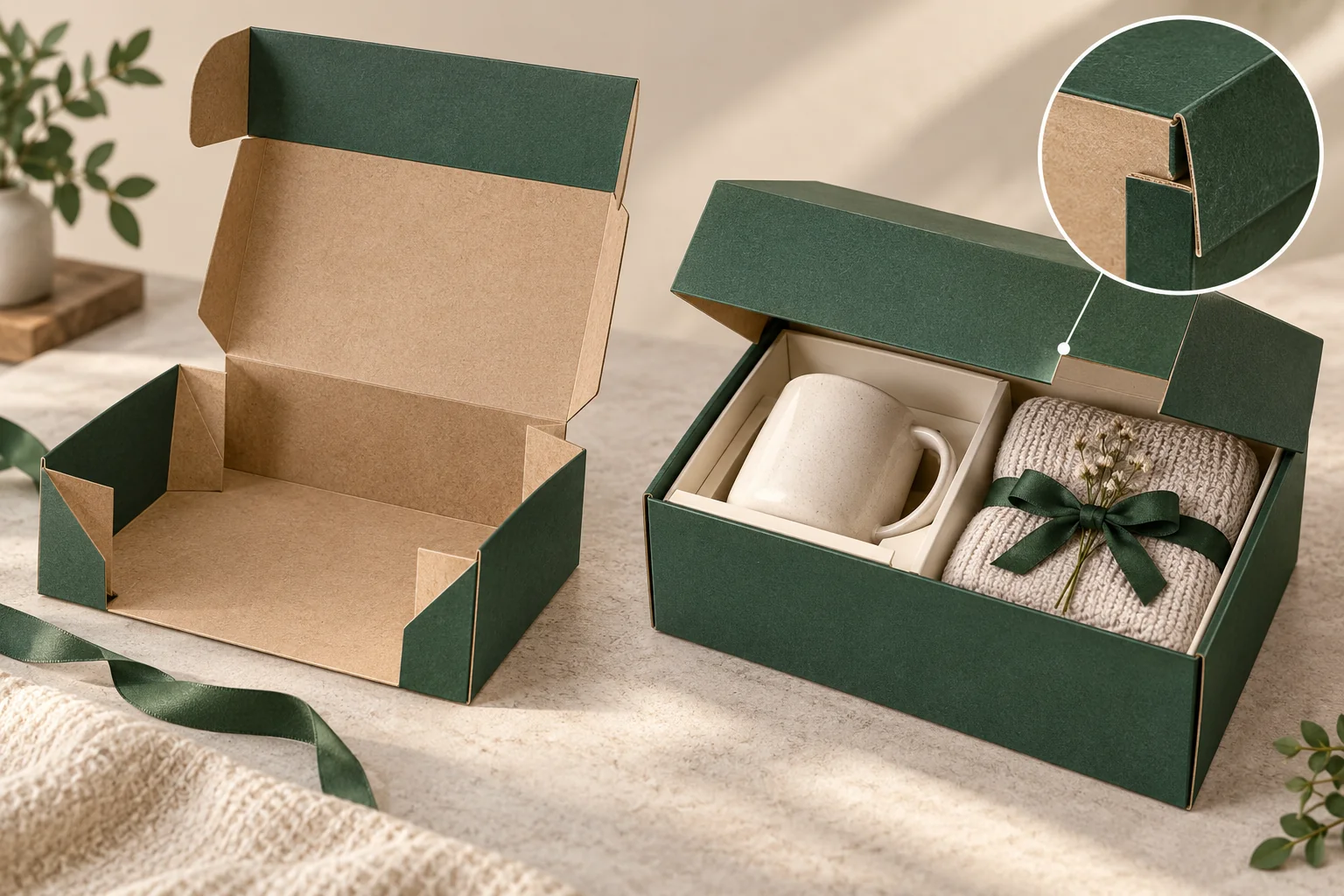
This option focuses on a collapsible base with a hinged lid and four prepared corners. It should be compared through setup and closure actions. The number of corners doesn’t establish a performance ranking.
Identify prepared corners and the lid fold
The four corner box reference describes a collapsible hinged-lid structure with four pre-glued corners. Request the supplier’s proposal to identify those joints and the lid’s actual edge details.
Keep the base joints separate from the lid hinge on the drawing. Mark the position the base should reach after forming. Ask whether any lid-side detail requires a manual tuck or other action beyond lifting the base walls.
A six corner pre glued carton adds another prepared-corner configuration to compare. Make that comparison with supplied and formed views, not an assumption that one style is automatically stronger.
Form the empty base before checking the product
Start with the sample in the agreed delivered state. Follow the proposed forming instruction and photograph each base corner afterwards. Note any corner that remains partly folded or needs a separate movement.
For a hypothetical small gift set, form the tray first, then place a card holder and accessory inside. This sequence helps show whether the holder interferes with a corner or whether the corner itself was incomplete before loading.
Raise and lower the attached lid while the base remains empty. Then repeat with the complete contents. Record the difference if the lid changes position when a product, tissue fold or card is added.
Keep a base-and-lid comparison record
Use one sample revision for all rows. Include photographs from the supplied and final loaded states.
| Part | Empty-state check | Loaded-state check |
|---|---|---|
| Four base joints | Each reaches its intended formed position | Holder or product leaves that position unchanged |
| Lid hinge | Movement and resting position | Clearance above the complete contents |
| Lid edges | Proposed closing action | Contact with walls, card or wrap |
| Customer access | Starting grip location | Product removal after lid opens |
If a lid edge catches, name the contacting part and the stage. A request to add depth may solve a product-height issue but won’t necessarily resolve a base corner formed incorrectly.
Agree the material and packing handoff
State the board grade, caliper, print surfaces and prepared joints proposed for the final sample. If those details remain open, leave them as explicit questions. A material substituted for an early mock-up should be named in its record.
The delivery-state guide helps define who forms the carton and adds the contents. Keep separate components visible in that scope rather than treating the folded box as a complete gift set.
Review corner formation, closure and removal as observations. Agree any weight, handling or distribution requirement separately; a clean lid fit doesn’t demonstrate protection. Final outside dimensions should be checked in the loaded closed state if that is the specified reference condition.
Keep lid-edge formation in the setup instruction if the supplier proposal includes it. The phrase ‘four prepared corners’ should not conceal a separate lid action. A reviewer should be able to identify the finished base and the ready-to-close lid as two checkpoints, even when both belong to the same continuous blank.
Submit the joint and lid record
Send the marked drawing, supplied-state request, complete contents, quantity and destination through Get a Quote. The minimum is 500 pieces per design. Construction, sample work and commercial terms need project confirmation.