
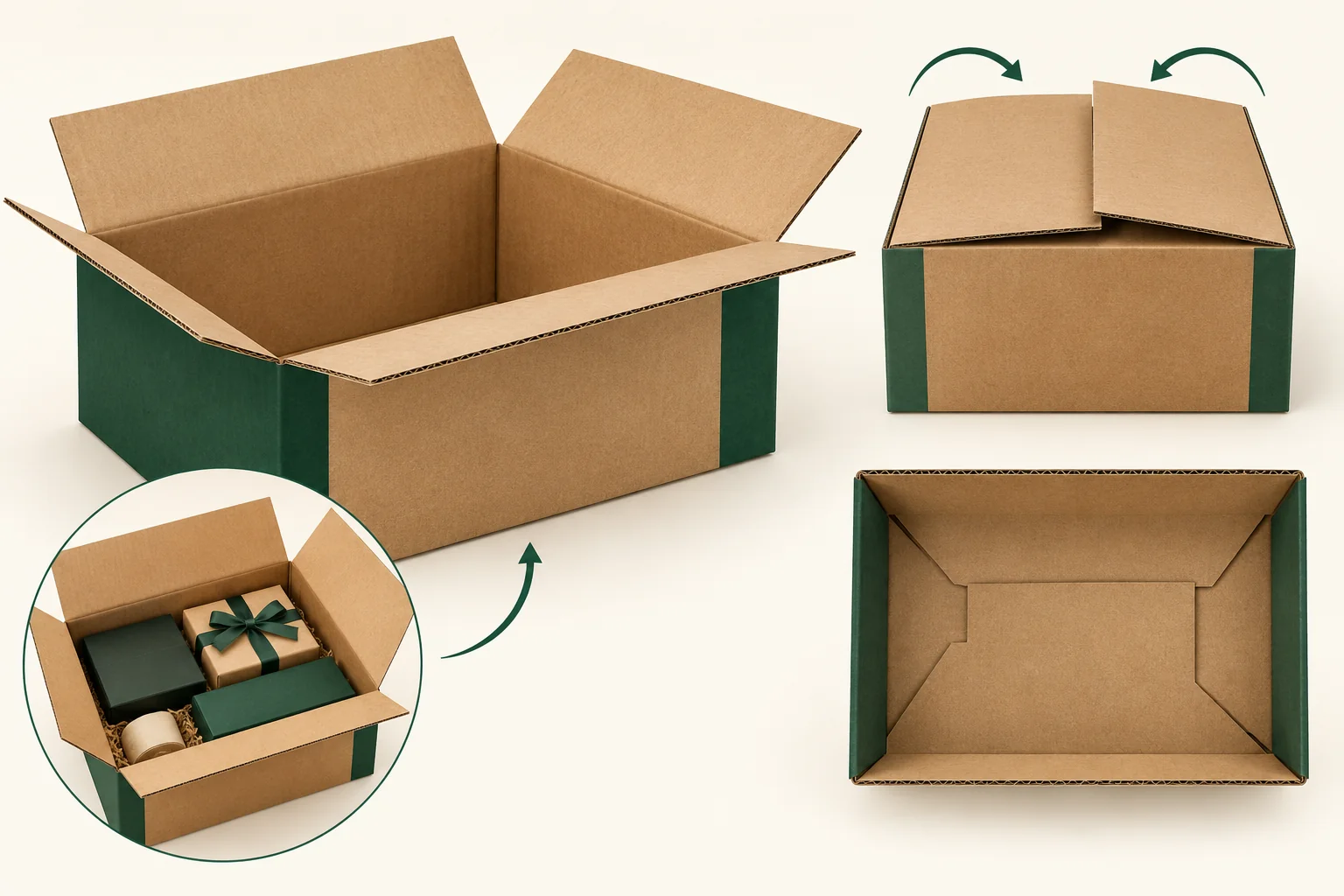
This option concerns flap geometry in a corrugated outer pack. Keep the complete contents and handling route in the brief. The extra layers at an end do not by themselves verify performance for your product.
Read the actual coverage drawing
Packaging Corporation of America’s basic box styles reference describes long flaps that largely overlap in a full overlap slotted container. Its catalog dimensions and performance statements are not universal specifications for your carton.
Request top and bottom views with the outer-flap closing order marked. Show which flap finishes outside and where the sealing surface lies. Request the overlap dimensions on both the inside and outside views of the proposed carton.
Compare a snap bottom slotted outer carton when manual interlocking base setup is an option. Here, focus on overlap coverage and the associated sealing operation, not a strength comparison based on names.
Match the seal to the packing operation
State who forms the bottom, loads the contents and seals the top. Describe the available sealing method and equipment. If these are unknown, leave them as open process questions before comparing proposals.
A hypothetical outer carton of gift sets might be filled at a small packing bench. Staff need an instruction that shows the bottom flap order before loading and the top order afterwards. Reversing the outer-flap order can also change the visible seam and label placement.
Provide the full packed weight and arrangement, including any dividers or void fill. Keep shipping labels and other printed information outside the unresolved sealing area until the operation is agreed.
Use a top-and-bottom map
Record the actual proposal revision. A photograph of one closed end should not be treated as evidence for the other.
| Location | Coverage input | Sealing operation and responsible party |
|---|---|---|
| Bottom inner flaps | Final folded positions | Order before outer flaps |
| Bottom outer flaps | Overlap shown on end view | Final outside flap and seal path |
| Top outer flaps | Overlap with full contents loaded | Closing order and sealing method |
| Receiving opening | Seam and tool-access area if relevant | Opening route clear of products |
The record gives a reviewer somewhere to put an observation such as ‘top overlap changed after loading’. That is more useful than asking for a stronger version without identifying the changed geometry.
Review supplied state and complete-pack evidence
Confirm the delivered form and side-seam preparation. Include the proposed corrugated construction and dimension reference condition. Inspect both ends after the loaded sample is closed using the agreed method.
Open the carton along the intended receiving route and check the contents before rearranging them. If a cutting tool is part of the operation, its safe route needs a responsible instruction suited to the actual pack.
Use the outer packaging collection for broader format options. Request a separate evaluation proposal for the intended distribution conditions. The overlap map is a configuration review, not proof of cushioning, stacking strength or transit protection.
If the carton carries an outside orientation instruction, review it against the actual final flap and seam position. A packing team may turn the carton during bottom formation and leave it in another orientation for loading. The end map should restore the intended top, front and receiving route before labels or artwork are treated as fixed.
Send both ends with the brief
Use Get a Quote to send end drawings, sealing responsibility, packed contents and weight, quantity and destination. The minimum is 500 pieces per design. Final construction, sample scope, pricing and timing require project confirmation.