
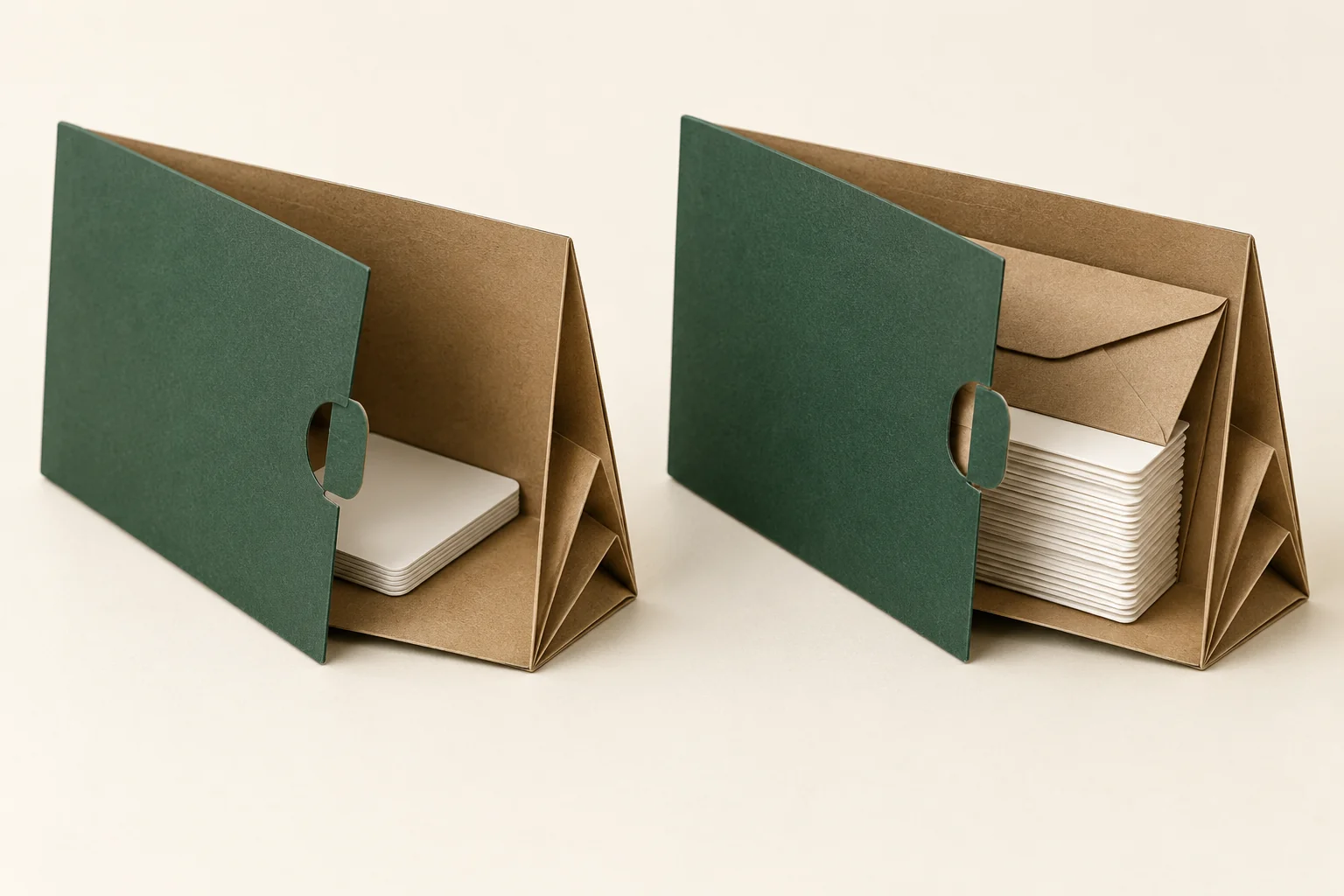
Use this option for a flat product or document-style bundle whose thickness is part of the purchase brief. Confirm the actual folder construction, lock and delivered form on the supplier proposal. It isn’t a general claim that one size will fit every bundle.
Describe the contents as a stack
PakFactory’s gusset folder reference identifies expanding sides for flat contents. Use that relationship to describe the side-fold job. The expansion you can accept for your own pack requires a drawing and loaded sample.
Measure the entire stack in its packed condition, including backing board, wrap and any raised component. Record the stack’s largest thickness and where that point occurs. A folded booklet and a flat card with a small attached item don’t create the same envelope.
For a hypothetical gift stationery set, the basic bundle might contain a few cards, while the larger bundle adds envelopes and a care sheet. Those are two named configurations, not two estimates of the same product.
Review the side folds at each thickness
Load the thinner bundle first and place the folder in the intended closed orientation. Observe the gussets from the side. Note loose areas, panel bowing or contents that sit at a different depth than the drawing suggests.
Use a fresh comparison sample for the thicker bundle if repeated folding has changed the first. Inspect the same locations, then open the lock and remove the contents. Include the customer’s likely grip rather than lifting the stack out through an unplanned gap.
Compare other folding formats if the product needs a fixed-depth cavity instead. This option’s core decision is how a defined thickness range meets side-fold geometry and the lock.
Keep a two-configuration comparison
Write actual measurements in the blank parts of your own record. The table identifies the fields; it doesn’t provide universal allowances.
| Record | Thinner bundle | Thicker bundle |
|---|---|---|
| Contents | List each included piece | List additions and changed parts |
| Thickness | Measure packed high point | Measure packed high point |
| Gusset position | Photograph both side folds | Repeat the same views |
| Lock and access | Record closure and removal action | Record contact or obstruction |
A thicker pack may need a different structure rather than more force at the lock. Send the observation to the supplier with the drawing revision and ask which part needs changing.
Confirm preparation and material together
Ask how the folder arrives and whether the side folds or joining areas are already prepared. State who forms it, inserts the stack and closes the lock. A packing instruction should show the side folds before the cover is pushed down.
Review the proposed board and caliper against the actual fold pattern. If artwork spans a gusset, view it loaded at both thicknesses before confirming its position. A flat print proof alone can’t show which part of that artwork becomes hidden in a fold.
Keep the sample checks on fit, formation, opening and presentation. Don’t treat them as measured protection or durability. Any handling evaluation should name the conditions, contents and agreed acceptance rule separately.
A bundle with one local raised part needs a side sketch as well as its maximum thickness. Show whether that part sits beside a gusset or under the cover. Two stacks with the same maximum thickness can place their high points differently. Keep that position fixed in the thin-and-thick comparison instead of treating one number as the complete contents description.
Send the thickness range, not a vague size
Use Get a Quote to send both contents lists, measured stacks, gusset observations, quantity and destination. The minimum is 500 pieces per design. The proposed folder, material, lock, samples and commercial terms are confirmed against that brief.