
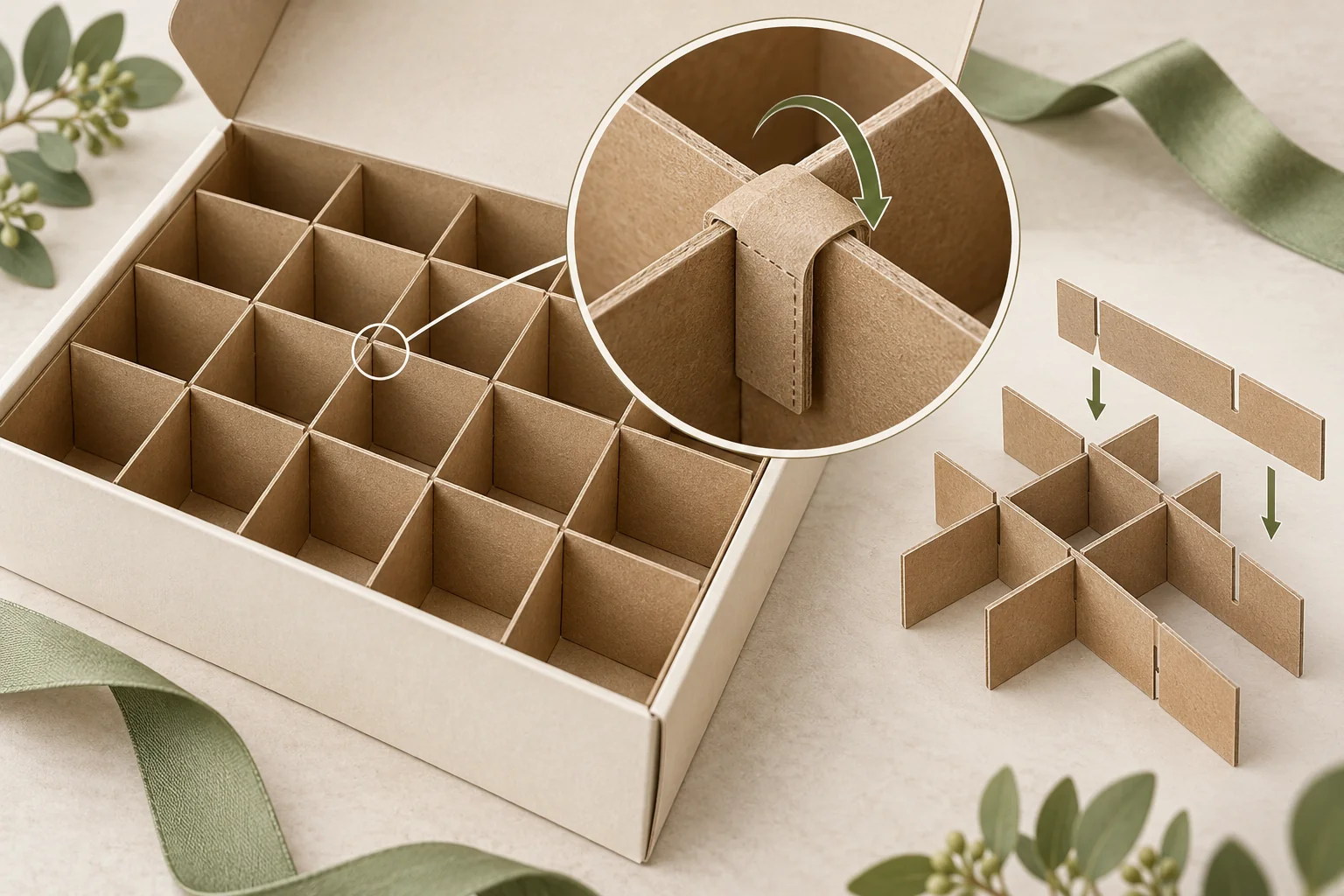
This packaging concept uses an offered fiber-board construction and joint drawing; the final grade and assembly are confirmed for the project.
Locate the joint that makes the cell fixed
Sonoco’s partition construction reference describes fold-over glue wall strips with opposite strips perforated, folded and glued. Use that description to ask for the offered strip and joint map. It supports a construction choice; it does not establish the performance of your particular gift set.
Label the long and short strips, their intersections and the folded attachment faces. Request a drawing showing where glue preparation occurs and whether the delivered partition is flat, collapsed, assembled or attached to the box. Keep that delivery description attached to the same revision as the cell layout.
Supply each item’s finished envelope and the intended contact restrictions. A jar with a projecting lid, a jewelry card and a separate accessory may need different usable spaces even when their outside rectangles appear similar. Identify which items are lifted independently and which should remain together.
Compare fixed joints with a loose grid
The paperboard grid divider creates a separate slot/intersection task. Compare its assembly and removal route with the proposed fold-over glued joint. Keep the item arrangement constant so the comparison explains who prepares the partition and what remains in place during packing.
The existing corrugated divider option is another compartment approach. Record the supplied state and box relationship rather than treating board names as proof that one partition is suitable.
Review the offered partition empty, fully loaded and partly empty after an item is removed. Inspect the actual joint and box seating in each state. If a crossing strip moves with the product, locate the movement before asking for a change. Record that observation without assuming a universal retention result.
Use a joint and cell-access record
These hypothetical gift-set entries are an original planning table. Cell identities should follow the offered drawing.
| Layout feature | Example input | Next confirmation |
|---|---|---|
| Joint J1 | Fold-over face joining strips L1/S1 | Prepared joint and glue drawing |
| Cell C1 | Finished candle box including its lid | Loaded clearance and contact view |
| Cell C2 | Jewelry card lifted independently | Removal access beside C1 |
| Box seating | Partition orientation in outer box BX1 | Assembled fit and insertion order |
| Partly empty state | C2 removed while C1 remains | Located joint/strip observation |
Keep assembly responsibility with the layout
The converter should return strip identities, preparation details and the delivered configuration. The packing owner should confirm how the partition is inserted and whether any joint action occurs locally. The buyer then chooses the cell arrangement or requests another sample using the same contents and box revision.
Use the insert material guide to keep grade questions separate from the joint configuration. Bring the cell map, actual item envelopes and open assembly question to Get a Quote. MOQ is 500 pieces per design; final materials, samples and commercial conditions are confirmed against the project.