
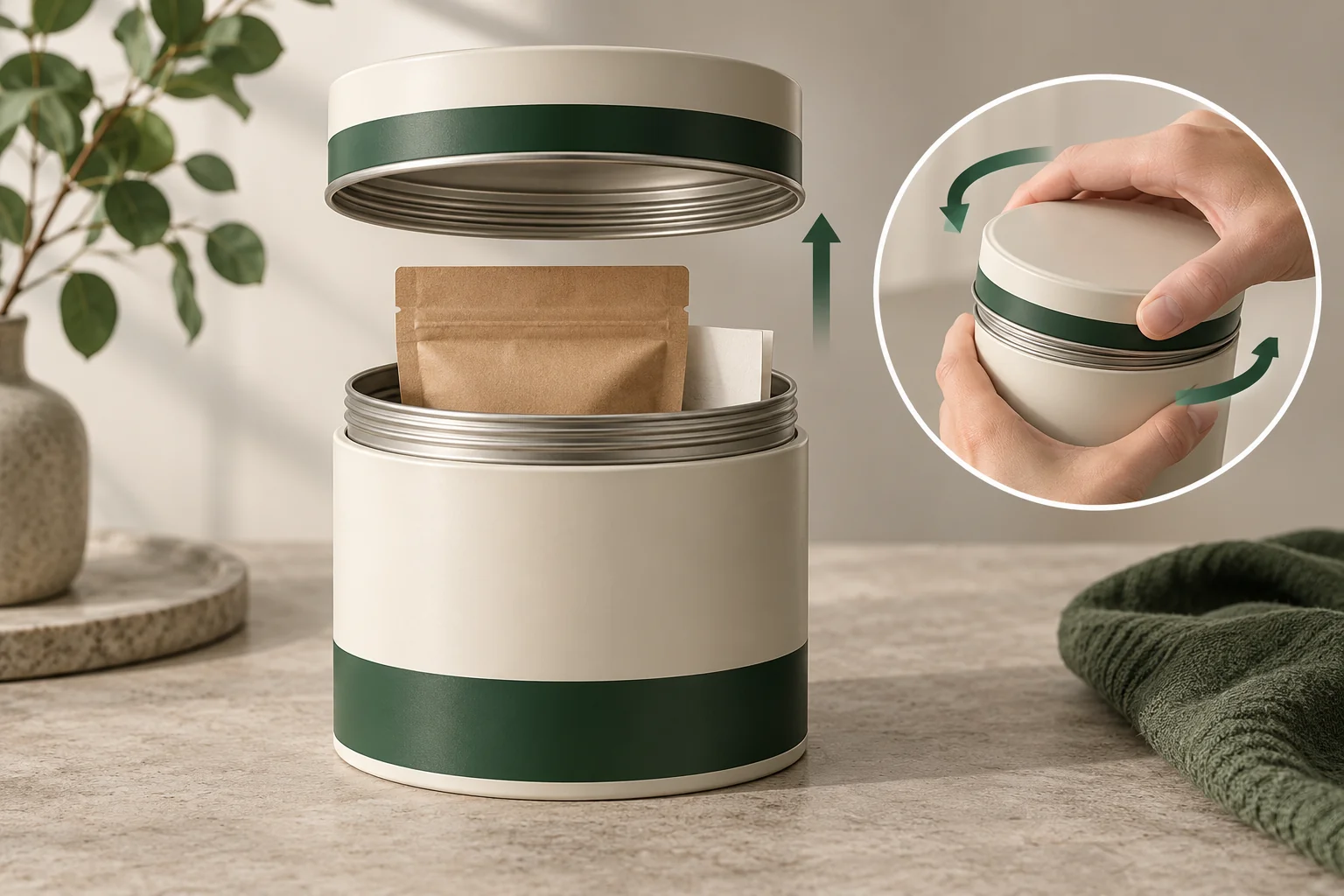
This is a packaging concept for dry gifts. The actual metal, coating, lining and closure construction need confirmation from the responsible source.
Identify lid and body thread relationships
The screw-top tin reference describes threads around the enclosure. Ask for the actual lid and body proposal, including where engagement starts and how the closed position is defined. Do not borrow its tight-seal marketing as project evidence.
Keep the lid and body as paired components. Ask how they are supplied and identified. A lid from another sample should not be used to create an apparently successful closure on the current body.
Show the outside grip surfaces and any proposed print or finish. The customer action should be reviewed with those finished surfaces present.
Locate the dry gift inside
Provide all inner contents, including pouch, wrap, card or holder. Show the maximum packed height and the surfaces that meet the container. Ask for the actual lining or contact-layer proposal rather than inferring it from a metallic-looking interior.
For a hypothetical gift charm in a pouch, review the pouch and folded card together. Place them in the intended orientation before closing the lid. A card leaning into the rim creates a different question from thread engagement itself.
Record contact during opening and removal. Keep material and performance claims within their evidence scope rather than assuming a dry-gift concept inherits a supplier’s food-safe statement.
Use a thread and contact record
Each row concerns one closure or inner interface. Keep sample and component revisions attached.
| Interface | Proposal input | Sample observation |
|---|---|---|
| Thread start | Paired lid/body geometry | Initial engagement action |
| Engagement | Confirmed closing route | Final position and any changed grip |
| Lid grip | Finished outside surface | Customer opening action |
| Inner contact | Lining and complete gift envelope | Located contact areas |
| Removal | Open rim and holder or pouch | Product exit without changed configuration |
If a closing action feels inconsistent, record the stage and paired parts. Do not prescribe a thread change or torque value without the responsible supplier’s proposal.
Keep the use and evaluation specific
In the hypothetical record, call the paired lid L1 and body B1. A thread observation belongs to L1/B1, while a card at the rim gets a separate issue ID. This stops one fit question from being described as a sealing failure without evidence.
Confirm delivered state, inner components and packing responsibilities. If finish or lining changes, review the relevant grip and contact interfaces on the revised sample.
Any sealing, retention, repeated-use or handling requirement needs a separately agreed method and responsible evidence. The local record documents configuration and action for the specified dry gift.
Send paired parts and contents
Submit lid/body details, complete inner envelope, use requirements, quantity and destination through Get a Quote. Packrivo’s minimum is 500 pieces per design. Final construction, samples, pricing and timing require project confirmation.