
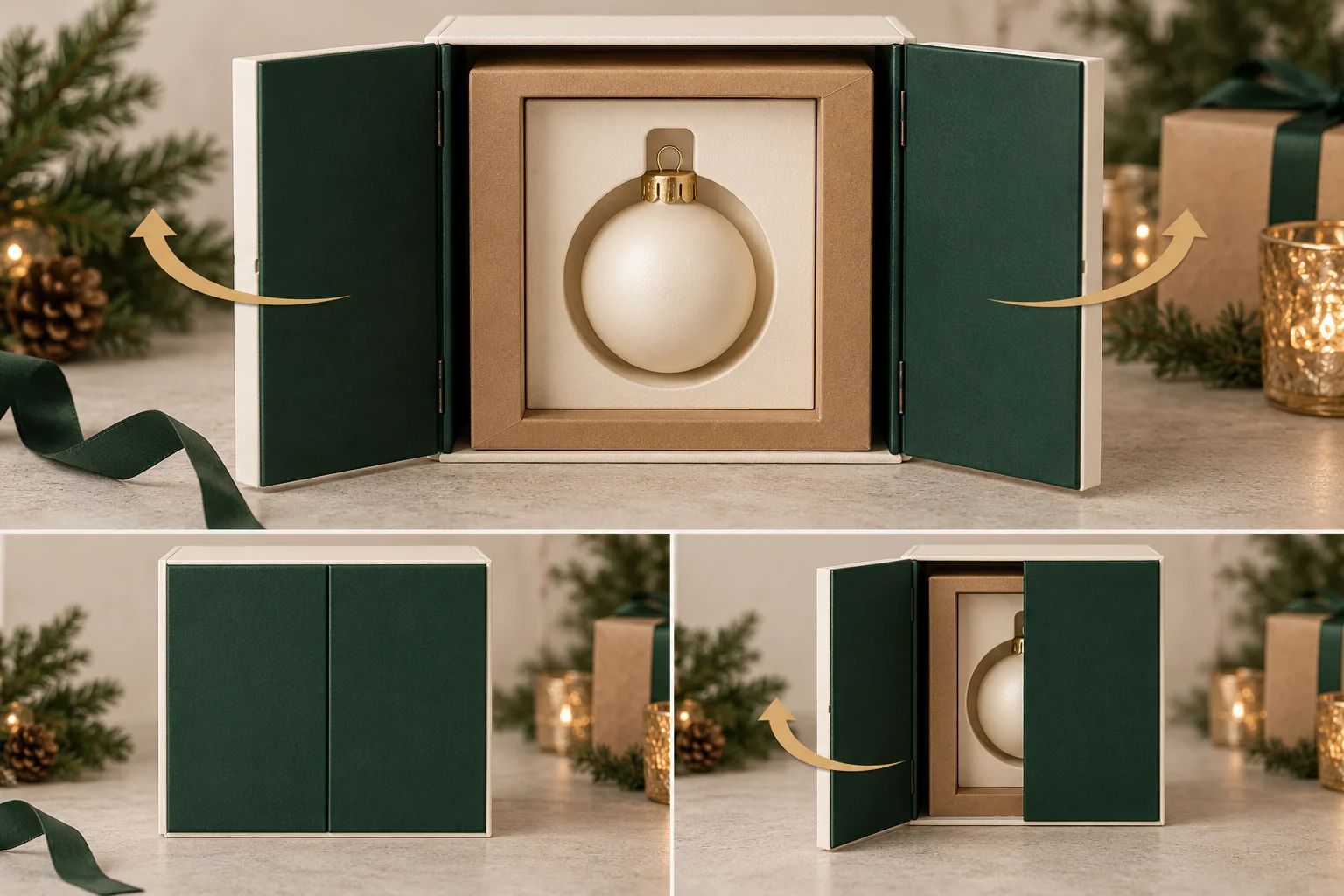
This concept needs a supplier proposal for hinges, closure and tray construction. Name the desired magnetic, tied or other closure in the brief, and request its attachment and opening sequence in the supplier drawing.
Name each door and its hinge
The double door maker reference describes doors opening in opposite directions. Use that structural relationship to ask for two labeled hinge axes and door panels. Do not adopt its promotional protection or production claims.
Show the closed meeting line and the position each door reaches when opened. If a sequence is needed to avoid interference, write it on the proposal. A front image can conceal one door sitting over the other.
The jewelry opening-format guide helps compare a single-cover box. The distinctive task here is the interaction between two moving panels, their meeting edges and the central loaded space.
Keep the central product in the review
Provide the full tray and holder envelope, product orientation and highest point. Mark any component that sits near a hinge or meeting edge. The opening route should be checked around the actual contents rather than an empty shell.
For a hypothetical gift ornament, the central holder may place the product close to the closed meeting line. Open the left door and right door in the intended sequence, recording any contact before the product is removed.
Decide which open state should permit removal. Both doors fully spread may be a presentation view, while a customer might use another position. State the intended action and support instead of relying on the most attractive rendered angle.
Use a two-door interaction record
Keep the door names consistent across drawing, photos and artwork. Fill one observation for each moving interface.
| Interface | Brief input | Sample view |
|---|---|---|
| Left hinge | Axis and intended arc | First opening with contents |
| Right hinge | Axis and intended arc | Second opening or agreed sequence |
| Meeting edges | Closed overlap or joining proposal | Loaded closed front |
| Door to tray | Installed tray and wall envelope | Located contact during travel |
| Product access | Required exposed holder area | Removal in intended open state |
If the left and right door constructions differ, retain separate part identities. A mirrored-looking outside design should not erase a handed assembly difference.
Check information and supplied assembly
Review artwork in closed and open positions. The inside faces can carry different messages, but their reading directions depend on the actual opening. Keep required instructions visible at the stage when they are needed.
Ask whether the doors and tray arrive assembled and which joints or closure parts are prepared. Name any remaining work and component matching. A box delivered with two loose panels describes a different assembly scope.
For the hypothetical ornament record, call the doors L1 and R1 and the tray T1. A change to one hinge reopens that door’s arc and its artwork view. Keep visible observations separate from any required hinge-life or distribution evaluation.
Send both arcs with the central envelope
Bring the door map, tray drawing, complete product details, quantity and destination to Get a Quote. Packrivo’s minimum is 500 pieces per design. Final construction, materials, sample scope and commercial terms require project confirmation.