
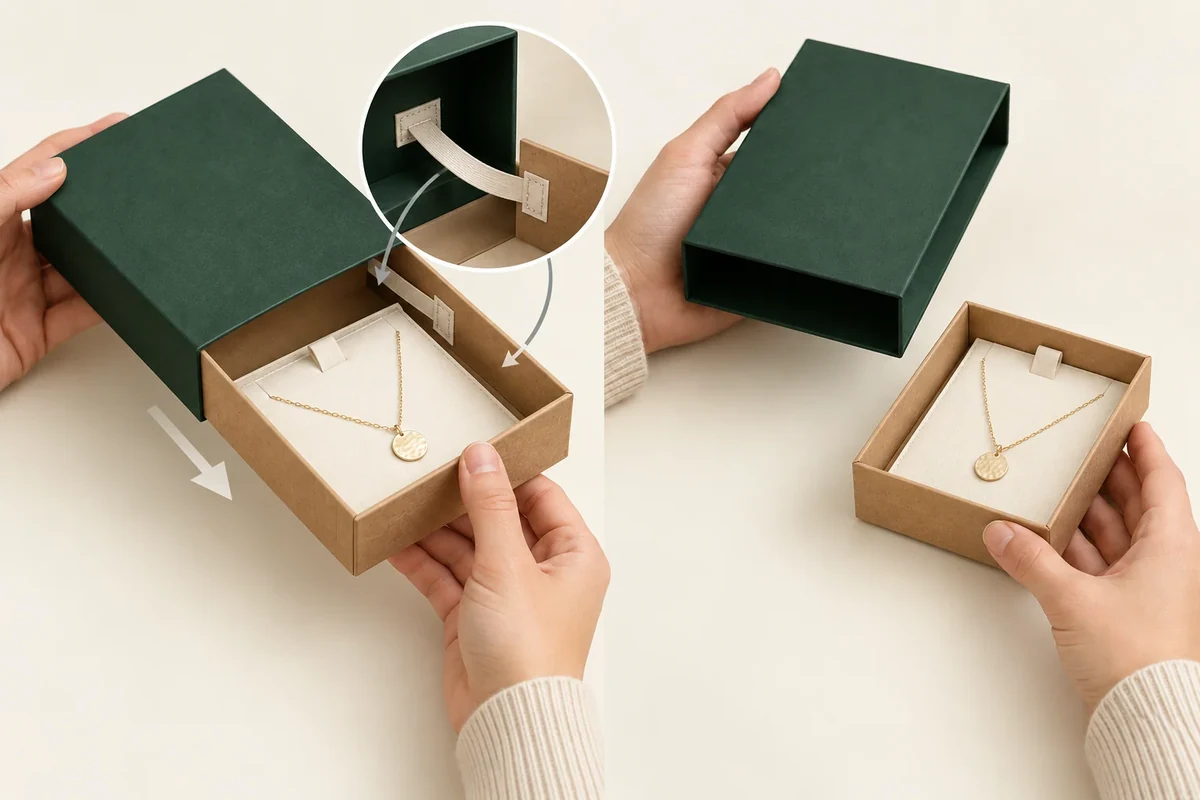
Decide whether the packaging drawer should remain captured at an agreed opening position or slide fully free before reviewing its travel. Show the desired end state, product removal route and support for the tray. Ask the supplier to confirm any stop mechanism; a sleeve’s closed rear end isn’t an outward travel stop.
A drawer concept can look convincing while leaving its final opening action undefined. The buyer should choose the user task first, then ask for a construction that can be reviewed against it.
Choose the end state as a use requirement
For a captured tray, describe the opening position needed to reach the product and how the tray is supported there. For a removable tray, describe where it will be placed once free and how the product is taken out.
PackMojo’s rigid drawer reference identifies a sleeve and sliding drawer. This supports the two-component relationship, not a built-in outward stop for your proposal. A stop must be identified on the supplier’s actual drawing.
Keep the desired behavior distinct from the mechanism. ‘Tray remains captured while the product is removed’ is a requirement. A ribbon, tab or other proposed restraint is a construction response that needs confirmation.
The jewelry structure guide compares broad opening formats. This record resolves one specific end-state decision within the drawer direction.
Show product access at the chosen position
Place the complete product and holder in the tray. Mark the opening position in a side view, then show the finger route to the item. If a product extends above the tray, include that height in the access view.
For a captured tray, ask whether the remaining sleeve overlap leaves the required holder area exposed. For a removable tray, review the transition as it becomes free rather than looking only at the tray sitting separately on a table.
Record where the user supports the sleeve and tray. A sample action performed with two convenient extra hands may not represent the intended customer use. Describe the actual grip instead of claiming universal ease of opening.
Use a travel and end-state record
Keep one chosen end state per proposal row. Use the decision record to compare options without assuming a mechanism.
| Decision | Captured proposal | Removable proposal |
|---|---|---|
| Desired end state | Tray remains joined at named position | Tray exits fully |
| Product access | Visible holder and grip area at stop | Access once tray is supported outside |
| Support | User grip and remaining overlap | User grip during final exit |
| Mechanism | Supplier-confirmed restraint if proposed | Unobstructed exit route to confirm |
| Evidence | Loaded opening and removal sequence | Loaded exit and placement sequence |
A drawn arrow that ends at a convenient point doesn’t prove a stop exists. Ask the supplier to show the parts responsible for the proposed behavior.
Follow a hypothetical necklace-card pack
Suppose a brand wants a necklace card removed while the drawer stays attached to its sleeve. The initial concept shows a partly open tray but no restraint. The buyer records the captured end-state requirement as unresolved.
The supplier is asked to propose and identify the construction that provides that state. The next loaded sample is reviewed for access at the proposed position and for the user support required during removal.
Alternatively, the brand may choose a fully removable tray that rests on a table. That is a different use choice, not a failed version of the captured proposal. The record changes the expected exit action and the sample evidence accordingly.
Do not invent a stop by adding a decorative pull or making the drawer tighter. The proposal must name its functional detail, and any required retention evaluation needs an agreed method.
Write a clear end-state instruction
For the hypothetical necklace drawer, a captured-state instruction can read: ‘Open to the supplier-confirmed retained position, support the sleeve as shown and remove the card through the exposed area.’ Keep this as a proposed use instruction until the actual retention construction is confirmed.
A removable-state instruction instead needs the final tray exit and a place to support it. The two instructions should have separate sketches. Combining a captured opening photo with a fully removed access photo can hide the difference in what the customer is expected to do.
Ask the supplier: ‘Please identify the proposed feature that keeps the loaded tray captured at the required access state.’ If no such feature is proposed, the captured requirement remains open. Increasing sliding resistance or adding a decorative ribbon is not evidence of a defined stop.
When the actual sample is reviewed, record product access and support at the proposed end state. Any required retention or repeated-use evaluation must have a separate agreed scope. The decision record helps select the intended behavior without inventing a mechanism or a performance result from a concept image.
Send the end-state choice before the mechanism
Bring the product access sketch, desired captured or removable behavior and support record to the packaging enquiry. Review the supplier’s actual mechanism separately from the concept. Keep travel, product access and any performance requirement in distinct approval fields.
Check full card withdrawal separately from reaching the card
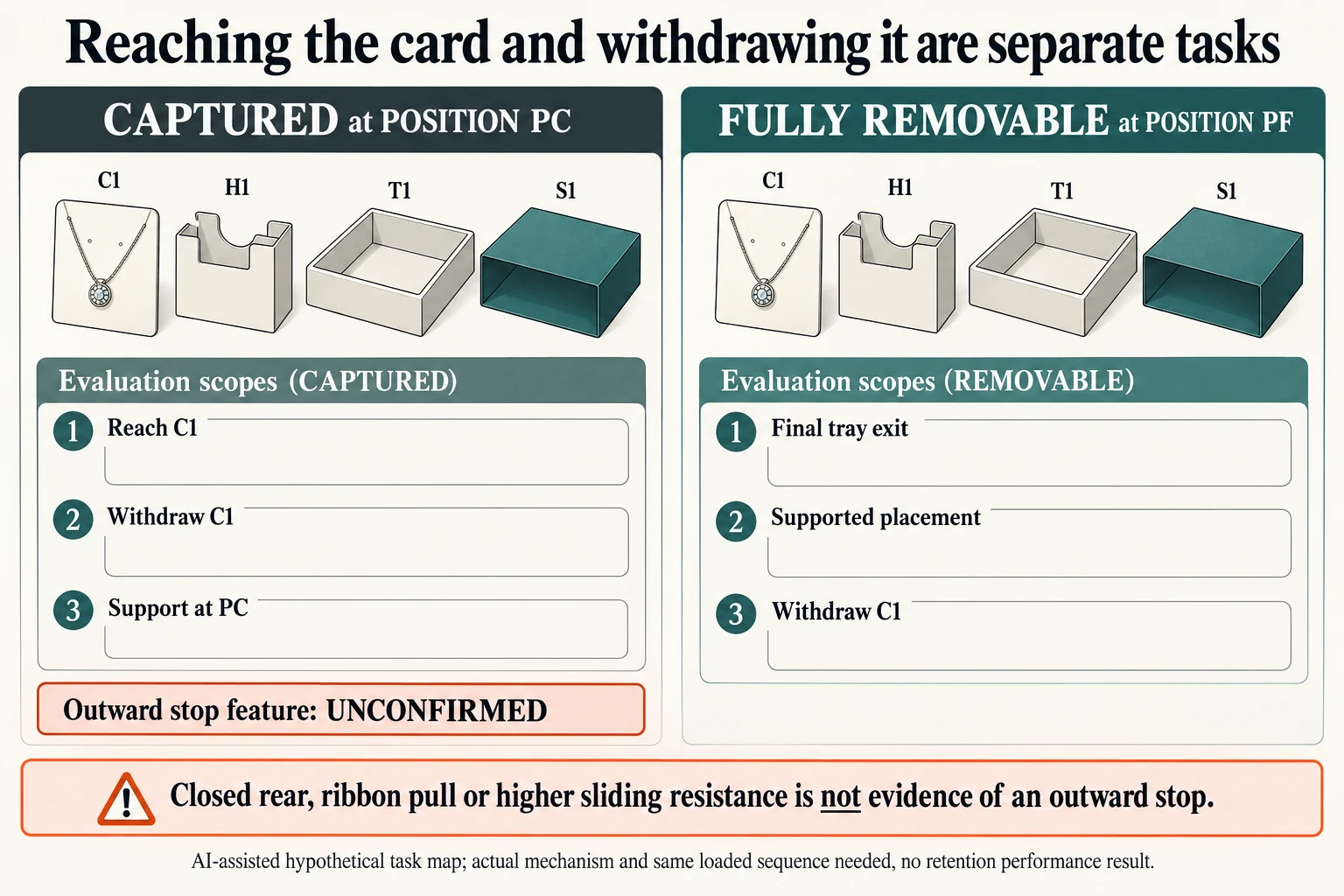
A card being visible or reachable at a partly open position does not establish that it can be withdrawn through the available route. For the fictional necklace-card pack, name captured position PC and free-tray state PF. Both proposals retain sleeve S1, tray T1, holder H1 and card C1, but require different action evidence.
Scroll horizontally if columns extend beyond the view.
| Hypothetical configuration | Named object | Relationship | Input or next scope |
|---|---|---|---|
| CAPTURED22 | CAPTURED22 | uses sleeve | S1 |
| CAPTURED22 | CAPTURED22 | uses tray | T1 |
| CAPTURED22 | CAPTURED22 | uses end position | PC |
| REMOVABLE22 | REMOVABLE22 | uses sleeve | S1 |
| REMOVABLE22 | REMOVABLE22 | uses tray | T1 |
| REMOVABLE22 | REMOVABLE22 | uses end position | PF |
CAPTURED22 asks for card reach, complete withdrawal, support at PC and the confirmed outward-stop feature separately. The stop remains unconfirmed here. REMOVABLE22 asks for the final tray exit, supported placement and card withdrawal. A photograph of C1 after the tray has been removed cannot answer how the card is taken out while T1 remains captured at PC.
Ask the supplier to show the actual feature responsible for the captured requirement, then review access with that feature and the complete contents. If the required card route needs more exposed space than the proposal provides, return the located access question rather than inventing a larger stop position or extra customer grip. The reviewer must document the support actually used; convenient extra hands should not disappear from the record.
The diagram names tasks and missing evidence without drawing a fictitious restraint. A closed rear, decorative ribbon or higher sliding resistance does not establish an outward stop. The buyer can choose a removable route instead, with a revised use instruction and its own evidence, while any retention, repeated-use or protection requirement remains a separate agreed evaluation. The CSV does not default either use choice or any actual result.
Download the drawer captured removable end state record (.csv). It includes the original table fields and scenarios alongside the added relationships. HYPOTHETICAL rows are editorial examples or required review scopes, not actual records. Actual quantity, configuration, component and file identities, materials, process, specification, copy, method, condition, observation, owner, decision, evidence and dates are blank. ACTUAL_BLANK is a separate empty starting row; enter permitted project evidence before using an actual record. A blank means unknown.
Use the Review a Drawer Pull With the Loaded Tray for its separate question. Use the Custom Packaging Sample: Approval Checks That Matter for its separate question.
References apply to the materials, processes or guidance named in each source. Worked configurations and dimensions are teaching examples, not tested specifications or production limits. Use the project’s material specification, drawing and formed sample for approval.
Discuss this packaging specification with Packrivo. We coordinate independent suppliers. MOQ: 500 pieces per product/design; illustrative quantities are not production offers. Confirm materials, samples, price and timing for your project.