
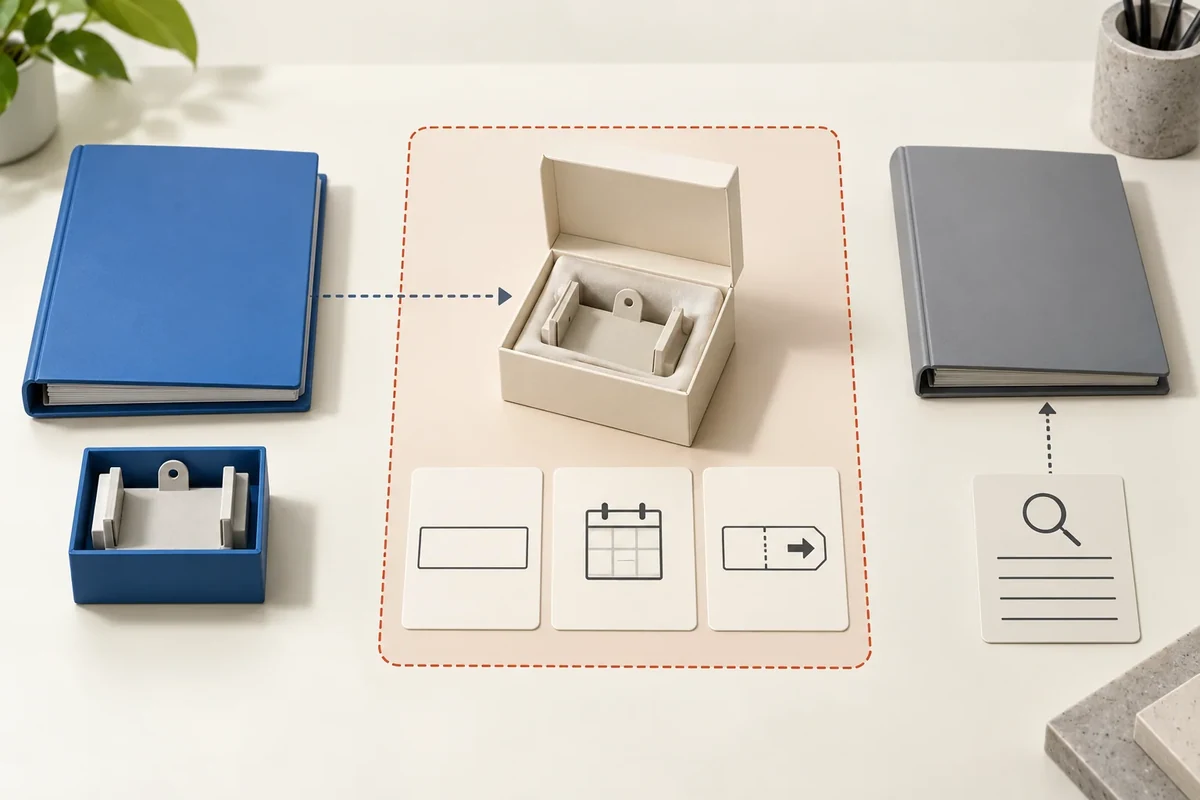
Record each supplier deviation from the requested packaging baseline before authorizing a sample. Identify the changed field, affected component and required evidence, then give it an accept, reject or hold decision. The resulting sample instruction should name the configuration actually authorized for review.
Separate a deviation from an unanswered requirement
This is an original Packrivo pre-sample decision aid. The project names who can authorize a sample instruction; a printer specification or structural catalogue does not supply that authority.
The clarification matrix makes proposals and changed fields visible. Use this table when a supplier offers a definite departure from a requirement, such as a different assembly state, contact arrangement or component construction. Keep missing information as an open field rather than calling it accepted.
Preserve the requested baseline and the actual proposed deviation. Record the supplier’s reason as a received statement, then identify which drawing, material, tool or packout component changes. A general approval to make a sample should not hide several unresolved departures.
Name what must be resolved before sample making
For each deviation, ask which evidence is needed to choose accept, reject or hold. It may be a revised drawing, an actual grade description, a complete packout map or another confirmed project input. Keep the buyer’s decision and supplier confirmation as separate records.
If a deviation is accepted for a trial, define the exact sample configuration and what the trial is intended to review. An accepted trial departure does not approve final production or establish performance. Retain any remaining requirement with its next decision owner.
If the deviation is rejected or held, state what revised proposal or evidence is required before another instruction. This prevents the supplier from making a sample based on an informal understanding different from the buyer’s intended baseline.
Use a pre-sample deviation table
The hypothetical example below records a holder/assembly proposal without inventing an actual supplier decision.
| Pre-sample field | Illustrative entry | Evidence or decision |
|---|---|---|
| Baseline | Holder I1 supplied in the requested state | Retain requirement and drawing reference |
| Deviation | Offered attachment or preparation differs | Record exact changed component/operation |
| Affected links | Box, holder, card or tooling references | Ask which drawings need revision |
| Required evidence | Revised offered construction/packout map | Supplier returns named proposal |
| Decision | Accept for stated trial, reject or hold | Named buyer/authorized owner and date |
| Sample instruction | Exact approved trial configuration | Keep purpose, substitutions and open checks |
Resolve an illustrative trial substitution
Imagine a supplier proposes a different holder attachment for the first sample. Record the requested attachment and offered substitute together. The buyer may authorize a specific fit/access trial while retaining the final attachment question as unresolved.
The sample instruction should identify the substitute and its purpose so later reviewers do not assume it is the final accepted component. If the supplier also changes the card or box, those are separate deviations requiring their own decisions. A trial can be useful while its scope remains clearly limited.
Bound a trial exception without replacing the master baseline
Give an accepted trial departure its own exception ID and sample configuration. Record the components, requested trial units or sample IDs, intended review purpose and conditions that limit it. The supplier confirms the actual sample scope and terms.
State the current master drawing/production baseline explicitly. A trial-only exception does not automatically replace it. Any permanent baseline change needs its own approved revision and acceptance decision, even if the trial appears useful.
Record an expiry date or named completion event chosen by the project authority, plus who can revoke the exception. A revoked or expired trial instruction should be identified as inactive and its remaining sample/review questions retained. Do not invent a default validity period.
At the later review, decide whether to reject the departure, authorize another bounded trial or approve a separate master-baseline revision. Keep that subsequent decision apart from the original permission to make a sample.
| Exception field | Hypothetical trial record |
|---|---|
| Master baseline | M02 remains the approved production drawing; no automatic replacement |
| Trial scope TR01 | Only holder I1 attachment on named sample configuration S1; actual trial units to confirm |
| Authorization | Named owner/date and purpose:review the proposed attachment scope |
| Validity | Project-chosen expiry E1 or named review-completion event |
| Revocation | Named owner may withdraw TR01; retain inactive instruction and reason |
| Later decision | Trial result separately reviewed; M03 requires its own approved revision |
Attach authorization to the sample revision
Use the sample revision record to connect the authorized configuration to the delivered sample. The sample approval guide remains the later requirement/evidence/disposition route; a pre-sample instruction is a different stage.
The supplier proposes the actual deviation and supporting facts. The coordinator records affected references. The named authorization owner decides the permitted trial scope, and the reviewer receives the sample with that scope visible. Retain any earlier baseline rather than replacing it with the new proposal silently.
Bring the deviation table, actual offered references and unresolved pre-sample questions to your packaging brief. MOQ is 500 pieces per design; materials, sampling and commercial conditions are confirmed for the project.
A second trial cannot borrow the first trial’s exception
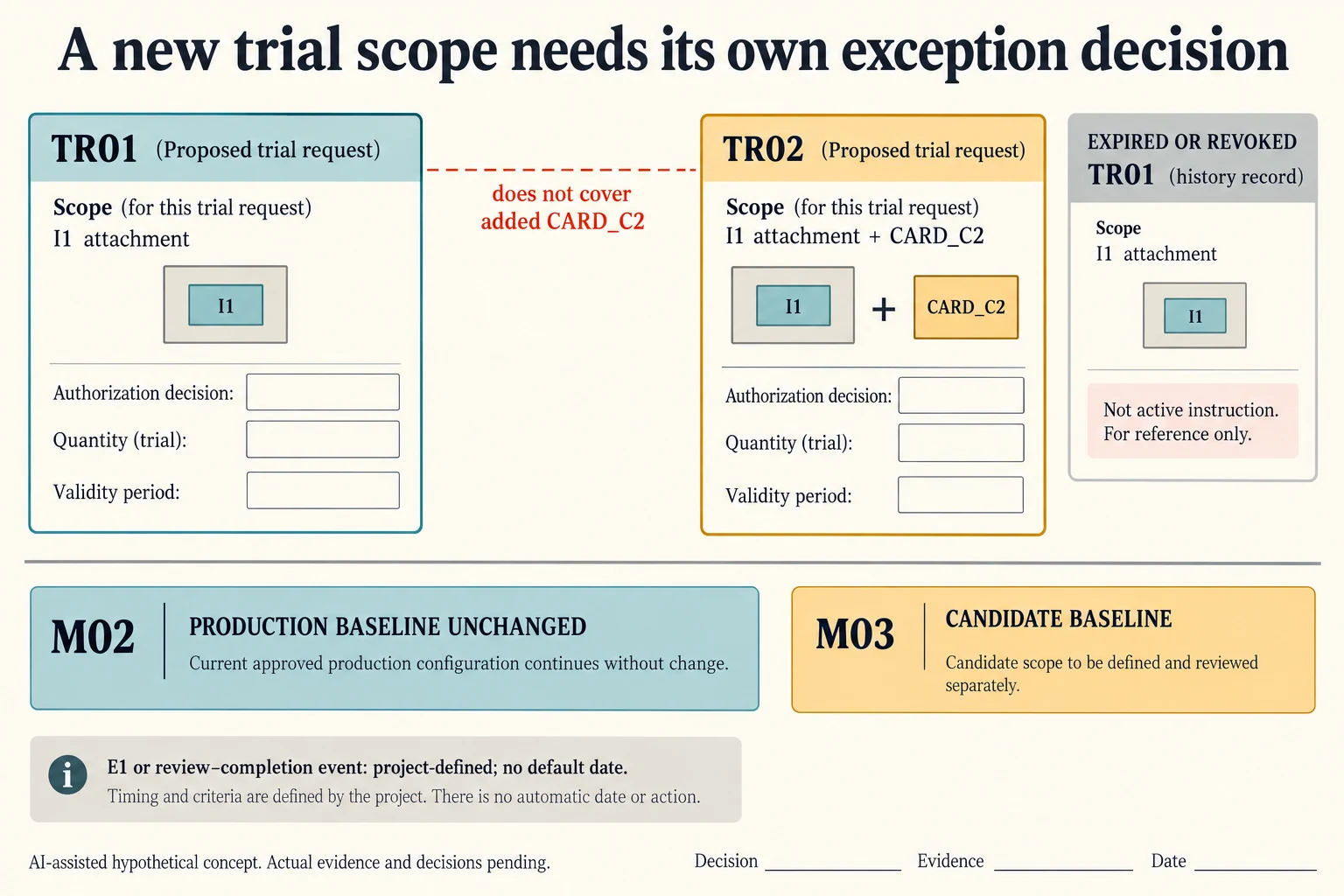
Keep the original TR01 request about I1 attachment separate from an invented TR02 request that also adds CARD_C2. The second trial changes the review scope. It cannot borrow TR01’s exception merely because both mention the same holder. Record what each trial proposes, the sample identity needed and the particular fit, access or attachment question. Neither request supplies an actual trial authorization or sample quantity.
Scroll horizontally if columns extend beyond the view.
| Hypothetical configuration | Named object | Relationship | Input or next scope |
|---|---|---|---|
| OVERLAP26 | TR01 | has proposed scope | I1_ATTACHMENT |
| OVERLAP26 | TR01 | leaves production baseline | M02 |
| OVERLAP26 | TR01 | requires | OWN_EXCEPTION_DECISION |
| OVERLAP26 | TR01 | requires | VALIDITY_END |
| OVERLAP26 | TR02 | has proposed scope | I1_ATTACHMENT_PLUS_CARD_C2 |
| OVERLAP26 | TR02 | leaves production baseline | M02 |
| OVERLAP26 | TR02 | requires | OWN_EXCEPTION_DECISION |
| OVERLAP26 | TR02 | requires | VALIDITY_END |
| OVERLAP26 | TR01 | does not cover | ADDED_CARD_C2_IN_TR02 |
| INACTIVE26 | EXPIRED_OR_REVOKED_TR01 | is not | ACTIVE_TRIAL_INSTRUCTION |
| MASTER26 | M03 | is | SEPARATE_REVISION_CANDIDATE |
Each trial needs its own exception decision, current instruction, validity end and revocation responsibility. The original alternatives remain a project-selected expiry E1 or a review-completion event; this worksheet supplies no default date. If TR01 expires or is revoked, retain its history as inactive and stop treating it as an active trial instruction. TR02 is a separate candidate, not an automatic extension.
M02 remains the production baseline throughout this illustration. A favourable trial observation, if later obtained, does not create M03 or authorize the added card for production. M03 is a separate revision candidate requiring its own scope and responsible approval. Keep the choices to accept a bounded trial, reject the deviation or hold for clarification distinct from the later production decision.
A supplier’s unanswered attachment field is also different from a definite offered departure. Identify which condition exists before opening an exception. The actual source wording, quantities, observations, owners, decisions and evidence remain blank in the CSV. Use the sample-version record for observed corrections; this register determines which limited departure is being requested and when it would cease to apply.
Download the packaging deviation overlapping trial scope record (.csv). It includes the original table fields and scenarios alongside the added relationships. HYPOTHETICAL rows are editorial examples or required review scopes, not actual records. Actual quantity, configuration, component and file identities, materials, process, specification, copy, method, condition, observation, owner, decision, evidence and dates are blank. ACTUAL_BLANK is a separate empty starting row; enter permitted project evidence before using an actual record. A blank means unknown.
Use the Packaging Sample Revisions: Compare Versions Before Approval for its separate question. Use the Name the Sample Version Included in Each Quotation for its separate question. Use the Packaging Reorder Checklist: Control the Version First for its separate question.
References apply to the materials, processes or guidance named in each source. Worked configurations and dimensions are teaching examples, not tested specifications or production limits. Use the project’s material specification, drawing and formed sample for approval.
Discuss this packaging specification with Packrivo. We coordinate independent suppliers. MOQ: 500 pieces per product/design; illustrative quantities are not production offers. Confirm materials, samples, price and timing for your project.