
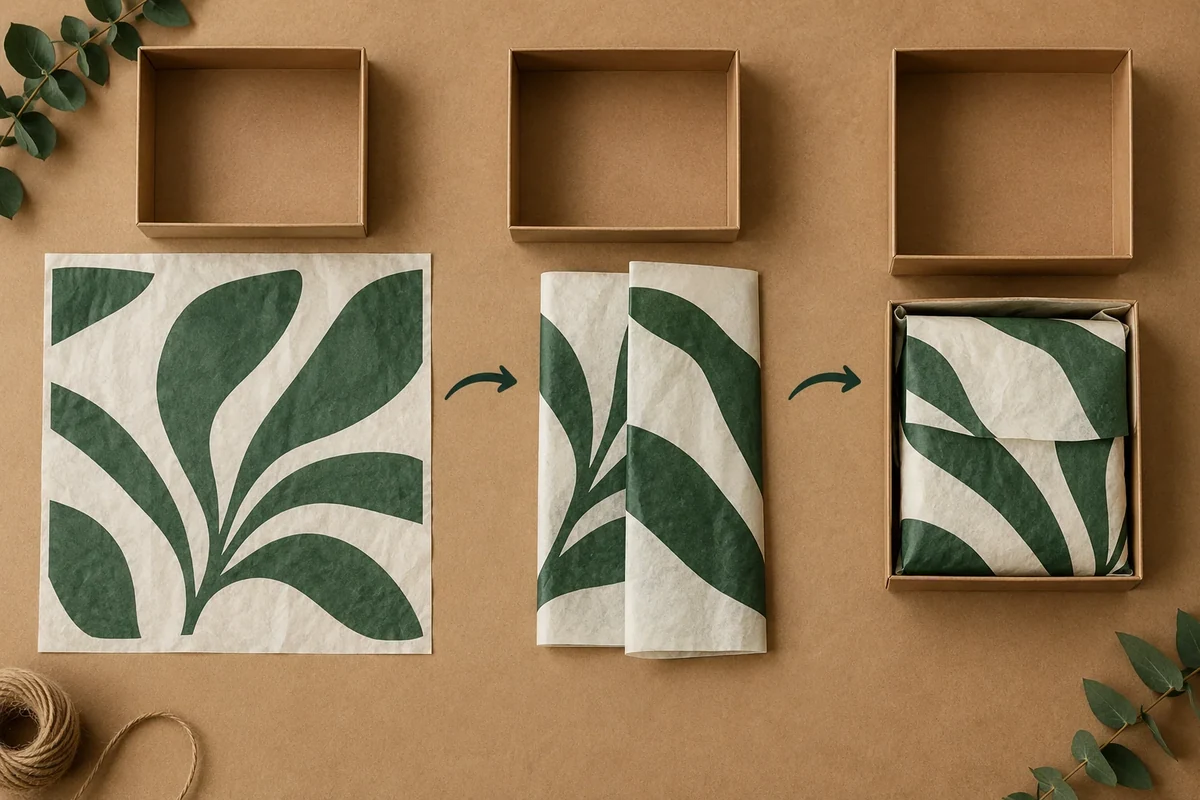
Choose the final tissue fold before placing a positioned printed mark. Map the flat sheet, fold order and visible face with matching references. A motif centred on a flat sheet can end up hidden, divided or facing away after the actual packing action.
This tool starts with the intended gift presentation. It records where the artwork should be seen, while the printer separately confirms the material and printing proposal.
Use one sheet reference through the fold
The tissue printing reference distinguishes position and non-position layouts. Ask which process is proposed for the desired visual job. The map does not establish placement accuracy or a supplier’s production tolerance.
Give the sheet four stable edge references and identify its print side. Mark the proposed fold lines on a working copy. Keep the product or box orientation visible so a rotated sheet cannot appear unchanged in the next photo.
Name the intended motif and the stage where the customer should see it. A repeating pattern may need another review from a single positioned mark. Record that choice rather than forcing both into the same artwork instruction.
Use the tissue component brief for paper, ink and contact questions. This map stays on artwork after folding, instead of repeating all material specifications.
Show overlaps and the final face
Photograph or sketch the sheet before folding, after each important fold and in the final pack. Mark which regions become hidden. Keep the outside visible face distinct from the product-contact face.
Write the packing order alongside the map. A motif placement that depends on one specific sequence needs that sequence available to staff. Do not assume a different fold order creates the same presentation.
| Artwork-map field | Reference | Evidence |
|---|---|---|
| Sheet orientation | Named edges and print side | Flat starting view |
| Fold order | Stable fold IDs | Intermediate views |
| Motif | Artwork ID and desired stage | Final visible location |
| Overlap | Covered regions | Hidden/visible boundary |
| Pack relationship | Product face and orientation | Complete final presentation |
| Revision | Artwork and fold instruction | Changed relationship to recheck |
The set checklist can hold the wider bag or box components. Keep the same final set in the motif review if those parts affect visibility.
Follow a hypothetical gift-box wrap
Suppose a brand wants a green abstract mark visible at the top of tissue around a gift box. The first flat layout centres it on the sheet. After the proposed folds, an overlap covers part of the mark.
The buyer names motif M1 and overlap O1, then compares moving M1 with changing the fold order. Those are separate options. The next proposal identifies which one changes and preserves the box orientation.
If the printer supplies a sample on another paper, retain that material limitation. The fold map can still explain position while leaving the final printing and contact evidence open.
Write a useful handoff note
A specific instruction is: ‘M1 should be visible on final face VF1 after folds F1 and F2 in the stated order.’ It links artwork to a named action. A request to centre the logo gives the printer no final-fold reference.
For a repeating design, record which degree of partial pattern visibility is intended without inventing a universal rule. The buyer’s presentation preference and the printer’s proposed process need separate replies.
Review the formed sample with the same fold instruction. If staff use another order, note the deviation before treating the view as evidence for VF1. The tool checks the intended presentation, not printing capability or sales effect.
Send the final-fold target
Bring the sheet map, motif IDs, folding sequence and complete presentation through Packrivo’s enquiry. The next response should tie the proposed artwork and printing scope to the same final view.
Keep mark movement separate from fold-order movement
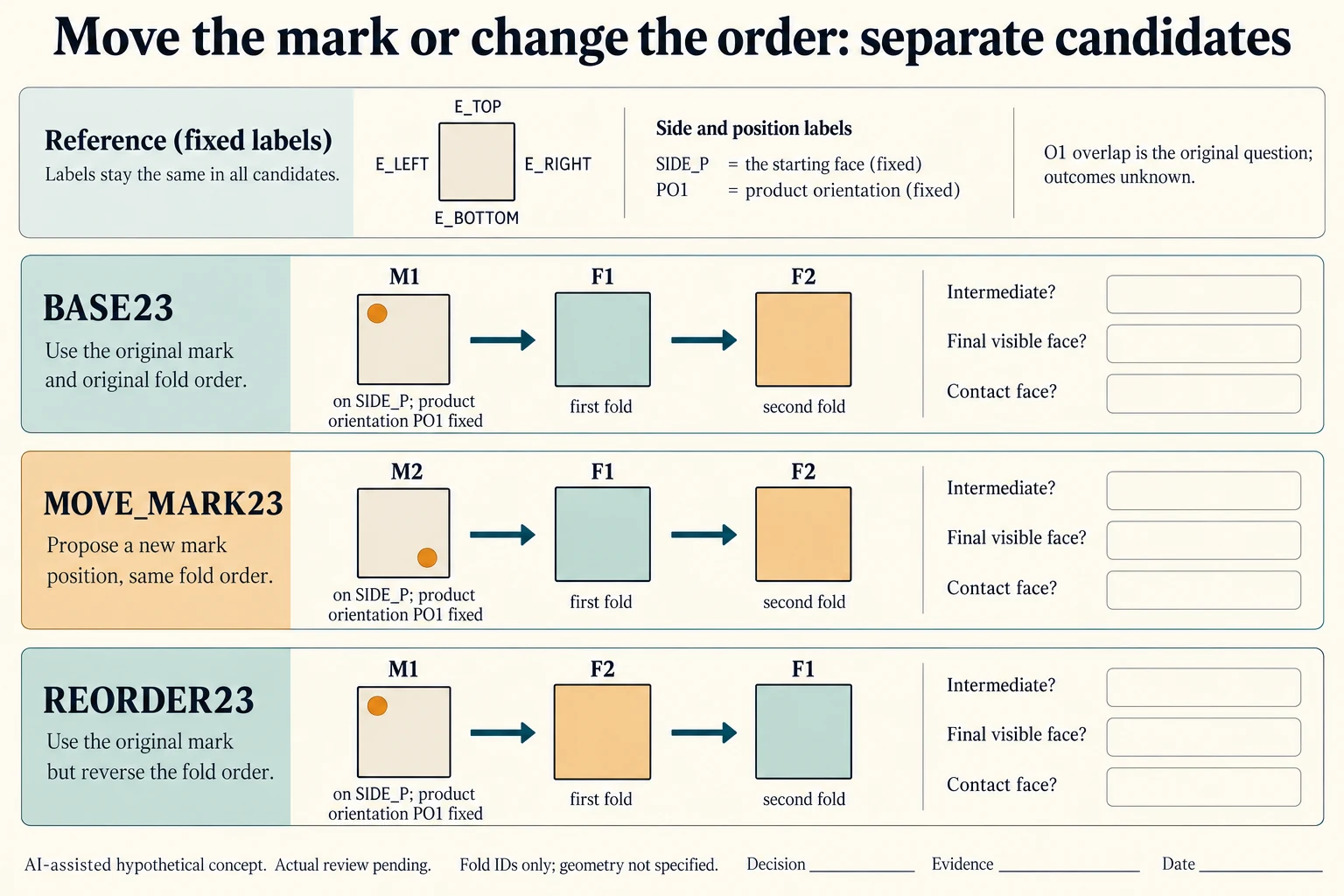
Name three invented tissue candidates while holding the edge reference, print side and product orientation constant. BASE23 uses mark M1 with F1 then F2. MOVE_MARK23 uses proposed mark M2 with F1 then F2. REORDER23 retains M1 but uses F2 then F1. M2 identifies a changed location, not another approved logo. No actual fold geometry or print coordinates have been supplied.
Scroll horizontally if columns extend beyond the view.
| Hypothetical configuration | Named object | Relationship | Input or next scope |
|---|---|---|---|
| BASE23 | BASE23 | uses motif | M1 |
| BASE23 | BASE23 | uses first fold | F1 |
| BASE23 | BASE23 | uses second fold | F2 |
| MOVE_MARK23 | MOVE_MARK23 | uses motif | M2 |
| MOVE_MARK23 | MOVE_MARK23 | uses first fold | F1 |
| MOVE_MARK23 | MOVE_MARK23 | uses second fold | F2 |
| REORDER23 | REORDER23 | uses motif | M1 |
| REORDER23 | REORDER23 | uses first fold | F2 |
| REORDER23 | REORDER23 | uses second fold | F1 |
The CSV records first and second folds in separate fields of relationship rows, so a reversed order cannot hide inside a generic revision note. Every candidate has its own after-first-fold, final-visible-face and product-contact-face scopes. A view rotation of the same folded object is not a change of fold order. Keep E_TOP, E_RIGHT, E_BOTTOM and E_LEFT tied to the same flat-sheet orientation when the actual drawings are returned.
The original O1 example says overlap hides part of M1 after the stated fold. It does not prove that moving the mark or reversing folds will resolve it. Request a marked flat sheet and the matching intermediate/final views for each candidate. A positional-print proposal and a repeating non-position print also need different expectations for partial marks; the responsible artwork owner must state the actual requirement.
Do not carry a successful concept fold onto different paper or assume exterior print is suitable for product contact. Actual stock, ink, supplier process and formed evidence control those questions. PakFactory lists positional and non-position options; it does not prescribe a universal motif allowance, fold sequence or visible logo result. Artwork release remains separate from these unreviewed proposals.
Download the tissue print fold revision comparison record (.csv). It includes the original table fields and scenarios alongside the added relationships. HYPOTHETICAL rows are editorial examples or required review scopes, not actual records. Actual quantity, configuration, component and file identities, materials, process, specification, copy, method, condition, observation, owner, decision, evidence and dates are blank. ACTUAL_BLANK is a separate empty starting row; enter permitted project evidence before using an actual record. A blank means unknown.
Use the Tissue and Gift Bag Set: A Buyer Specification Checklist for its separate question. Use the Packaging Artwork Handoff Checklist for Print Approval for its separate question. Use the Packaging Dieline Changes Need an Impact Record for its separate question.
Source scope checked 16 October 2026. References cover only the named materials, processes or guidance. Added configurations and geometry are hypothetical, not supplier specifications, tests or production approval; they set no universal tolerances or machine limits. Confirm the actual material, process, drawing and formed sample for the project.
Discuss this packaging specification with Packrivo. We coordinate independent suppliers. MOQ: 500 pieces per product/design; illustrative quantities are not production offers. Confirm materials, samples, price and timing for your project.