
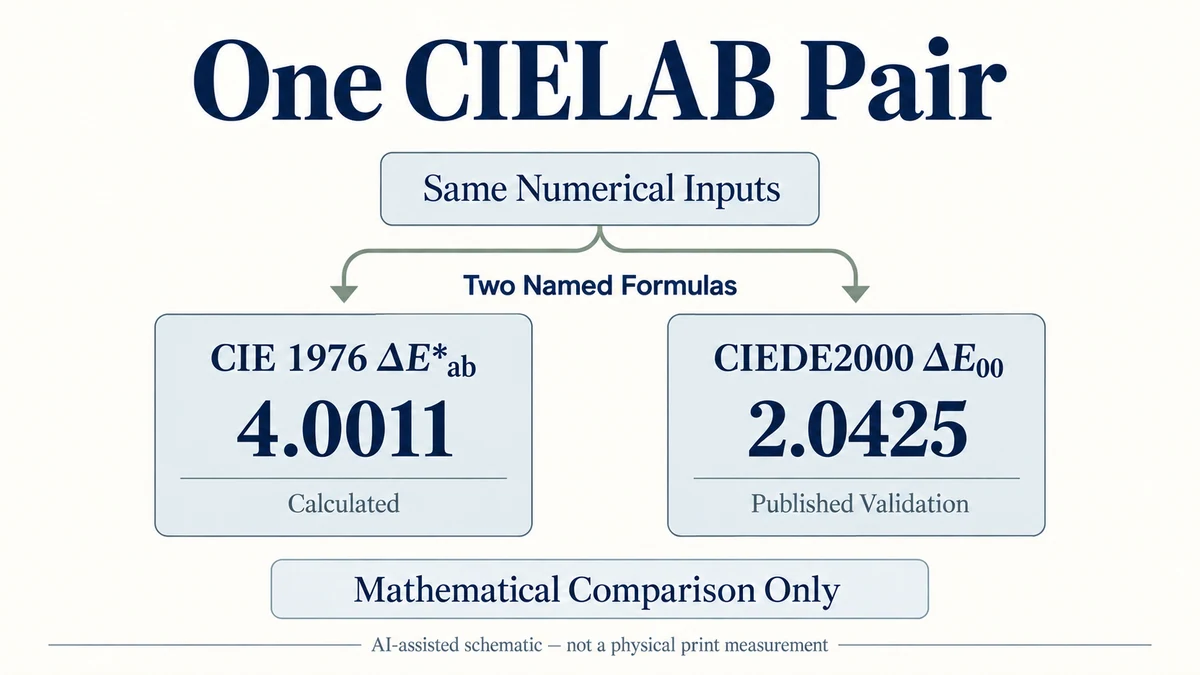
Two reports can use the label “Delta E” and show different values even when both calculations start from exactly the same CIELAB coordinates. Before a gift brand treats a lower number as a closer colour match, it needs to know which formula produced each result. A CIE 1976 ΔE*ab number and a CIEDE2000 ΔE00 number are not two interchangeable readings on one scale.
One CIELAB Pair, Two Different Results
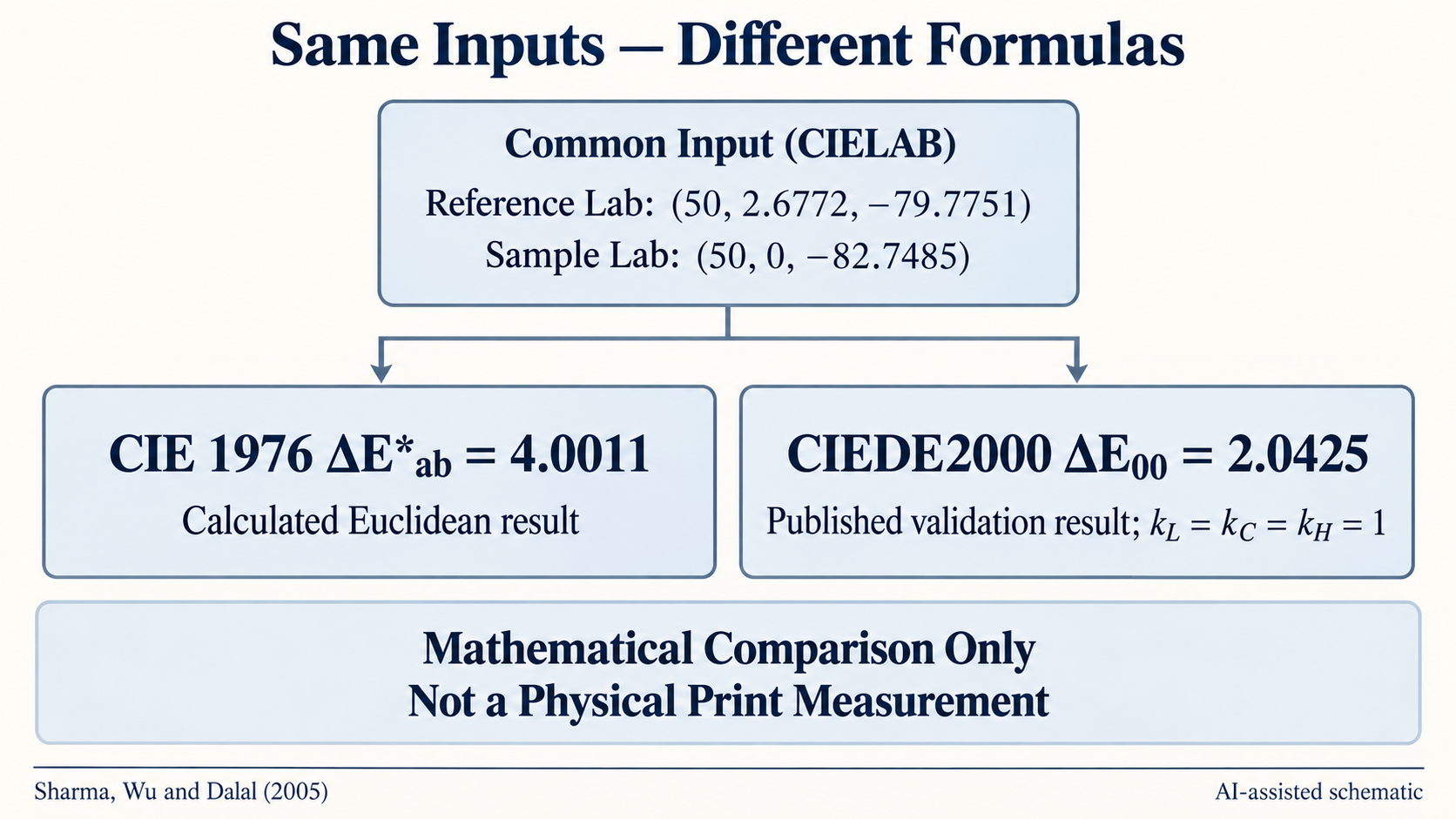
Consider the first public software-validation pair published by Gaurav Sharma, Wencheng Wu and Edul N. Dalal. These are numerical test inputs, not measurements of a gift box, ink, printed proof or finished material.
| Coordinate | Reference | Sample |
|---|---|---|
| L* | 50.0000 | 50.0000 |
| a* | 2.6772 | 0.0000 |
| b* | −79.7751 | −82.7485 |
For the 1976 formula, subtract reference coordinates from sample coordinates:
- ΔL* = 0
- Δa* = −2.6772
- Δb* = −2.9734
The Euclidean CIELAB difference is:
ΔEab = √[(ΔL)² + (Δa*)² + (Δb*)²]
= √[0² + (−2.6772)² + (−2.9734)²] = 4.001063… ≈ 4.0011
For the identical coordinate pair, the authors’ published CIEDE2000 validation value is ΔE00 = 2.0425, using unit parametric factors (kL = kC = kH = 1).
| Named computation | Result | Provenance |
|---|---|---|
| CIE 1976 ΔE*ab | 4.0011 | Arithmetic shown above |
| CIEDE2000 ΔE00 | 2.0425 | Published software-validation value |
Nothing about the coordinates changed between the calculations. The second number is smaller because the mathematical rule is different. It does not mean a physical print improved, and neither number is an approval grade.
Why CIEDE2000 Cannot Be Obtained by a Fixed Multiplier
CIE 1976 ΔE*ab measures straight-line distance between coordinates in CIELAB space. CIEDE2000 instead computes adjusted lightness, chroma and hue differences, with weighting that depends on the colour pair. It also includes a coupling term associated with chroma and hue. These changes aim to relate numerical differences more closely to relative perceived differences in the formula’s intended domain; they do not make it a universal packaging-appearance test.
The International Commission on Illumination’s ISO/CIE 11664-6:2022 description identifies CIEDE2000 as an extension of the 1976 formula. The 2022 edition replaced 2014 with a minor revision: the year is a standard-edition identifier, not evidence that two calculations made under different formulas are equivalent.
CIEDE2000 also uses parametric factors kL, kC and kH, associated with lightness, chroma and hue. As Konica Minolta explains, the unit setting applies under standard conditions, while factors may vary with measurement conditions. Thus even the word “CIEDE2000” may be insufficient for a reproducible numerical comparison if the factors are omitted.
There is no sound single conversion ratio between ΔE*ab and ΔE00. The influence of the weighting changes with the input pair, so a ratio inferred from this one test cannot be applied to the next colour pair. Nor should anyone assume two formulas always order all candidate pairs identically.
The Buying Decision When Reports Disagree
Imagine a buyer receives two calculation summaries, each headed simply “Delta E.” Both use the validation coordinates above. Summary A shows 4.0011; summary B shows 2.0425. If A is ΔE*ab and B is ΔE00, those totals describe the same two coordinate sets. Ranking summary B as the better colour result would compare formulas, not samples.
The useful decision is do not rank these numbers or transfer an acceptance limit from one formula to the other. First establish the named formula and edition or implementation basis, and for ΔE00 obtain the declared kL, kC, kH settings. If two actual candidate reports are to be judged against one numerical criterion, have the responsible measurement or printing source supply valid calculations on the same agreed formula, factors and relevant CIELAB input basis. Do not multiply a previous result by a fixed “correction” or infer equivalence from similar rounded totals.
A focused response could say:
“Before comparing these Delta E figures, please identify whether each is CIE 1976 ΔE*ab or CIEDE2000 ΔE00, give the ΔE00 parametric factors, and confirm whether both can be calculated consistently from the relevant original CIELAB data.”
An unresolved formula identification is a reason not to make a numeric comparison—not a reason to reject a physical sample as defective.
What These Numbers Still Cannot Establish
Real colour coordinates require a meaningful measurement context. The underlying colour stimulus, chosen observer, illuminant, white/reference normalization, and material/finish state must make the reports relevant to the intended comparison. Using the same formula cannot repair measurements taken under incompatible conditions. Nor does a computed difference establish how a formed package will look under the brand’s agreed viewing conditions.
The public ISO scope for CIEDE2000 covers qualifying CIELAB stimuli perceived as reflecting or transmitting objects; it excludes stimuli that appear to emit primary light or specularly reflect such light. A metallic or strongly specular finish, or an RGB preview viewed as a light-emitting display, cannot automatically inherit the conclusion from this flat mathematical example. The standard does permit suitably normalized display simulations of reflecting/transmitting objects, but a screen preview is not physical print proof.
For physical target selection and viewing conditions, use Packrivo’s colour approval guide. For changes between flat and formed solid areas, use the solid-panel review. And when checking a report against an ordered configuration, see the report applicability guide. Those are separate decisions; none makes two different Delta E formulas interchangeable.
The Rochester original test dataset and implementation paper support the mathematical example, not a tolerance for actual packaging. Packrivo can coordinate sourcing questions with a proposed printing partner; it does not claim to operate an accredited colour laboratory or to certify any print from these figures.
The defensible next step is a like-for-like calculation, followed by a separately agreed physical approval decision.
Two distances from a reference do not give the distance between candidates
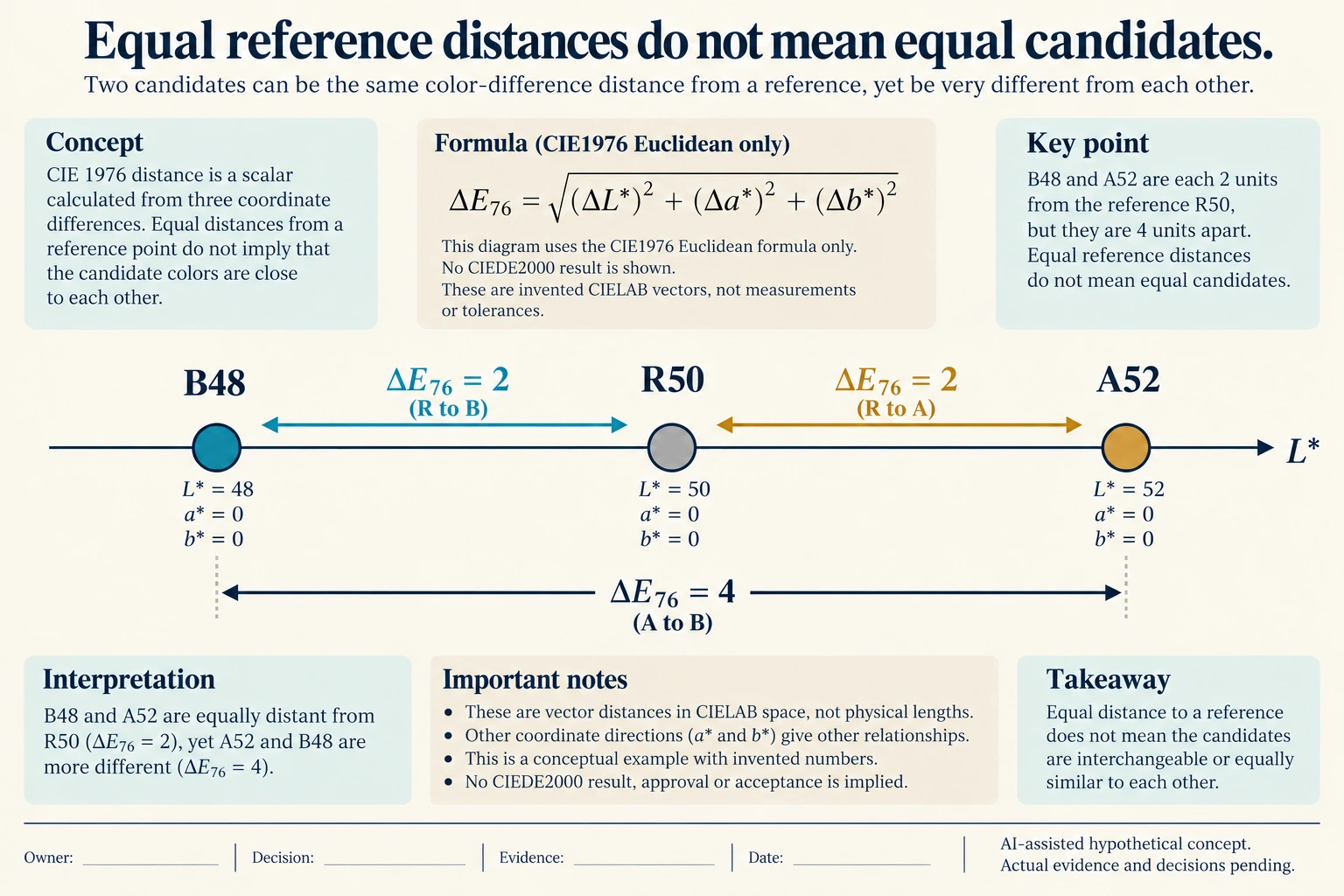
Keep the original published CIEDE2000 validation pair separate and use a new, entirely invented CIE 1976 calculation. Let R=(50,0,0), A=(52,0,0) and B=(48,0,0) in CIELAB. The values are mathematical vectors, not measured reference or supplier samples. All three comparisons use the same Euclidean Delta E76 formula.
Scroll horizontally if columns extend beyond the view.
| Hypothetical configuration | Named object | Relationship | Input or next scope |
|---|---|---|---|
| VECTORS29 | REF_R29_L | assumed input | 50 CIELAB_coordinate |
| VECTORS29 | REF_R29_a | assumed input | 0 CIELAB_coordinate |
| VECTORS29 | REF_R29_b | assumed input | 0 CIELAB_coordinate |
| VECTORS29 | CAND_A29_L | assumed input | 52 CIELAB_coordinate |
| VECTORS29 | CAND_A29_a | assumed input | 0 CIELAB_coordinate |
| VECTORS29 | CAND_A29_b | assumed input | 0 CIELAB_coordinate |
| VECTORS29 | CAND_B29_L | assumed input | 48 CIELAB_coordinate |
| VECTORS29 | CAND_B29_a | assumed input | 0 CIELAB_coordinate |
| VECTORS29 | CAND_B29_b | assumed input | 0 CIELAB_coordinate |
| VECTORS29 | REF_R29_VS_CAND_A29 | calculated from | sqrt(sum((x_axis-y_axis)^2)); 2 DeltaE76 |
| VECTORS29 | REF_R29_VS_CAND_B29 | calculated from | sqrt(sum((x_axis-y_axis)^2)); 2 DeltaE76 |
| VECTORS29 | CAND_A29_VS_CAND_B29 | calculated from | sqrt(sum((x_axis-y_axis)^2)); 4 DeltaE76 |
| VECTORS29 | CALCULATIONS | use only | CIE1976_EUCLIDEAN_NOT_CIEDE2000 |
| VECTORS29 | TWO_REFERENCE_DISTANCES_EQUAL2 | does not establish | CANDIDATES_EQUAL_OR_DISTANCE2 |
The difference from R to A is 2, and from R to B is also 2. But A and B lie on opposite sides of R along L*, giving a direct A-to-B difference of 4. Therefore two reports each stating 2 from the reference do not establish that their candidates are 2 apart, identical, or mutually acceptable. The pair being compared belongs in the record alongside the formula.
This is a different missing fact from comparing Delta E76 with Delta E00. Even when formula names match, a reference-to-candidate result cannot simply stand in for candidate-to-candidate agreement. Request the appropriate pairwise calculation from compatible original inputs if that is the buying question. Do not use this one-dimensional illustration as a universal doubling rule: other coordinate directions give other relationships.
For real printing, coordinate provenance, observer, illuminant, normalization, specimen and finish still have to be suitable. CIEDE2000 would additionally need its named implementation basis and kL/kC/kH; its result is not calculated or inferred by a fixed ratio here. ISO/CIE 11664-6:2022 public scope and the Rochester software-validation resources do not supply a commercial tolerance. No display swatch, metallic appearance, physical improvement or print approval follows from the three invented numbers.
Download the Delta E pairwise candidate reference distances record (.csv). It includes the original table fields and scenarios alongside the added relationships. HYPOTHETICAL rows are editorial examples or required review scopes, not actual records. Actual quantity, configuration, component and file identities, materials, process, specification, copy, method, condition, observation, owner, decision, evidence and dates are blank. ACTUAL_BLANK is a separate empty starting row; enter permitted project evidence before using an actual record. A blank means unknown.
Use the Packaging Color Approval With a Physical Reference for its separate question.
Source scope checked 17 October 2026: ISO/CIE 11664-6:2022 public scope/description and the Rochester 2005 paper/data were acquired; the paid full standard was not. The original 2.0425 software-validation value is not a print tolerance. The added CIE 1976 vector arithmetic establishes no physical colour match, metallic appearance or display proof. The added configurations and calculations are hypothetical, with actual evidence and decisions pending.
Discuss this packaging specification with Packrivo. We coordinate independent suppliers. MOQ: 500 pieces per product/design; illustrative quantities are not production offers. Confirm materials, samples, price and timing for your project.