
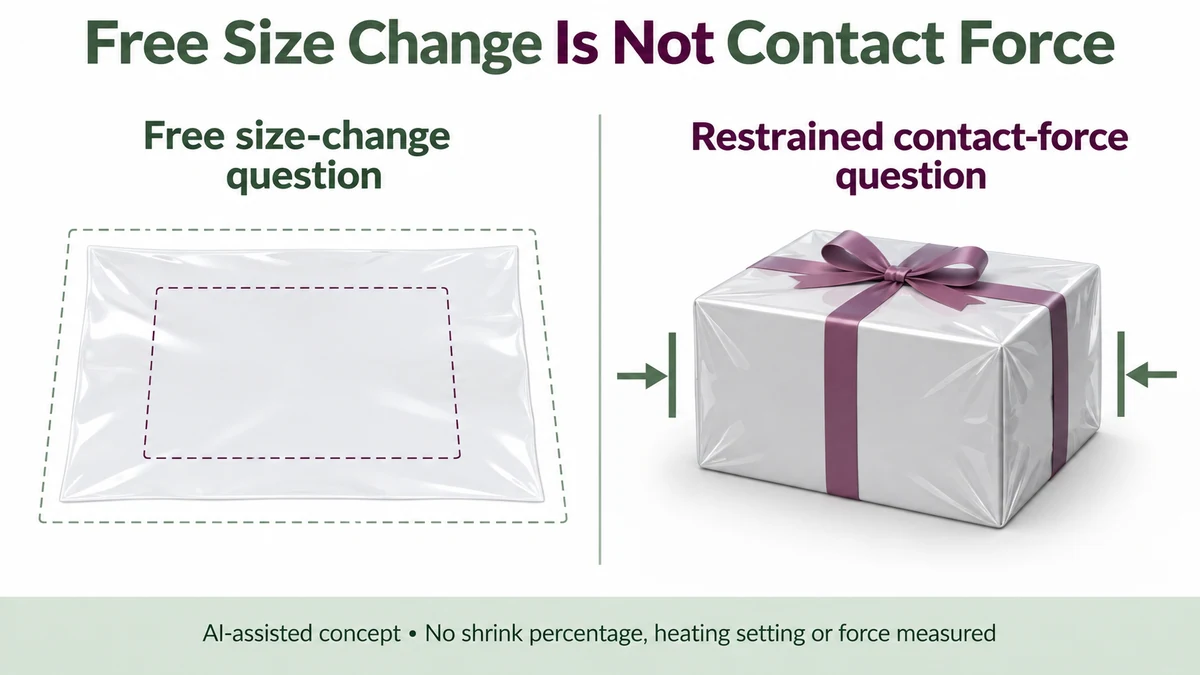
A film’s free-shrink percentage does not, by itself, predict the force it will exert against a gift set that restrains its contraction. Dimensional change without the item’s restraint and force under restraint are different mechanical questions.
Use Packaging Test Reports: Match the Ordered Configuration to keep the specimen, method and constrained state attached to any shrink-film evidence. A free-shrink percentage and force against the actual gift set answer different questions; neither can replace the other in a supplier comparison.
For a brand considering shrink wrapping, identify whether the unresolved requirement concerns the film’s change of size, its contact with the package or the response of the complete loaded set. A larger shrink percentage is not automatically a tighter, better-protected or suitable package.
No film, heating process, force or wrapped-gift result is evaluated in this article.
Free Shrink Describes an Unrestrained Dimensional Response
Some manufacturing histories leave orientation and internal stresses in a heat-shrinkable film. Heating can release a tendency for the material to contract, with the response depending on the particular film and conditions.
The public explanation of ASTM D2732-14(2025) concerns unrestrained linear thermal shrinkage. That is a dimension-change assessment under its stated conditions, not a test of the force received by a particular object inside the film.
A percentage therefore needs its direction and thermal basis. A film can behave differently along different material directions, and a value under one condition cannot silently represent every process or temperature.
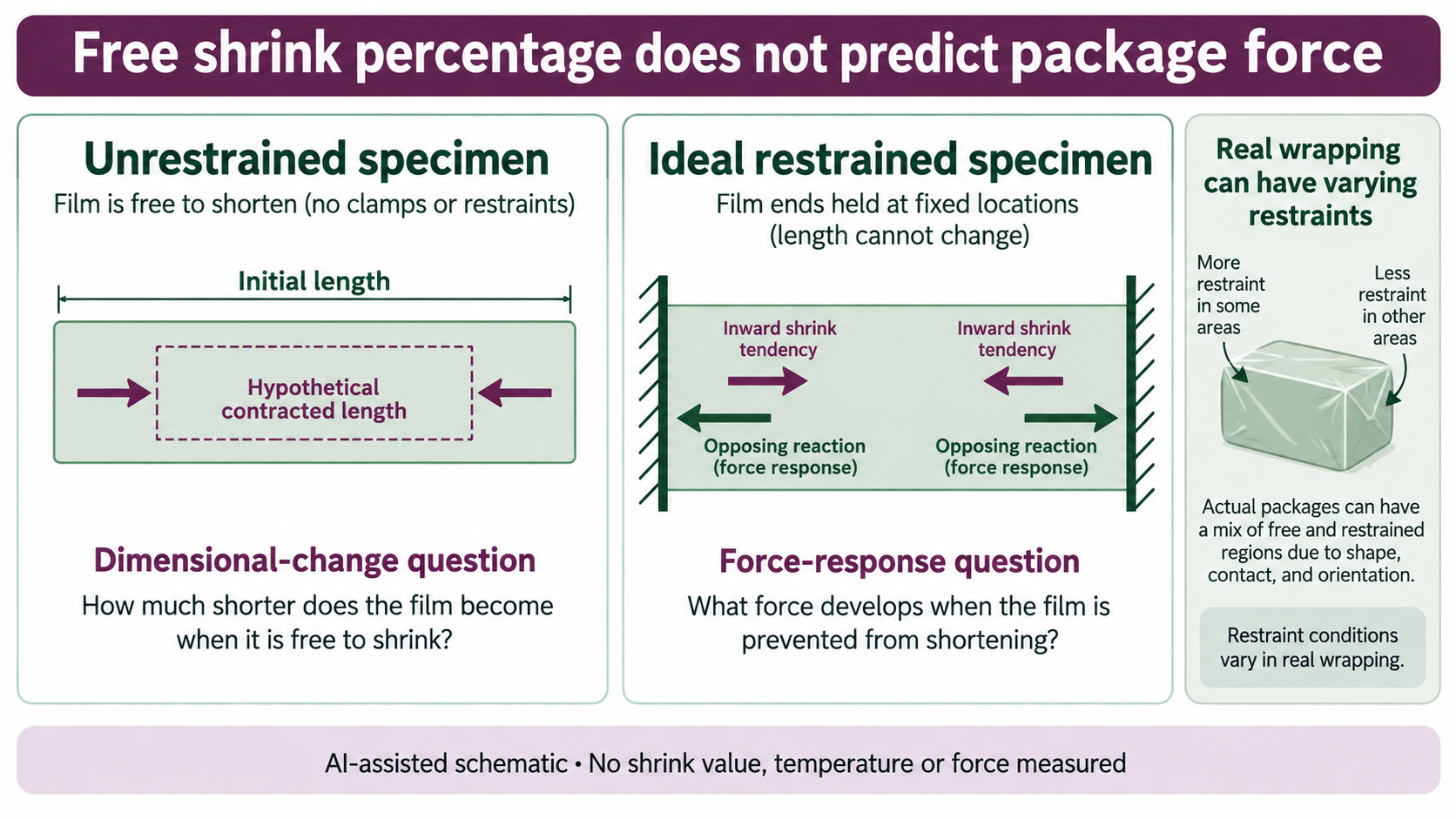
The buyer should also distinguish an unrestrained specimen from a finished wrapping. Contact with the item changes the constraints, so the film may no longer be able to take the same dimensional path.
Restraint Makes the Interaction a Force Question
When an object limits contraction, the response includes forces at the constrained arrangement rather than only a free change in length. The actual restraint and available movement matter.
ASTM D2838-18(2026) identifies shrink-tension and related force/stress questions in its public scope. It distinguishes restraint arrangements and notes that actual packaging is not generally identical to an ideal totally restrained state.
That boundary is important. Neither a freely shrinking strip nor one particular laboratory restraint automatically reproduces the contact around a finished gift set.
The same free-shrink percentage can leave the relevant force response unresolved. A dimensional ratio has no universal conversion into the load at a box corner, label or fragile component.
A Hypothetical Two-Candle Gift Set Has Several Constraints
Imagine a brand considering a shrink-film proposal around a rigid gift box containing two glass candle jars. The material information identifies free-shrink characteristics, but the brand is also concerned about interaction with the box corners and the loaded presentation.
This is a proposed comparison, not a recommendation to heat or shrink-wrap a real candle container. No film grade or process compatibility has been established.
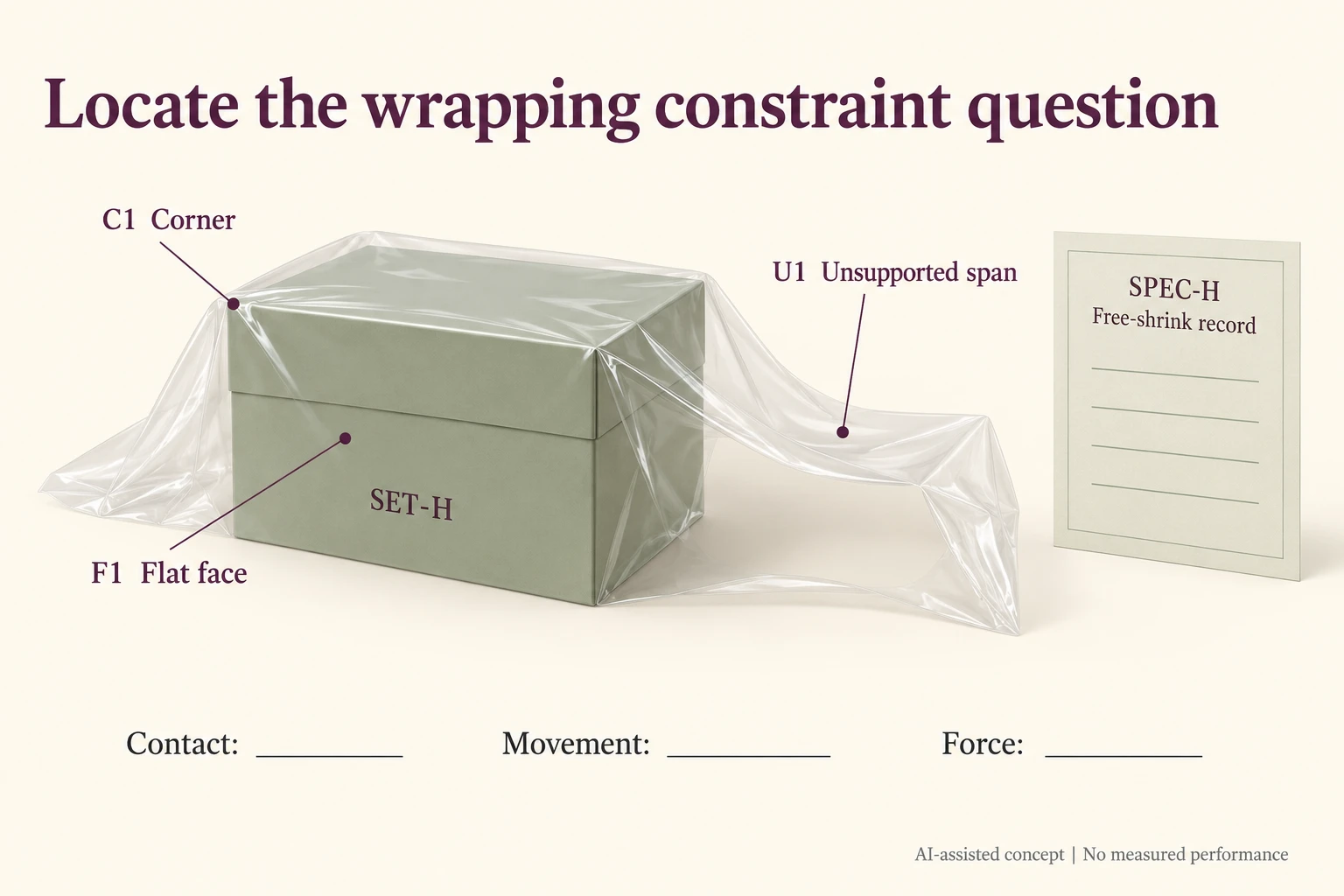
The wrapping can encounter corners, flat faces, unsupported film spans and transitions around the set. Those locations do not necessarily impose the same restraint or contact geometry.
A free-shrink description could inform the dimensional tendency of the specified material under its stated basis. It does not identify the force received at those different locations or prove that the loaded presentation remains suitable.
The immediate evidence gap is therefore specific: what information relates the offered film and proposed process to the actual wrapping constraints and contact question?
Choosing a greater percentage from a different material sheet would not answer that gap. It might change the construction or thermal behavior while leaving the application force unknown.
Appearance and Contact Loading Are Related but Separate Requirements
A visually close wrap does not measure its contact loading. The film can appear to fit a shape while the relevant package response remains unestablished.
Likewise, a material force characterization does not alone approve the complete wrapped appearance, label position or loaded product condition. The intended construction and use need to remain part of those decisions.
The tapered-container label guide concerns a flat label’s fit on a tapered receiving shape. A thermal shrink response is a different mechanism; successful label geometry cannot be relabeled as shrink-force evidence.
The film-and-varnish construction guide identifies surface layers in a packaging proposal. An independent shrink wrap is not automatically equivalent to a film laminated onto paperboard.
Retain Film Direction, Construction and Thermal Conditions
For a relevant material result, identify the film and direction, its thickness, the evaluation condition and the restraint arrangement. If a comparison changes those inputs, the meaning of the result changes as well.
This article does not provide a heating temperature, dwell time or machine speed. A process setting copied from a specimen method or another material cannot establish compatibility with the actual package and contents.
It also does not predict a shrink-force curve or a peak force from a generic percentage. Such a graph without relevant data would create an unmeasured result, not explain the remaining requirement.
The appropriate supplier or technical party must determine which material and application evidence can address the proposed construction.
Choose Evidence for the Actual Wrapping Job
First decide what is being asked: the film’s unrestrained size change, its force under a particular constraint, or the finished wrapping’s behavior around the gift. Keep the separate purposes visible when comparing information.
Where only a free-shrink value is available, contact loading remains an open question. Where a relevant restraint result is available, the actual package and process still need a suitable basis before any acceptance or heating recommendation.
Packrivo can coordinate film identity, construction and supplier questions. It does not operate a shrink line, measure contact forces or certify thermal suitability through project coordination.
Free shrink tells how a specimen can change dimensions under its stated conditions. It does not independently tell how much force a restrained gift set receives.
Source scope: Public ASTM catalogue material accessed 11 October 2026. D2732-14(2025) is the active reapproval updated 12 December 2025; D2838-18(2026) is the active reapproval updated 22 April 2026. Full paid methods were not obtained. No shrink percentage, heating condition, measured force, wrapped sample or product-contact suitability is established.
Locate free spans and constrained contacts on the same wrap
A single hypothetical film proposal F-H can meet a corner C1, a flat face F1 and an unsupported span U1 around one gift-set outline. This map identifies local questions without assigning a shrink percentage, heating condition or force.
Scroll horizontally if columns extend beyond the view.
| Region | Proposed relationship | Evidence gap |
|---|---|---|
| C1 | Film meeting a box corner | Actual contact/constraint and local response |
| F1 | Film beside a flat face | Actual contact and available movement |
| U1 | Film across unsupported region | Local geometry and possible free movement |
| SPEC-H | Separate unrestrained specimen record | Direction, material and thermal basis; not application force |
A region label does not classify the entire wrap as totally restrained. Contact can vary around one assembly, and its state can change during a proposed process. Leave actual contact and movement blank unless the responsible evidence establishes them.
Keep film identity, material direction and process reference with every document. A free-shrink percentage can populate only its dimensional-response record; it cannot fill the C1 force cell. A restrained-specimen result also needs an applicability review before describing the gift set.
This is a construction and evidence map, not permission to heat the package or its contents. No temperature, dwell, machine speed, force curve, thermal compatibility or material recommendation follows from the illustration.
Download the shrink film force versus shrink percentage record (.csv). HYPOTHETICAL rows are invented examples. Use ACTUAL_BLANK for permitted project inputs; replace that row label only when recording actual facts. Empty evidence, observation and date fields mean unknown or not performed, never acceptance. Keep checkpoints and revisions separate.
Bring the film identity and region-specific contact questions through the original enquiry route so dimensional and force evidence retain their separate meanings. Packrivo coordinates independent suppliers. These records establish no supplier offer, service availability or MOQ exception; its published baseline is 500 pieces per product/design.