
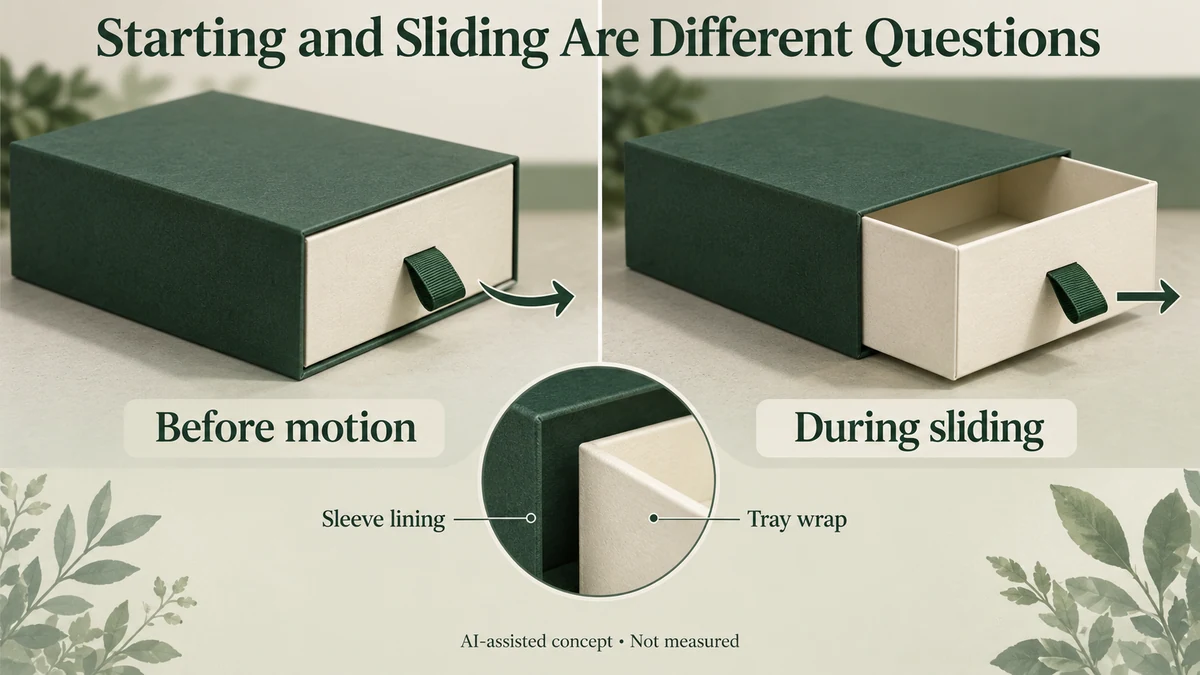
A sliding gift box that takes a firm first pull but then moves smoothly presents a different question from one that becomes harder to move halfway through its travel. The first pattern may involve resistance before sliding begins. The second may involve sliding friction, changing contact pressure or a local obstruction.
Neither pattern can be explained by visible clearance alone.
For a jewellery drawer, candle presentation sleeve or small gift tray, the useful first distinction is between starting resistance and resistance during movement. Identify the surfaces actually meeting, how they are pressed together and when the difficulty occurs before requesting a larger sleeve or an anti-scuff finish.
Starting resistance is not the same as sliding resistance
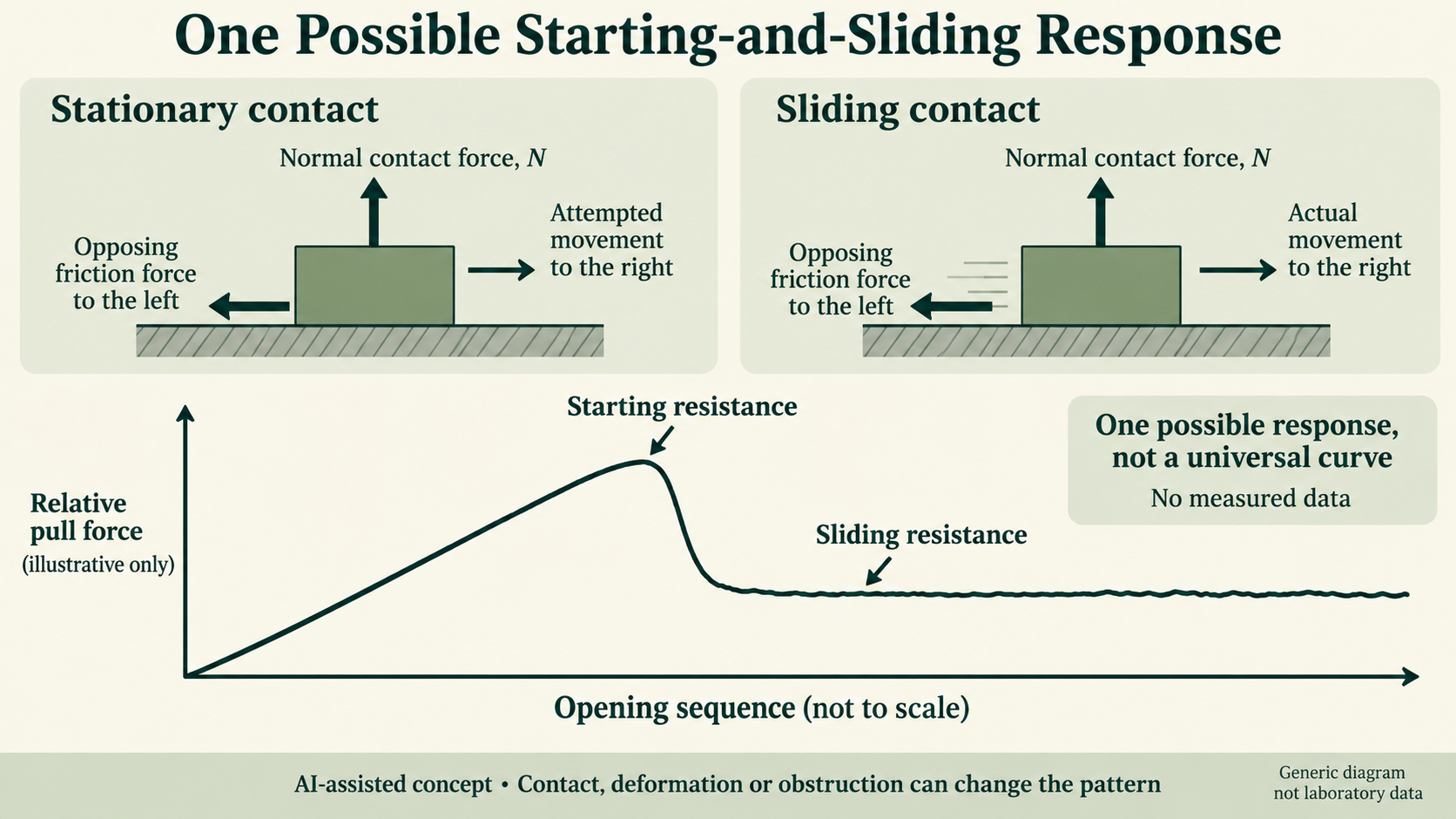
When two surfaces are pressed together but are not moving relative to each other, static friction can oppose an attempted movement. That resistance responds to the applied force up to a limiting value.
Once the surfaces slide relative to each other, kinetic friction becomes relevant.
An elementary friction model expresses the distinction using two relationships:
-
Static friction before movement: fₛ ≤ μₛN
-
Kinetic friction during sliding: fₖ ≈ μₖN
Here, N represents the normal contact force pressing the two surfaces together. The coefficients μₛ and μₖ describe the relevant contact pair under stated conditions. The limiting static resistance in the simple model is μₛN; static friction does not remain at that maximum throughout every stationary moment.
The kinetic relationship is also an approximation for interfaces whose friction behaves simply, not a universal description of every surface.
OpenStax’s University Physics Volume 1, Section 6.2, published September 19, 2016, explains these relationships as an empirical model.
The equations establish an important distinction for packaging buyers: a friction coefficient is not itself a pull force. Resistance depends on both the contacting surfaces and the normal forces acting between them.
For a drawer sleeve, the normal force pressing a sidewall against the tray is not necessarily equal to the weight of the product inside. Wall deformation, assembly fit and support conditions can also affect that contact.
Nor should a buyer assume that starting friction always exceeds sliding friction for every material pair and movement condition. A higher starting resistance followed by easier travel is one possible behavior, not a guaranteed feature of every package.
Friction belongs to a contact pair under stated conditions
A finish cannot be described as having one universally applicable friction value.
Consider the inside lining of a paperboard sleeve meeting the printed wrap of its tray. That is a different contact pair from a plastic film sliding against itself. Changing either face can change the interaction.
The public scope of ASTM D1894-24, Standard Test Method for Static and Kinetic Coefficients of Friction of Plastic Film and Sheeting, distinguishes starting and sliding friction for plastic film and sheeting against itself or another specified substance under stated conditions.
Its publicly accessible significance-and-use information also identifies motion conditions, surface condition and material age as factors relevant to some film and sheet measurements.
Westpak’s material-analysis service description likewise lists starting and sliding coefficients separately for plastic film and sheeting.
These sources support treating the two measurements as different quantities. They do not establish a standard opening-force test for a completed rigid paperboard drawer.
A film coefficient supplied for one pairing should therefore not be treated as the opening force of a finished sleeve-and-tray assembly. Even when a relevant surface measurement is available, the assembly may have multiple contacts, changing normal forces, deformation and other sources of resistance.
A meaningful comparison must identify which finished faces touch, their condition, the loading arrangement and the movement conditions. A different coating, board construction or opposing face changes the comparison rather than simply changing a material name.
A sleeve can change its contact pressure during travel
A drawer is not necessarily a rigid block moving across one unchanging flat surface.
A paperboard sleeve can flex when a loaded tray enters or leaves it. A sidewall may press against the tray wrap in one position and release some of that contact farther along the opening path. The loaded tray itself may change shape or alignment.
These are possible mechanical responses, not established characteristics of a particular Packrivo package.
The distinction matters because visible space and normal contact force describe different things.
A nominal gap at the sleeve mouth does not establish the contact conditions farther inside. Similarly, finding that one measured dimension has sufficient clearance does not prove that the assembled drawer will move with little resistance.
If two surfaces do not touch, their interface cannot contribute sliding friction at that location. But a clear-looking region does not rule out contact at an adjacent wall, folded edge or seam.
The mechanical questions are different:
A contact surface may resist the first movement without a hard geometric obstruction. An internal overlap may cause a localized catch only after the drawer reaches it. A flexible wall may progressively increase contact pressure while the tray moves.
All three can produce a complaint that the drawer feels tight, but they do not justify the same design change.
Packrivo’s sleeve seam travel guide addresses the separate task of locating possible seam interference. A contact-location observation is useful, but it does not by itself determine friction coefficients or quantify sliding resistance.
A hypothetical starting peak does not establish the cause
Consider an entirely hypothetical jewellery drawer containing a pendant on a fitted holder and an information card.
The tray has a ribbon pull, and the finished sleeve and tray are assembled in their intended orientation.
Imagine that a properly supported opening action produces the following qualitative response:
At first, the tray remains stationary while the applied pull increases. There is a relatively high resistance immediately before movement begins. Once the tray starts moving, the resistance falls to a lower, fairly even level through the remaining travel.
This is an invented, schematic force pattern. It is not a measurement, an estimated force, a Packrivo test or a claim that the package will behave this way.
A friction-dominated start is one possible explanation for such a pattern. Contact that has remained stationary can resist the initial movement differently from contact that is already sliding.
But the shape alone does not prove that explanation.
A mechanical catch, temporary deformation or another release event could also produce an apparent starting peak. A force trace without the matching movement and contact context is not a definitive diagnosis.
Now imagine a different response from the same hypothetical packaging format.
The drawer begins moving easily but becomes harder to pull near the middle, then moves more freely after passing that region.
That pattern raises questions about changing contact geometry, sleeve deformation or a localized obstruction. It should not automatically be labelled high static friction, because the tray was already moving when the difficulty developed.
The two hypothetical responses have different decision implications. One directs attention toward the contact pair and conditions immediately before movement. The other directs attention toward what changes along the travel path.
Neither response supports a universal opening-force limit, a particular friction coefficient or an automatic material substitution.
Separate the starting grip from the force needed to start sliding
Before interpreting resistance, establish whether the buyer is actually observing resistance of the moving assembly.
A ribbon that is difficult to grasp can make a box feel hard to open even when the tray itself is not particularly resistant. A flexible pull may change the hand position or loading direction. An attachment may move or deform before the tray starts sliding.
Those are pull-design and attachment questions.
The drawer-pull attachment guide addresses the availability of the starting grip, the hidden attachment and the loaded opening action.
Once the intended grip and attachment are understood, the remaining question is whether resistance comes from the tray-to-sleeve interaction and how it changes between starting and continued movement.
This separation avoids treating a ribbon revision as proof that sleeve friction has changed. It also avoids blaming the ribbon simply because the first movement requires more effort.
Match the next investigation to the movement pattern
For a complaint concentrated at the first movement, the useful technical request is to review the identified tray-to-sleeve contact pair and the conditions under which movement begins.
That includes the finished contacting surfaces, loaded configuration, assembly orientation, starting condition and intended pull direction. If quantitative opening resistance matters, the responsible technical party must define an appropriate assembled-package evaluation rather than transferring a flat-film coefficient into an unsupported drawer-force prediction.
For resistance concentrated partway through travel, investigate what changes at that position. A seam, folded edge, shifted holder or flexing wall can alter the local contact condition. Enlarging the complete sleeve before identifying the interface may change the overall fit without addressing the specific mechanism.
For a visible mark noticed after sliding, keep the appearance observation separate from the force question. The surface-scuff observation guide addresses how to document a mark and its preceding action. A scuff does not reveal the resistance that occurred or prove that an anti-scuff finish will reduce opening effort.
If two material or construction proposals are to be compared, the basis must remain identifiable. The loaded contents, finished geometry, supported opening orientation, pull direction, starting dwell and movement conditions all affect what a comparison means.
Where geometry or loading changes along with the surface, the result represents a changed assembly, not a friction-only comparison.
A supplier may propose a suitable way to evaluate starting and travelling resistance on the actual package. The measurement method, relevant conditions and functional criteria still require project-specific agreement. This article does not prescribe an improvised ASTM test or a numerical pass threshold.
Decide whether the problem begins at rest or develops in motion
The practical decision is not simply whether the drawer feels tight.
If the intended grip is unavailable or its attachment is unresolved, address that construction first.
If the grip works and the loaded tray shows difficulty mainly before movement, investigate starting resistance and the contacting surfaces under their actual conditions.
If resistance increases after movement begins, examine changing contact, deformation and local interference along the travel path.
Only then can a proposed clearance or surface change be connected to a defined problem.
Packrivo can coordinate these distinctions within the packaging brief, supplier questions and sample-review discussion. It does not establish friction performance, certify a material or guarantee a particular opening effort.
Starting a drawer and keeping it moving are separate friction questions. A sensible packaging decision preserves that distinction before changing the structure or finish.
Source and scope note — checked October 10, 2026: ASTM D1894-24 is the active edition; its public catalogue lists December 16, 2024 as the last-update date. Only the publicly available scope and significance-and-use material were consulted, not the paid seven-page method. Westpak’s accessible material-analysis and coefficient-of-friction service pages have no confirmed publication date. OpenStax’s University Physics Volume 1 was published September 19, 2016 and provides the general approximate friction model. None of these sources supplies a measured force, friction coefficient or acceptance criterion for the hypothetical paperboard drawer described here.
Attach the observation to the movement stage
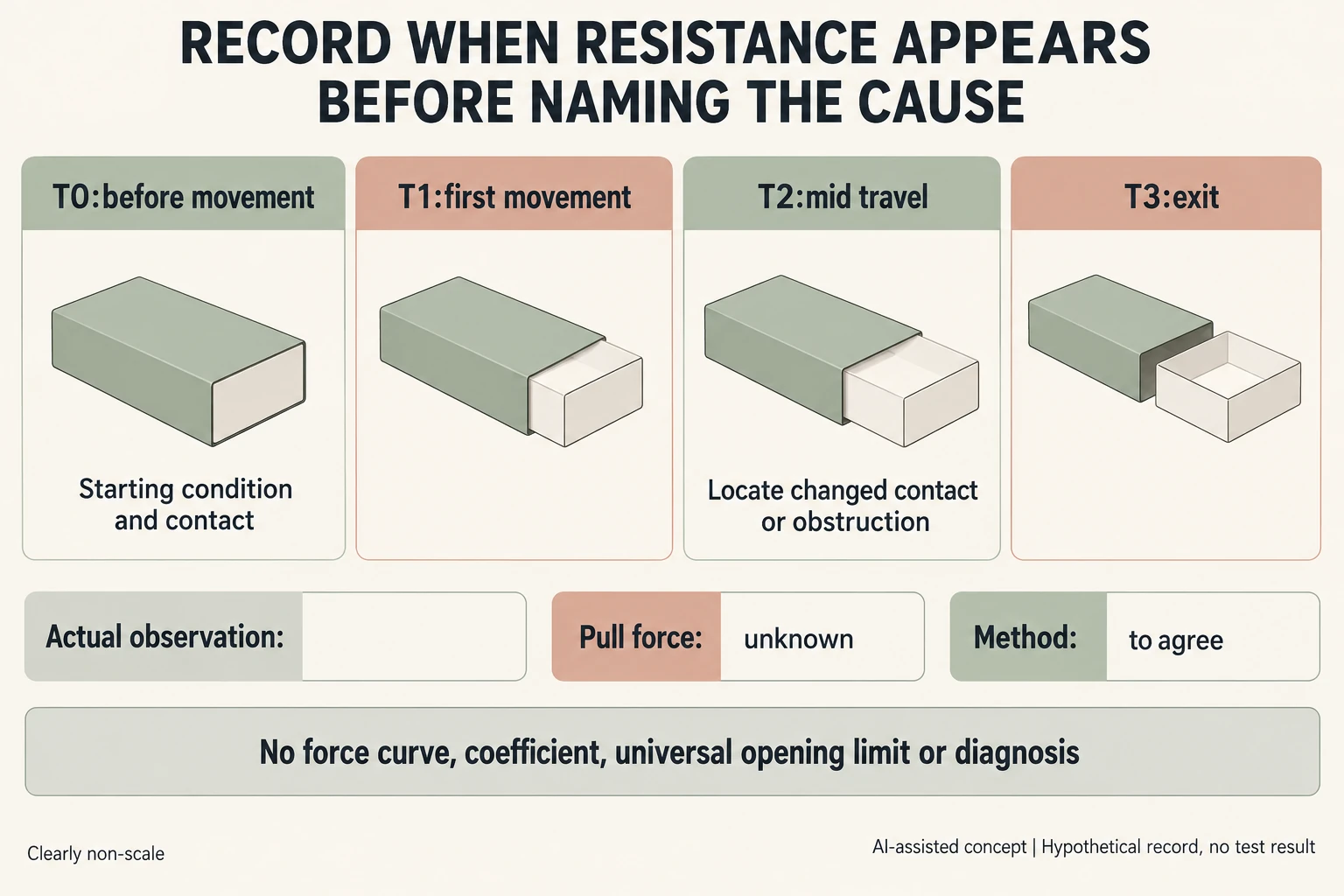
For invented sleeve S-H and tray T-H, use T0 before motion, T1 first movement, T2 mid travel and T3 exit as record headings. They are planned checkpoints, not an observed opening sequence. The icons depict position only, without a loaded specimen or a force trace.
Scroll horizontally if columns extend beyond the view.
| Stage | Located question | Do not infer |
|---|---|---|
| T0 before motion | Starting grip, support and contact | A friction coefficient from feel |
| T1 first movement | What first moves or deforms? | Starting peak proves one cause |
| T2 mid travel | Where does the interaction change? | All moving resistance is static friction |
| T3 exit | Final contacts and support | Free exit proves every earlier stage accepted |
If difficulty begins after motion, retain the actual position and contact question rather than labelling the whole event high starting friction. If the pull changes shape before the tray moves, keep that attachment/grip observation separate. These are routing questions, not diagnoses.
Define the actual loaded configuration, supported action, contact pair, conditions and any quantitative method with the responsible party. Do not import a plastic-film coefficient into a paperboard drawer-force field. The CSV leaves force in newtons, position in millimetres, method and observations blank; no universal force limit, elapsed-time rule or successful operation is invented.
Download the sliding gift box friction record (.csv). HYPOTHETICAL rows are invented examples. Use ACTUAL_BLANK for permitted project inputs; replace that row label only when recording actual facts. Empty evidence, observation and date fields mean unknown or not performed, never acceptance. Keep checkpoints and revisions separate.
Send the located stage, actual loaded contact configuration and supported action before requesting a surface, clearance or quantitative evaluation change. Packrivo coordinates independent suppliers. These records establish no supplier offer, service availability or MOQ exception; its published baseline is 500 pieces per product/design.