
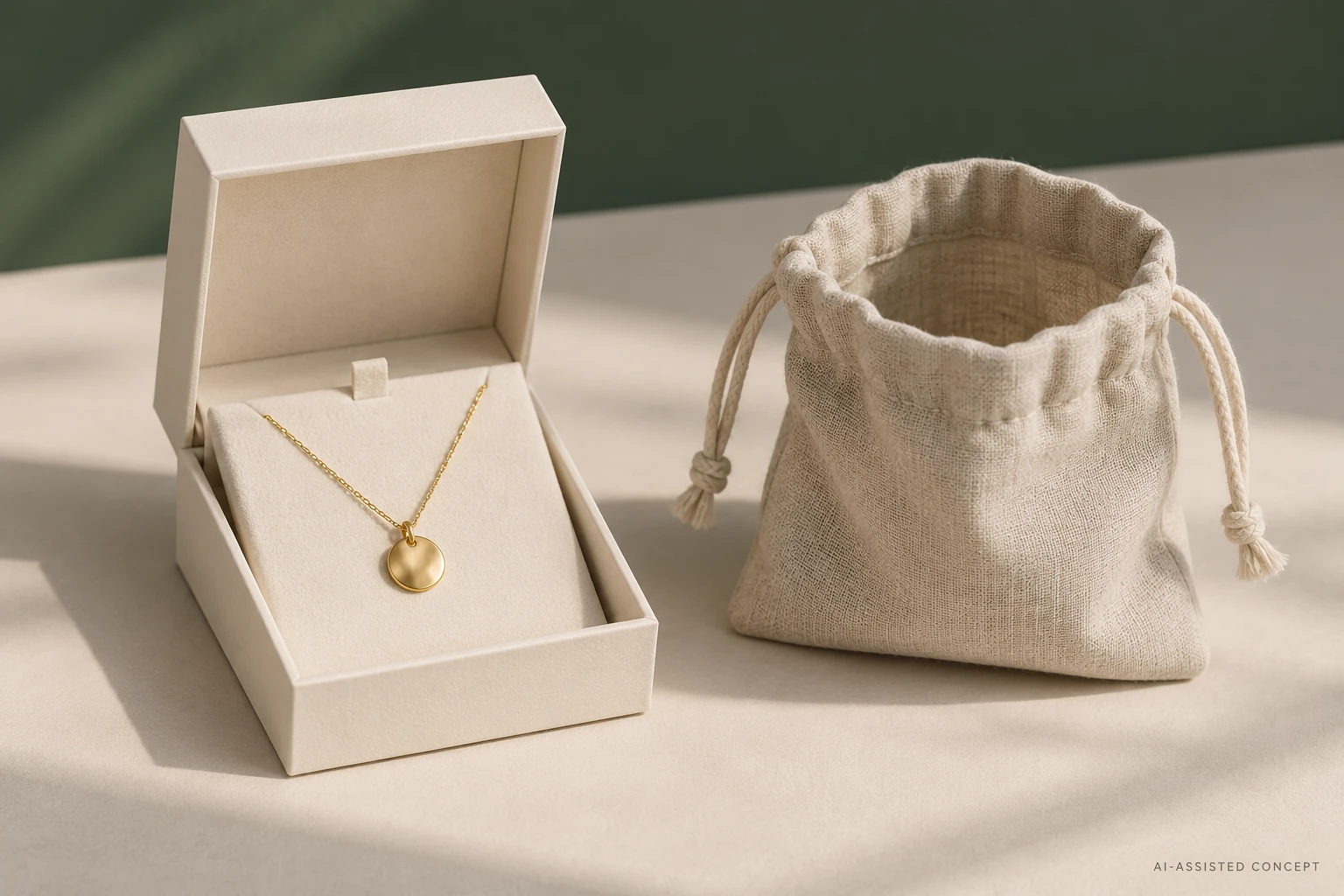
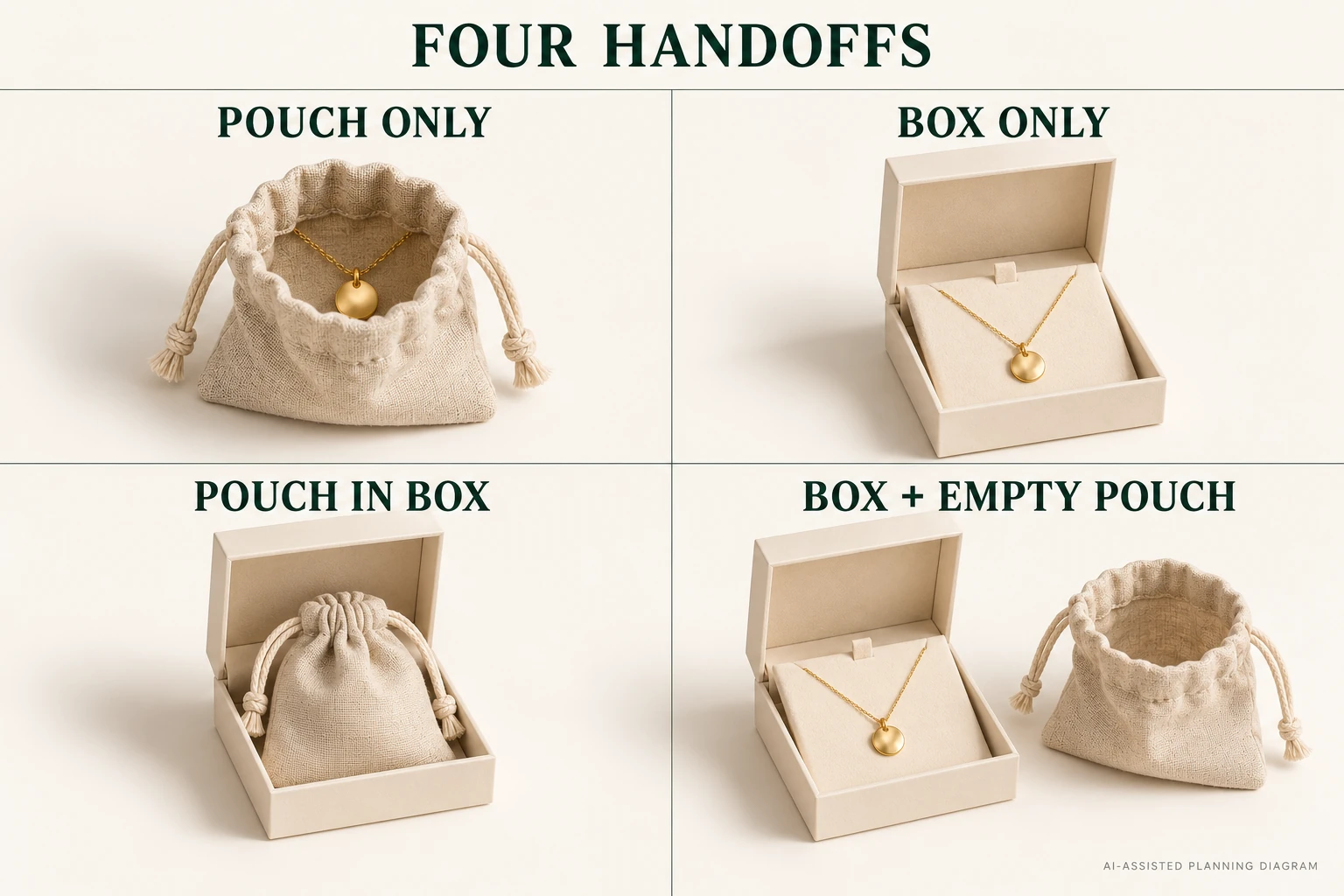
Choose the jewelry package by deciding what the customer receives and sees first, not by assuming every purchase needs a box. A pouch-only offer, a box-only offer, a filled pouch inside a box, and a box display with a separate empty pouch create different handoffs. The right shortlist follows the intended first reveal and later use.
Choose the handoff you want the customer to receive
Start with the finished offer, rather than the packaging components on a supplier page. Will the recipient untie a pouch to discover the jewelry, open a box to see it displayed, or encounter one container inside another? What, if anything, should remain useful after that first opening? These questions decide which arrangement deserves development.
Keep the jewelry piece, selling context and intended audience constant while comparing the four packaging handoffs.
A box with a suitable holder can provide a fixed presentation position. A pouch can provide a deliberate soft-container handoff. Keep both when each has a defined purpose. If a fixed box display matters, a pouch alone leaves that requirement unanswered. The relevant difference is what the recipient experiences and what the product owner intends the recipient to use later.
Treat the eventual parcel as a separate problem. A customer-facing box or pouch is not, by its name, a complete shipping configuration. The jewelry boxes and pouches collection provides commercial directions to explore after choosing the handoff.

When a pouch can take the place of a presentation box
A pouch-only offer is worth shortlisting when the brand does not need the jewelry displayed in a fixed position as a rigid lid opens. The recipient first meets a closed or gathered pouch, opens it, then finds the item inside. That sequence can be the intended presentation rather than a compromise for an absent box.
The brand must decide whether the jewelry is received loose, attached to an agreed display card, or accompanied by another defined support. A card may still serve product identity or presentation even when there is no rigid box.
If the proposed pouch is intended for later individual storage, define that intended use narrowly. The GIA jewelry-care article, published December 10, 2015, discusses boxes, pouches and separation, while also noting that different jewelry requires different care. It does not certify a generic fabric pouch for every metal, gemstone or storage condition. Jewelers of America’s undated care guidance likewise cautions against keeping jewelry jumbled together.
The pouch-only offer is not a promise of safe travel or transport. FedEx’s US jewelry-shipping guide places a pouch or cloth within additional cushioning and box layers. The parcel needs its own assessment. Once the handoff is chosen, the jewelry pouch specification guide handles finished opening, closure and item entry rather than making that technical detail the reason to select the offer.
When a box and pouch earn separate places
A box-only offer puts the displayed jewelry at the center of the first reveal. The box opens and the recipient sees the intended piece or holder without opening a second enclosure. If an independent pouch has no defined later role, adding one can make the offer more complicated without answering a buyer requirement.
A filled pouch inside a box makes a very different first impression. The outer box opens to a pouch; the recipient must then open the pouch to discover the jewelry. That concealed-item sequence can be chosen deliberately when the pouch itself is the reveal object and the outer box contributes a separate presentation role. It is unsuitable when the specified first reveal is the jewelry already on display.
A displayed-jewelry-plus-empty-pouch offer keeps the jewelry visible when the box opens. A separate, empty pouch is included for a use defined by the product owner. The pouch might be intended as an individual take-home container after removal from the display, subject to suitability for the actual piece. It is not where the jewelry is hidden at handoff.
This distinction changes what product photography, an opening illustration and customer-facing offer copy should show. A styled image of a pouch next to a box must not quietly imply that every customer receives it, or that it arrives filled. First decide which of the four offers is being sold. Then, if a box remains in that offer, the jewelry box structure guide can address the separate opening mechanism and retrieval task.
Put branding on the surface the customer actually sees
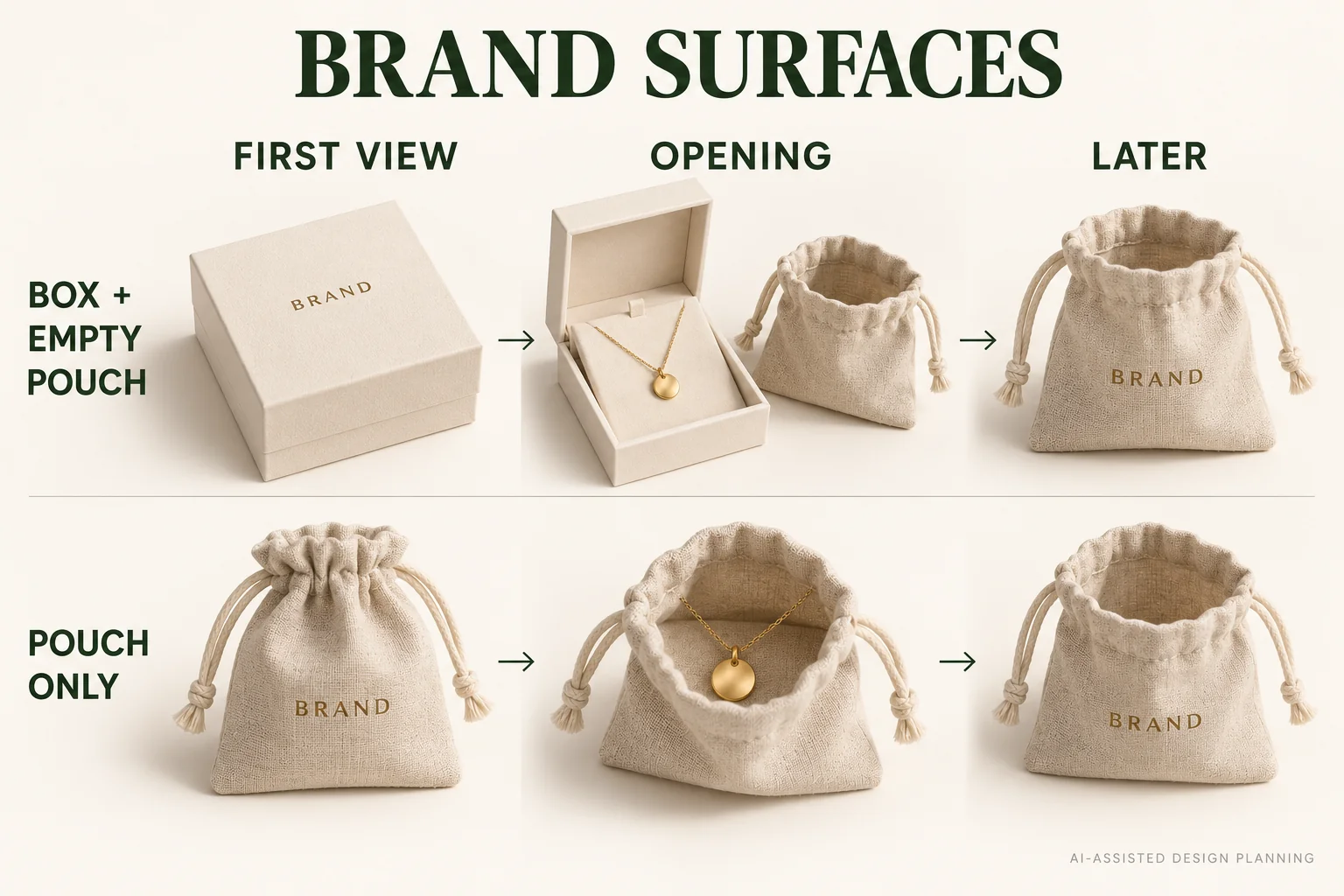
Branding should follow the chosen sequence rather than automatically appear on every face. For pouch-only handoff, the pouch exterior may be the main branded object; a mark that disappears into the gathers when closed may not serve that proposed viewing moment.
For box-only handoff, the exterior can establish identity before opening and the inside can frame the displayed piece. Choose the face that performs the more important job. A logo on the lid and another directly behind a pendant are not necessarily both needed to establish a coherent design.
In a filled-pouch-in-box offer, the recipient encounters at least two surfaces before the jewelry. Decide whether the outer box carries the main brand expression and the pouch remains quiet, or whether the box introduces a stronger mark on the pouch. Neither is proven to increase preference or sales; they are distinct proposed storyboards.
For displayed jewelry plus an empty pouch, keep the box as the primary first-reveal surface. A restrained identifying mark on the later-use pouch may be enough if the brand wants it recognizable after separation. A simple opening map follows the closed handoff, the first object seen, the revealed jewelry and the object intended to remain. It helps the designer choose surfaces without repeating a list of print specifications.
Compare four ways to deliver the same pendant
Consider this explicitly hypothetical planning example: one unnamed pendant, one defined selling context, and no existing sample or customer research. The brand must select one offer for further development. The table describes proposed experiences, not tested constructions, measured preferences or supplier quotations.
Scroll this comparison table to see all columns.
| Proposed offer | First reveal | Reason to shortlist | What the decision does not settle |
|---|---|---|---|
| Pouch instead of presentation box | Recipient opens the pouch to find the pendant or agreed card arrangement | A fixed box display is unnecessary and the pouch is the intended handoff | Later storage suitability, jewelry contact and separate parcel protection |
| Box only | Pendant is visible on its agreed holder when the box opens | Immediate displayed presentation is the priority | A pouch must not be implied as included |
| Filled pouch inside box | Recipient sees the pouch first, then opens it to find the pendant | The brand deliberately wants a two-stage, pouch-first reveal | The closed pouch’s box fit and actual item contact |
| Displayed pendant in box plus empty pouch | Recipient sees the pendant and a separately supplied empty pouch | Immediate display and a separate later pouch role are both desired | The pouch’s purpose, placement and suitability still need definition |
Suppose the product owner insists that the pendant be visible the moment the box opens. The filled-pouch-in-box route fails that stated requirement, regardless of how attractive its exterior might be. The pouch-only route also fails the particular requirement for a box opening. Box-only and displayed-pendant-plus-empty-pouch remain candidates.
If the owner additionally wants a separately supplied pouch for an explicitly defined later use, the fourth route becomes the more relevant shortlist. The empty pouch is not a second wrapping layer around the pendant at first reveal. Conversely, if no later pouch role is needed, box-only avoids including an object without a purpose.
A different product owner who does not require the fixed display could instead shortlist pouch-only. These are conditional design judgments, not sales findings. The choice establishes the proposed handoff; technical compatibility and any required shipping review still follow for the selected configuration.
Request the combination you have chosen
A useful first inquiry explains the offer in plain language: “We want this pendant visible on its holder when the presentation box opens, with a separate empty branded pouch intended for later individual use. Please explore that arrangement, not a filled pouch hidden inside the box.” Replace this hypothetical sentence with the actual product owner’s chosen route.
If the preference is pouch-only or filled-pouch-in-box, state that directly instead. Name the surface where the branding is intended to appear and whether any card stays with the jewelry. Ask for a proposal showing what the recipient sees at each opening, then move to specifications for the actual jewelry and offered materials. The handoff decision need not turn into an extensive approval form.
Packrivo coordinates packaging sourcing questions with independent suppliers rather than manufacturing these parts itself. Supply feasibility, product contact, finished samples, prices and delivery terms need project-specific confirmation. Packrivo’s public starting minimum is 500 pieces per product/design, not a promise that a mixed box-and-pouch offer is available as one divisible order.
Discuss the selected jewelry handoff with Packrivo, naming the chosen route and the one presentation decision still to resolve.
Sources and scope
Sources were checked on 25 October 2026 (America/Los_Angeles). Their guidance applies only within the conditions described above. The worked example and planning images are hypothetical; they do not establish a supplier offer or tested result.