
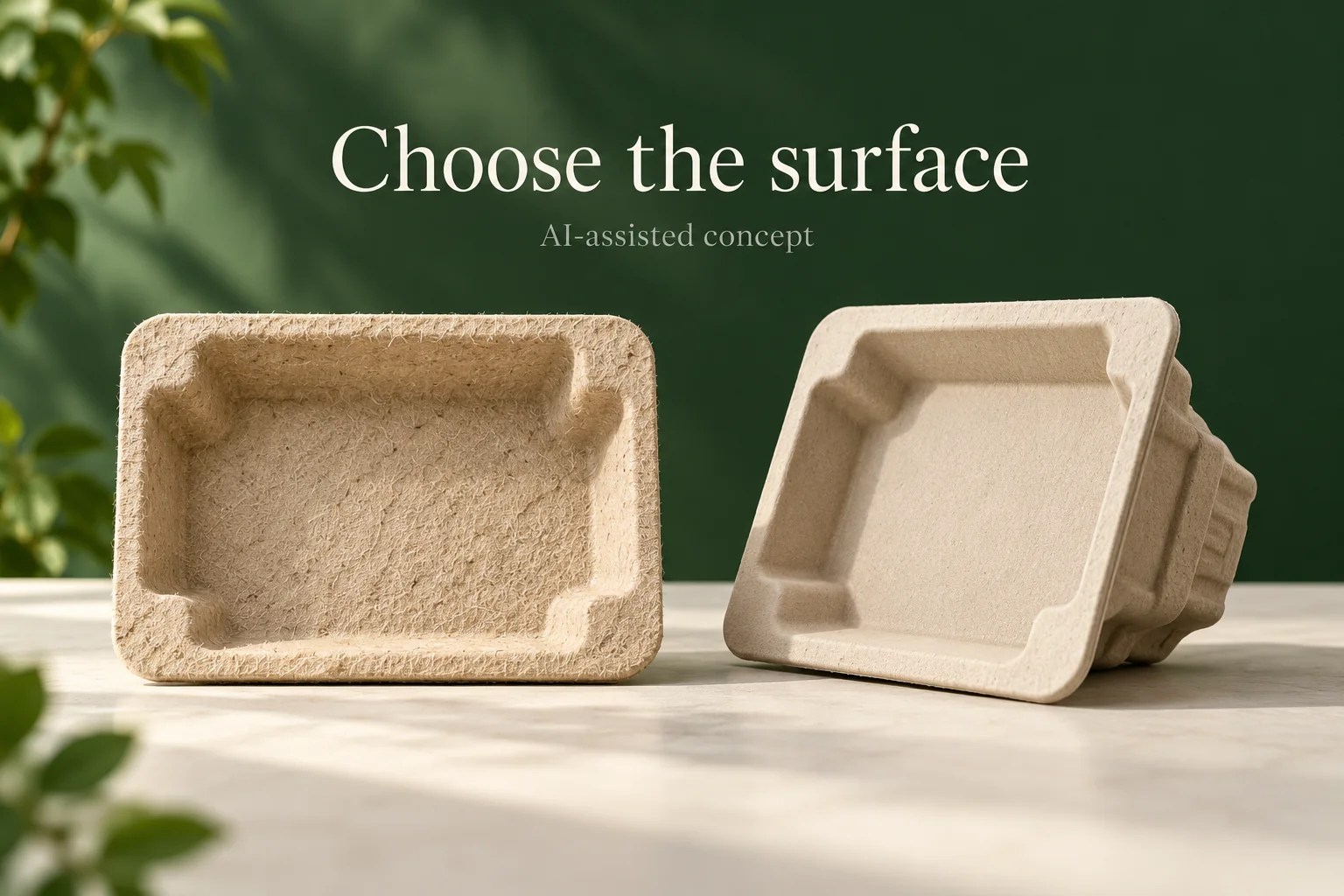
Choose a molded pulp insert by matching its finished surfaces to the way the gift is presented and held. Transfer-molded, thermoformed and supplier-specific pressed processes can produce different results. Identify the proposed route, then examine the actual visible, contacting and reverse areas before shortlisting a sample. A smooth appearance alone cannot establish product compatibility.
Start with the surfaces the gift actually uses
Consider a fictional candle brand placing one glass jar J1, with a paper label, inside gift box B1. The brand has decided to explore molded pulp. It wants a deliberate appearance around the jar when the lid opens, while the insert locates the contents. No actual dimensions, supplier or sample is assumed.
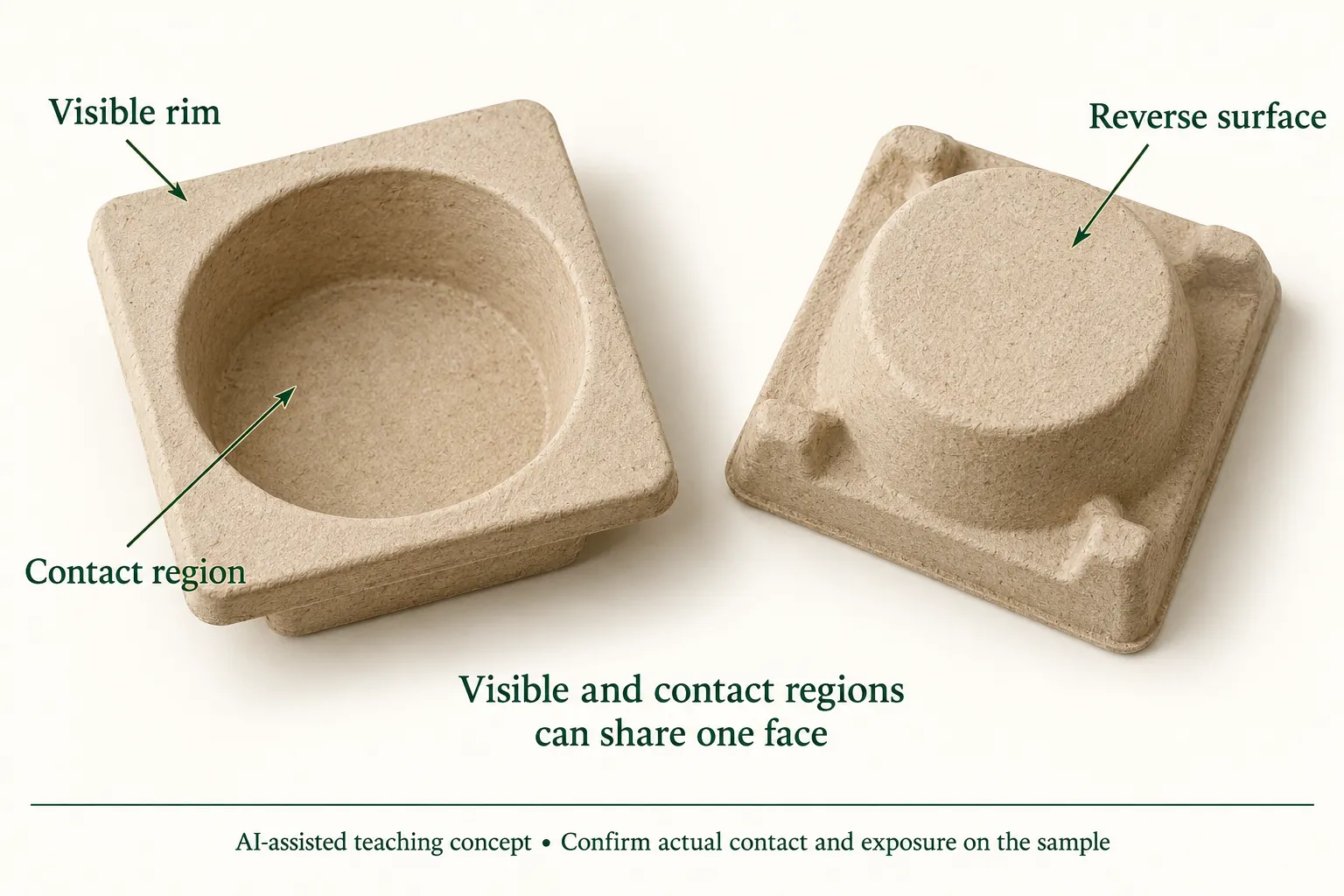
Three area names make the choice easier. V is the area visible in the intended opening view. C is the area that contacts the glass, base or label in the proposed arrangement. R is the reverse, facing away from that opening view. These names describe jobs and orientation; they need not describe three separate physical faces.
The front face can contain both a visible rim and a contacting cavity wall. A label may meet part of that wall. The reverse may face the box floor initially, yet become visible if the recipient lifts the insert. A design decision to hide it needs the complete arrangement and intended use.
The insert materials comparison addresses the earlier choice between different holder forms. Here, the buyer has selected pulp and needs to choose which manufacturing and finished-surface proposal deserves a closer look.

Follow where the formed pulp is dried
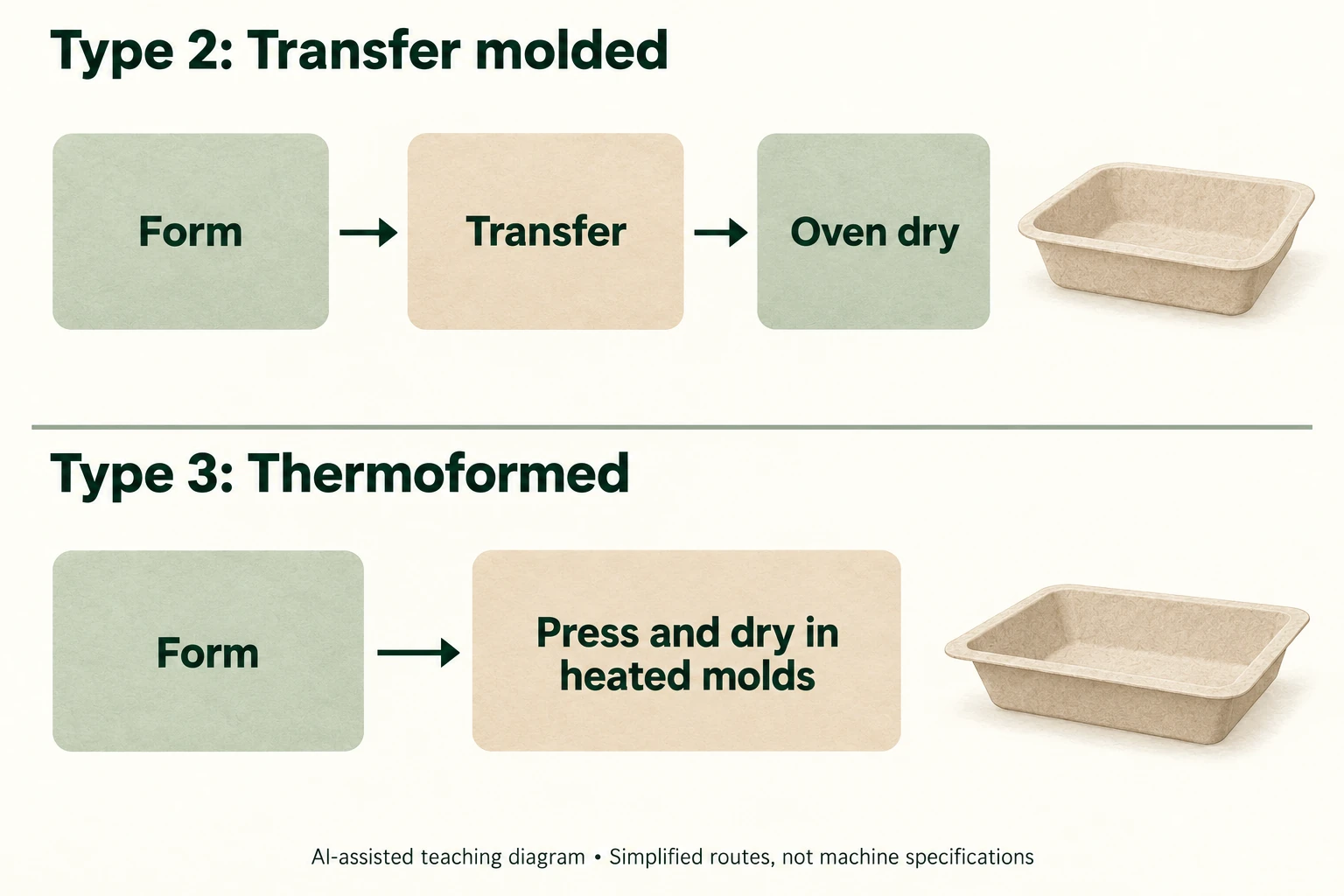
The International Molded Fiber Association’s four-type classification gives a useful starting vocabulary. Its Type 2, transfer-molded route uses a forming mold and a transfer mold, followed by oven drying. The association describes a relatively smooth surface on one side.
Type 3, thermoformed or thin-wall molded fiber, uses multiple heated molds and dries the product in the mold. IMFA describes smooth surfaces and detailed forms. This is molded fiber processing; it should not be confused with stretching a plastic sheet into a tray.
The drying step also helps identify a separate finish operation. A conventionally formed part can be dried and then pressed again. IMFA lists hot or after pressing among its Type 4 secondary treatments. A smooth finished insert therefore does not, by itself, reveal whether it was dried in heated molds or pressed after drying.
For a buyer, the useful distinction is the actual sequence behind the offered part. Ask where drying occurs and whether a later pressing operation is included. You do not need to prescribe machine settings to distinguish those proposals.
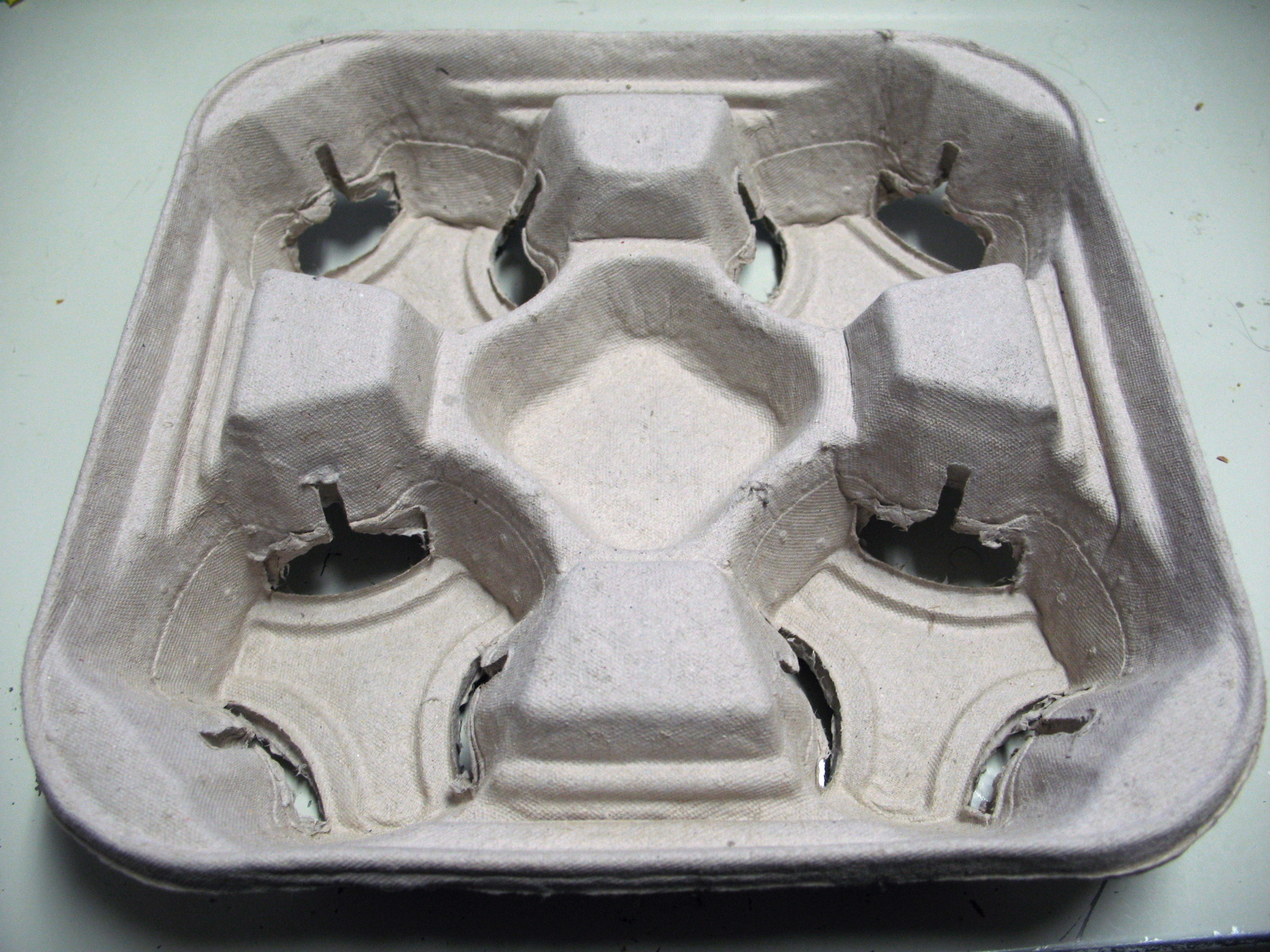
Read wet press and dry press in the supplier’s own terms
Commercial terminology needs a description beside it. A quotation saying only “wet press” leaves you without a complete account of the finished surfaces. Treat the phrase as the beginning of the question, rather than a substitute for a sample.
Pulp-Tec’s process descriptions distinguish Premium Pressed Pulp, which presses an already dried conventional part, from Premium Thermoformed Pulp, which dries the wet formed product directly in heated tools. The manufacturer describes both of those particular routes as producing smooth surfaces on both sides.
WEILAI’s technology page uses dry press for a process that includes hot pressing after drying. Its wet-press description specifies one smooth side and a mesh texture on the other. Those are that manufacturer’s definitions and offered surface descriptions; they do not contradict another manufacturer’s different finished product.
Neither wet press nor dry press should be translated automatically into a universal IMFA type or a two-sided finish promise. Preserve the supplier’s wording and add its forming, drying and subsequent-treatment explanation. A proposed process and the surface it actually supplies can then be compared together.
Shortlist three directions for the fictional candle box
Return to J1 and B1. Assume the brand wants V to have an even-looking finish in its chosen opening view. It has not specified how the reverse should look, and product-contact suitability remains unresolved. The following are three sample directions to request, not existing samples or quotations.
Scroll this comparison table to see all columns.
| Direction | Proposed scope | Reason to consider it | Observation that changes the shortlist |
|---|---|---|---|
| T: transfer molded | Identified Type 2 route; actual front and reverse finish to show | Explore whether its supplied appearance meets V without assuming another pressing step is needed | If V meets the selected visual requirement, retain T; if a visible area does not, request a different finish direction |
| W: supplier-described one-sided finish | A specific offer describing one smooth side and a mesh-textured reverse | Explore a finished face oriented toward V, with R reviewed in the installed pack | If textured R becomes visible in intended use and conflicts with the requirement, W needs a changed presentation or finish |
| H: specified two-sided finish | A particular after-pressed or thermoformed proposal claiming smooth front and reverse | Explore a part where both physical faces have a defined appearance role | If both faces meet the visual requirement, retain H for that scope; an unresolved contact area still prevents a compatibility conclusion |
T and W are not necessarily mutually exclusive process categories. W describes a supplier’s particular face result, which may overlap a broader route. H likewise names a required finish rather than one exclusive manufacturing method.
If R stays hidden throughout the intended handoff, a two-sided appearance requirement may add nothing to this particular presentation. If the insert is meant to be lifted and retained, R has a different role. Decide that use first, then compare what each candidate actually shows.
A different brand could deliberately prefer a visible fiber texture around the jar. Its shortlist might retain a textured candidate that the fictional brand above would set aside. Describe the intended appearance in the sample request so the supplier can respond to that choice. The word “premium” cannot communicate which texture belongs on which face.
Examine the visible and contacting areas separately
View each representative formed candidate in B1 with the same J1 arrangement. Look at V in the intended opening view, then inspect R directly. A photograph showing only the front cannot answer the reverse-face question. Keep lighting and viewing conditions consistent enough to make the visual comparison useful.
Locate C on the same part. Its overlap with V does not make appearance a contact test. A visually smooth cavity can still leave the actual glass, label and material relationship unanswered. If a mark or transfer is observed, the product-contact observation guide addresses that separate investigation.
Check whether the concern is a broad face or the rim crossed during handling. A face-finish description cannot settle a particular cut or formed edge. The formed-tray edge guide keeps that location and action identifiable.
Nissha’s pulp-molding description shows a wet-mold route using mesh forming followed by heated pressing from above and below. It also describes different available textures. Smoothness and deliberate texture are therefore proposed finish choices to define, rather than an automatic better-or-worse scale.
Request the finish that serves the chosen presentation
A useful sample request names the intended visible areas, the contact surfaces still to assess and whether the reverse will be seen. Add the supplier’s actual process description and any secondary pressing or other treatment proposed. Ask for representative formed parts showing both faces, rather than accepting a process label or a flat swatch as the whole answer.
Keep the resulting decision narrow: a candidate can remain on the shortlist for its appearance while product contact, fit and transport questions remain open. Neither a smooth texture nor a Type 3 label establishes scratch resistance, cleanliness, dust behavior or protective performance.
Packrivo coordinates sourcing questions with independent suppliers. Discuss the insert’s process and finished surfaces with Packrivo, including the opening view and the face that still needs a sample. Actual materials, samples, quantities, pricing and timing require project-specific confirmation.
Sources and scope
- IMFA: About Molded Fiber.
- Pulp-Tec: Moulded Pulp Technologies.
- WEILAI: Technology.
- Nissha: Pulp-Molding.
These undated pages were checked October 26, 2026 (America/Los_Angeles). Manufacturer descriptions apply to their named routes. J1, B1 and the proposed sample directions are fictional; no supplier offer, physical sample result or Packrivo manufacturing capability is established.