
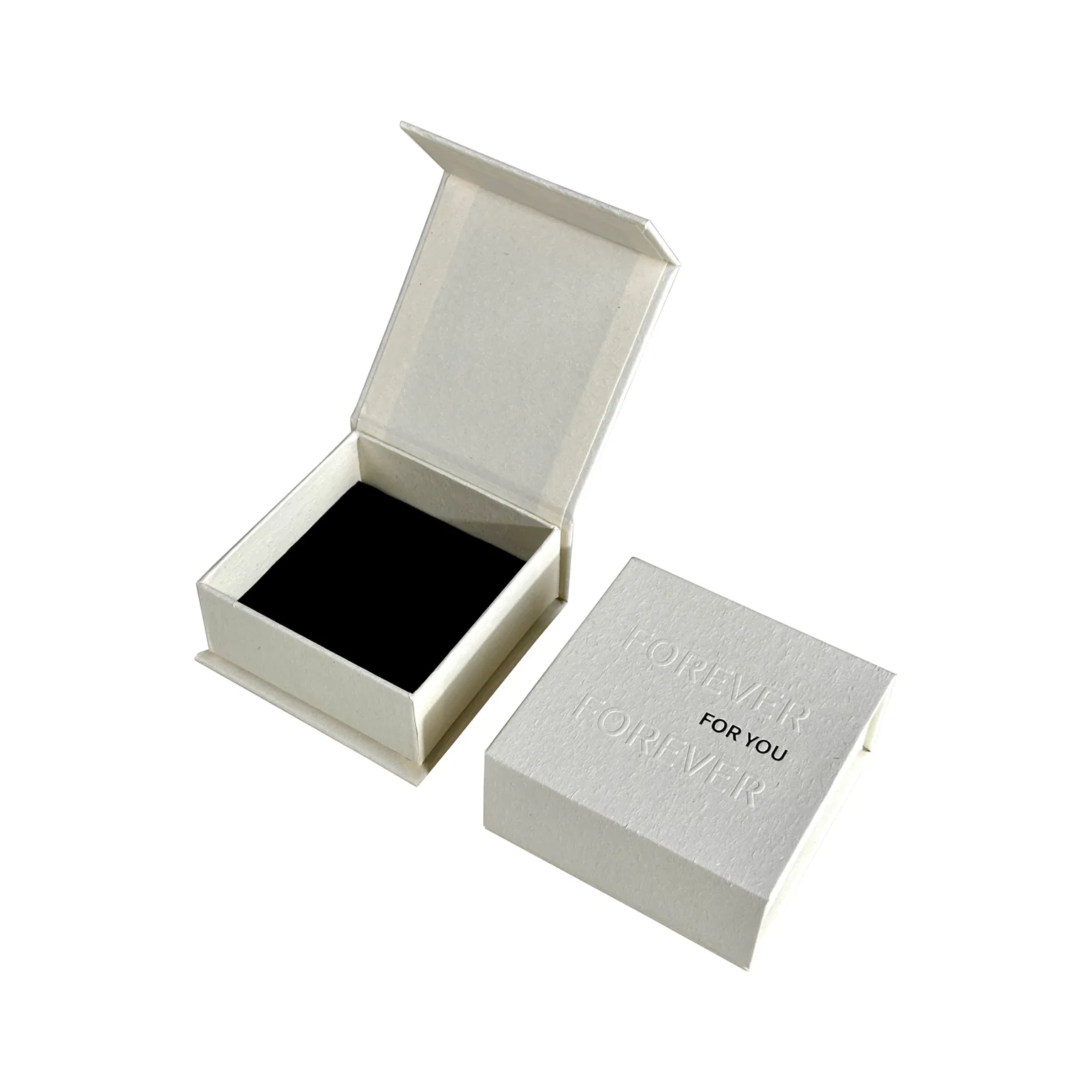
Choose brooch packaging by deciding how the brooch attaches to its support and how the recipient releases it. A pierceable pad can use the brooch's own pin; a separate holder is another proposal to investigate. Buy the mounting arrangement and box together, with the actual fastening available for review.
Supplier reference photo of an empty enclosure and its dark interior.
Photograph source. Supplier reference photograph, used with permission. Full original reference photograph.
An attractive empty jewelry box leaves this decision unresolved. The decorative face may fit while the clasp sits against the base, or a mounted brooch may need rear access that disappears once its pad is installed. Establish the mounting route before selecting the enclosure by its exterior alone.
Brooch packaging can use different mounting arrangements
Ask whether the offered mount uses the jewelry's pin, a separate retaining feature, or simply a loose resting position. These are different arrangements even when their boxes look similar from above.
Gemworld's brooch, earring or pendant box describes an insert that can be pierced for pinning. Azure Aster's brooch storage kit likewise includes a cushion intended for pin-through attachment. These descriptions establish that this mounting route is offered; they do not establish its suitability for your fastening.
HIPC Jewel Box's brooch case lists several pad options, including a plain pad and an elastic-loop option for a pin or brooch pin. Its product is a multi-piece stock case, rather than a single gift box. The relevant distinction is the selectable attachment feature. A loop's description alone does not establish whether your particular pin stays closed during mounting or how the brooch releases.
For a custom proposal, ask the supplier to show which part passes through or under the support. If you want the brooch's fastening to remain closed throughout packing, state that requirement explicitly and request a holder designed around it. A shallow recess or independent retaining band is a design question, not an automatically available insert.
The illustrated separate holder below is hypothetical. It shows the question to take to a supplier, rather than reproducing the mechanism of any cited product.
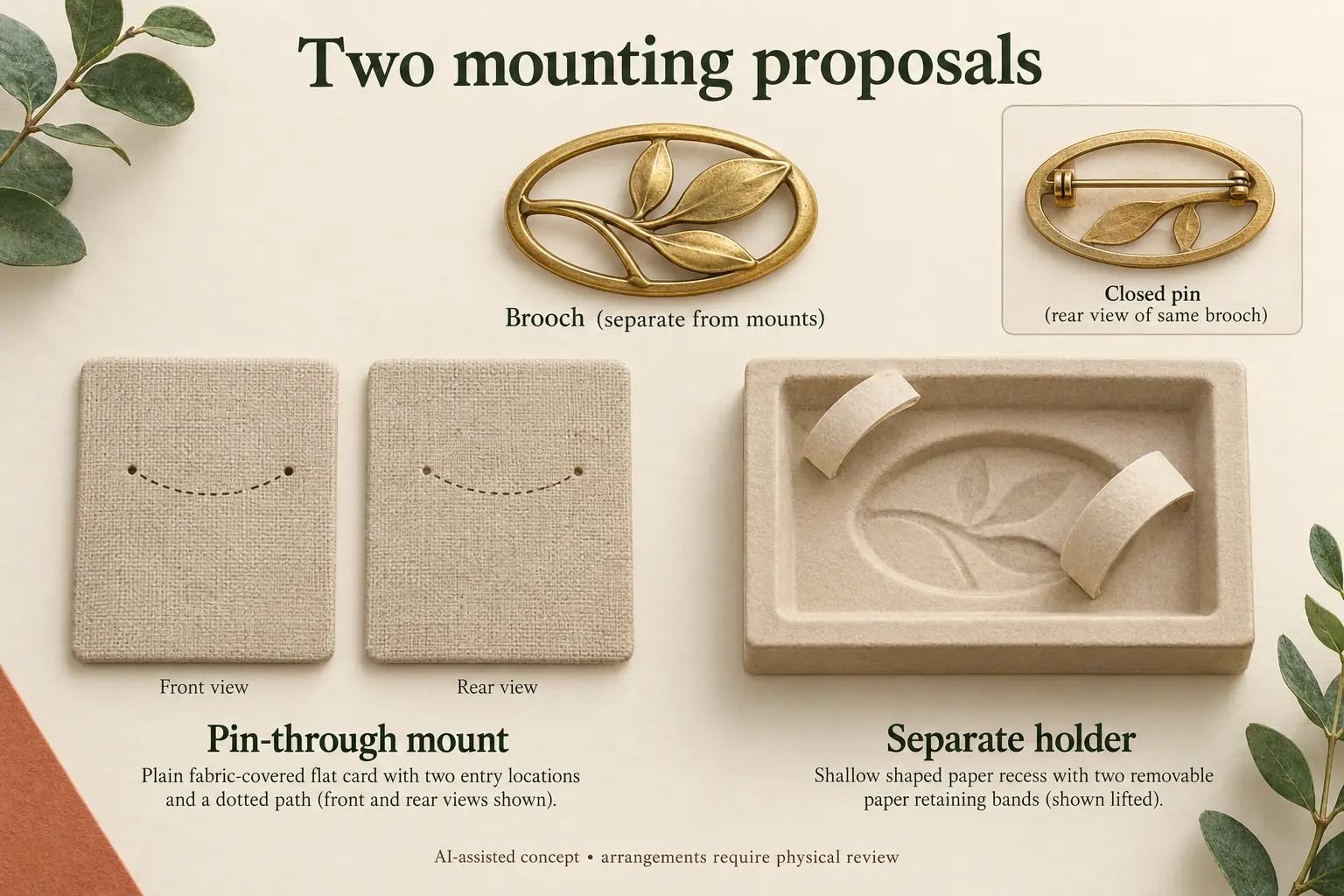
Choose the mounting route around the actual fastening
Consider a pin-through proposal only after the jewelry owner confirms that the actual fastening can be operated through the proposed support as intended. Choose a different proposal when mounting would require bending the pin, changing the clasp, or inventing an undocumented release action.
Show the brooch's reverse as well as its decorative face. Identify the hinge, pin and catch in their ordinary closed state. Include projecting fittings and any part that extends beyond the visible outline. A flat oval ornament and a layered floral piece may need different supports even if their longest face dimensions match.
For a pin-through proposal, ask how the support is prepared, where the pin travels and when the catch is closed. The supplier should describe whether openings are supplied or made during packing. Avoid treating the jewelry itself as a tool for forming unspecified holes. Any proposed packing operation needs agreement from the party responsible for the jewelry.
For a separate holder, identify the parts that actually retain the brooch. Ask whether the fastening remains closed, where the holder contacts the object and which feature the customer releases. Soft appearance does not establish compatibility with a polished, plated or painted surface.
The jewelry packaging measurement guide helps distinguish the complete product envelope from the enclosure's usable interior. Here, add the fastening's state to those measurements: closed on a separate support and attached through a pad are different packed configurations.
Make the recipient's first release action visible
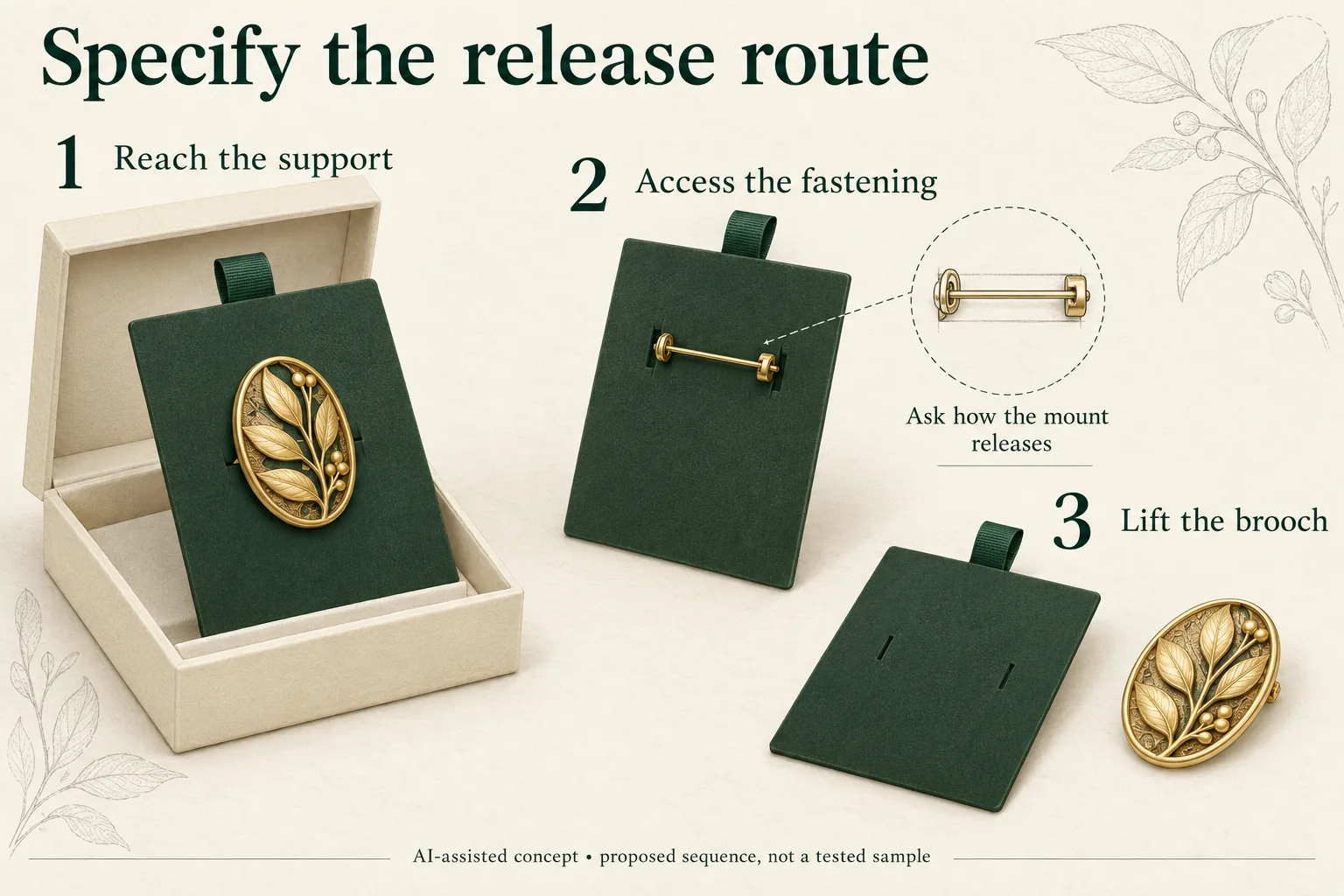
Choose a removable pad when the intended release requires access behind it, unless the installed holder provides another clearly demonstrated route. The recipient should be able to reach the specified release point before lifting the brooch.
A pad lift ribbon and a brooch retaining feature have different jobs. Pulling a ribbon may lift the whole loaded pad; it does not necessarily detach the jewelry. Ask the supplier to demonstrate the two actions separately so a neat front view does not become an instruction to pull the ornament harder.
Start with the box closed, open it normally and identify what the recipient can see. If the pad must lift out, check that its intended grip remains accessible with the brooch mounted. Then examine the rear connection and follow the agreed release. No sharp-point handling procedure is prescribed by this article; the actual jewelry's instructions and responsible supplier must settle that operation.
For an independent holder, the release might involve a separate band or another retaining component. Identify what is removed and what stays with the packaging. A recipient should not need to infer that the brooch's own clasp doubles as a box attachment.
Once a route is selected, the front-and-back mounting instruction guide provides a way to document its packing steps. Selecting the route comes first; that existing guide records an agreed method rather than choosing between mounting purchases.
Compare complete mounting proposals in the quotation
Compare the box, support and supplied mounting features as one purchase scope. An empty enclosure, a box with a loose pad and a box with a fitted independent holder are different offers.
| Proposal to compare | Ask the supplier to identify | Decision still requiring evidence |
|---|---|---|
| Pierceable removable pad | Pad construction, preparation and the actual pin-through action | Whether the jewelry can be mounted and released as intended |
| Pad with a retaining feature | Supplied loop or other feature and its connection to the jewelry | Whether the fastening participates and remains accessible |
| Separate holder proposal | Retaining parts, contact locations and removal sequence | Whether the brooch can stay closed throughout loading and release |
| Loose padded enclosure | What limits movement, if anything | Whether the resting arrangement meets the intended presentation and handling needs |
Keep loose resting and positive attachment separate in the brief. A padded base can provide a place to lay the brooch without establishing that it stays in the selected orientation. Equally, an attachment that holds it visibly does not by itself establish compatibility or protection during delivery.
Ask what arrives assembled, which features are prepared by the supplier and what the packing team must do. Include any removable pad, retaining component or lift ribbon in the component schedule. A photograph that includes those parts does not prove they are included in the quotation.
Use one brooch to make a definite purchasing choice
For a hypothetical brand that wants a brooch packed without opening its clasp, the initial purchasing direction is an independent-holder proposal, with a pin-through pad retained only as an explicitly different alternative. That is a requirement-based choice, rather than a claim that one material is universally better.
Suppose the brand's fictional oval brooch has a raised decorative face and a closed horizontal pin on the reverse. It wants the recipient to see the leaf design immediately and remove the piece without operating its jewelry clasp while it is still attached to packaging. These are invented requirements, not a customer case or tested result.
The inquiry therefore asks for a holder that leaves the clasp closed during loading and customer release. It requests a drawing showing the independent retaining points, plus the intended sample scope. A conventional pierceable pad may still be quoted, but it cannot be accepted as equivalent merely because the face fits the same box.
If the independent holder cannot meet that requirement, the buyer has three honest options: request a revised proposal, reconsider the customer action with the jewelry owner, or decline the proposed arrangement. Buying a larger empty box alone does not answer the mounting question.
Before production, review the actual brooch, support and complete enclosure together. Loading, closure and removal need physical review; any required transport evaluation remains a separate scope. None of the illustrations here demonstrates tested retention or an accepted sample.
Bring front and reverse photographs, the required fastening state, quantities per design and destination to Packrivo's jewelry packaging sourcing discussion. Packrivo coordinates independent suppliers. Request the complete mounting-and-box proposal, with unresolved contact and release questions stated plainly.
Sources checked 31 October 2026. Supplier listings support only their stated product distinctions. Teaching arrangements and the worked example are editorial concepts; the real enclosure photograph is an owner-authorized supplier reference.