
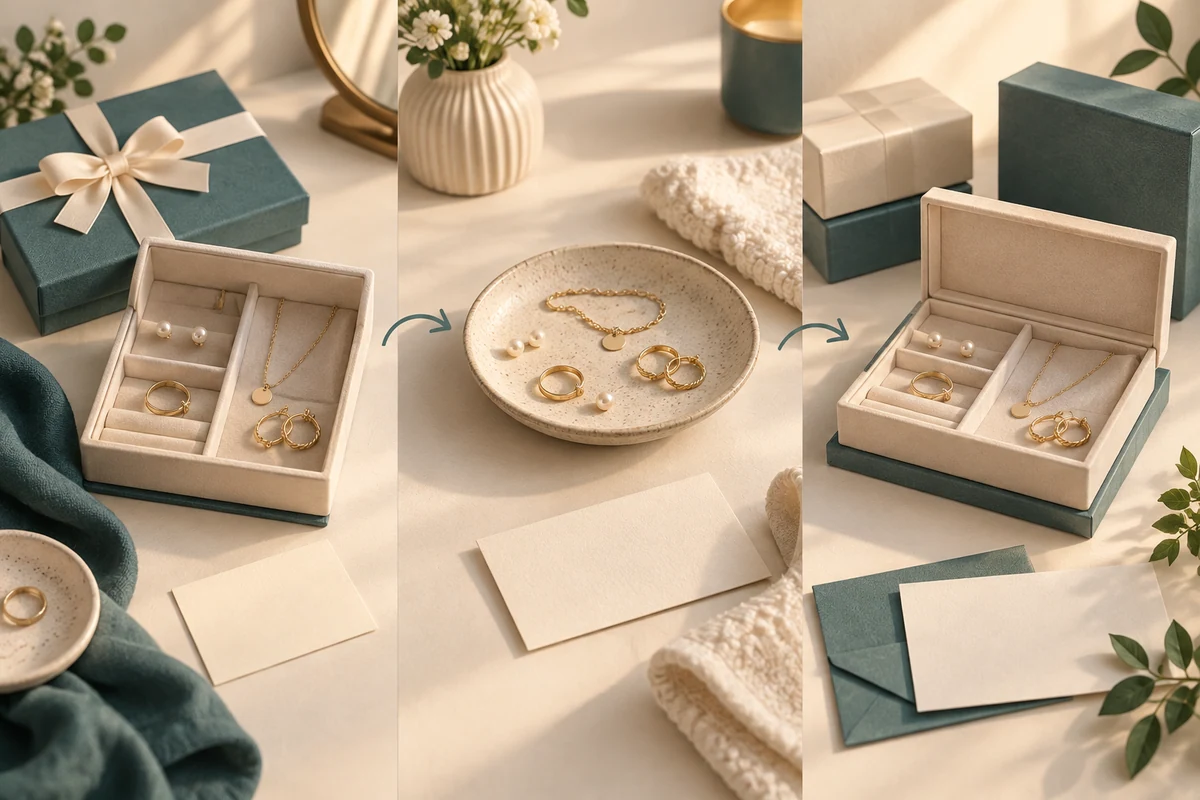
A jewelry box intended for daily storage needs a practical way for the owner to put the worn piece back. Compare taking off, storing and retrieving the jewelry with the initial factory mounting. Customers may no longer have the original ties, card attachments or tools, so daily use needs its own defined arrangement.
Opening and closing the lid is only part of that task. The owner also handles clasps, earring backs, chains and any intended protective components. Record where each object goes while the jewelry is being stored.
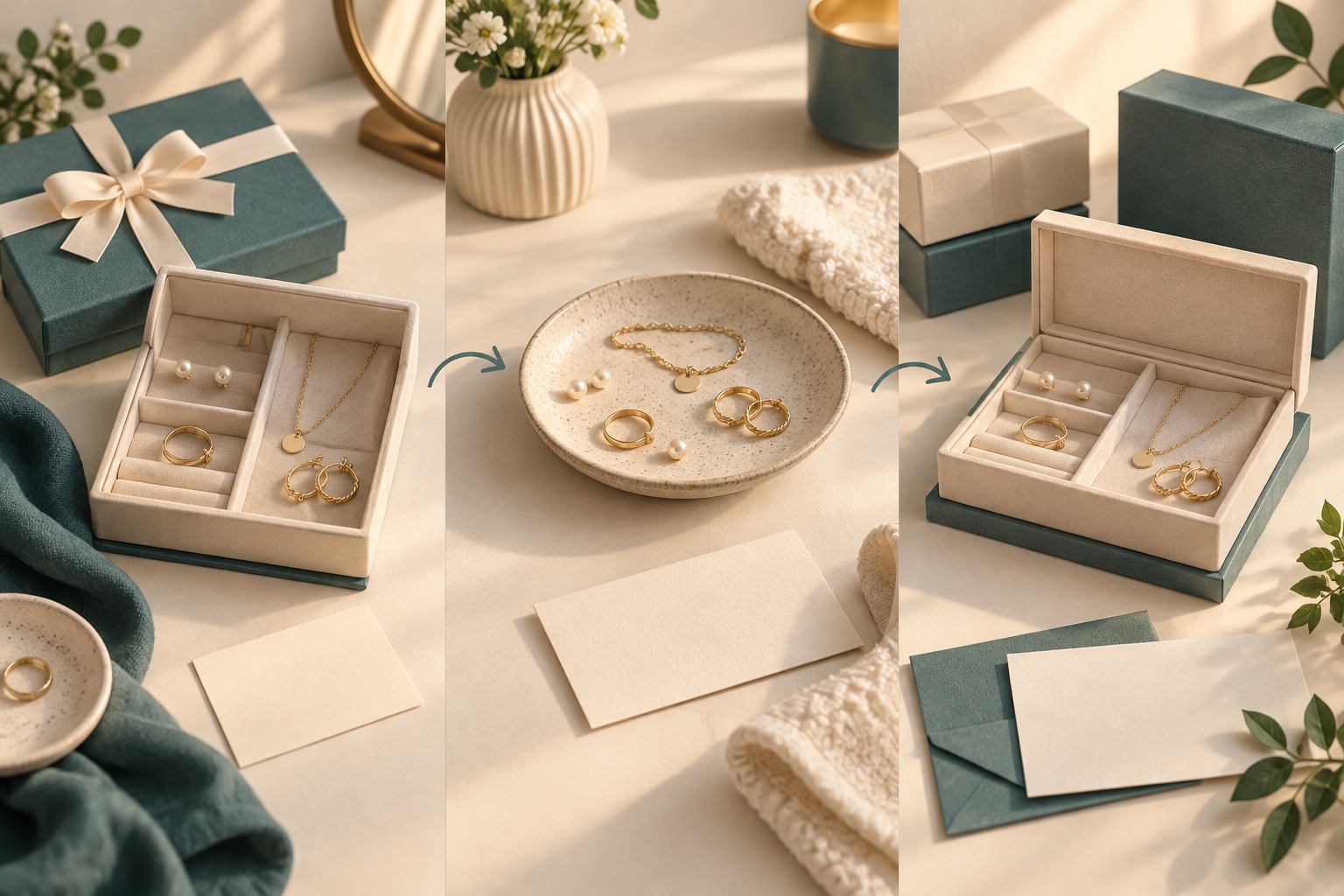
Begin after the jewelry has been worn
A factory-packed pair of earrings may have its posts threaded through a card and its backs fitted behind it. The owner later removes both earrings and the backs. Returning every part to the original display position could require actions different from placing the jewelry into storage.
Use the actual product and the proposed routine. State whether the owner is expected to remount the earrings, use a separate resting area or store a card and jewelry independently. No general box name resolves that choice.
The front-and-back mounting instruction explains initial packing and keeps release separate. This daily-storage brief starts after release and wearing, when the recipient is choosing the next resting state.
Compare two hypothetical routines
Assume a fictional gift includes earrings, removable backs and a presentation card. No user trial or material-contact assessment has been performed.
Scroll horizontally if columns extend beyond the view.
| Routine | Actions that need observation | Open decision |
|---|---|---|
| Return to the presentation card | Align posts, reach the rear of the card and refit backs | Whether this is realistic for the intended owner |
| Use an approved separate resting area | Place earrings and backs in their designated positions | Whether the proposed support and contact surfaces suit the actual jewelry |
Keep loose parts visible in the comparison. If backs have nowhere defined to rest while the owner handles the earrings, a successful lid-closing photo leaves the everyday task unanswered.
For necklaces, include the intended chain path and how a clasp is returned. Do not use the chain as a lifting feature unless that is an actually supported product instruction. A broad “store as shown” message can hide several fine handling actions.
Check the whole recurring task
Microsoft’s accessible-packaging design guidance encourages considering the complete interaction and intended users. Apply that approach to the repeated storage routine, while keeping any performance claim limited to evidence actually obtained.
A proposed comparison can record pauses, loose components, assistance requested and deviations from the supplied instructions. Ask the relevant users which arrangement suits their routine. The designer’s successful demonstration is one observation, not an answer for every recipient.
Repeated-hinge performance remains separate. The finished-hinge life explanation shows why a clean first fold or laboratory paper-strip result cannot establish a complete box’s repeated-opening life. A workable storage sequence does not supply that endurance evidence either.
Write the storage job into the brief
Identify the jewelry version, loose parts, retained packaging, intended resting position and retrieval action. State which original packing components are not expected to survive or be reattached. Request proposals against that routine before adding a daily-storage promise to customer copy.
Packrivo can coordinate the structural and supplier questions through a packaging project inquiry. This hypothetical comparison establishes no tested usability, scratch resistance, contact compatibility or lifetime. Public design guidance was checked on 14 October 2026.
Observe the return and the next retrieval as one routine
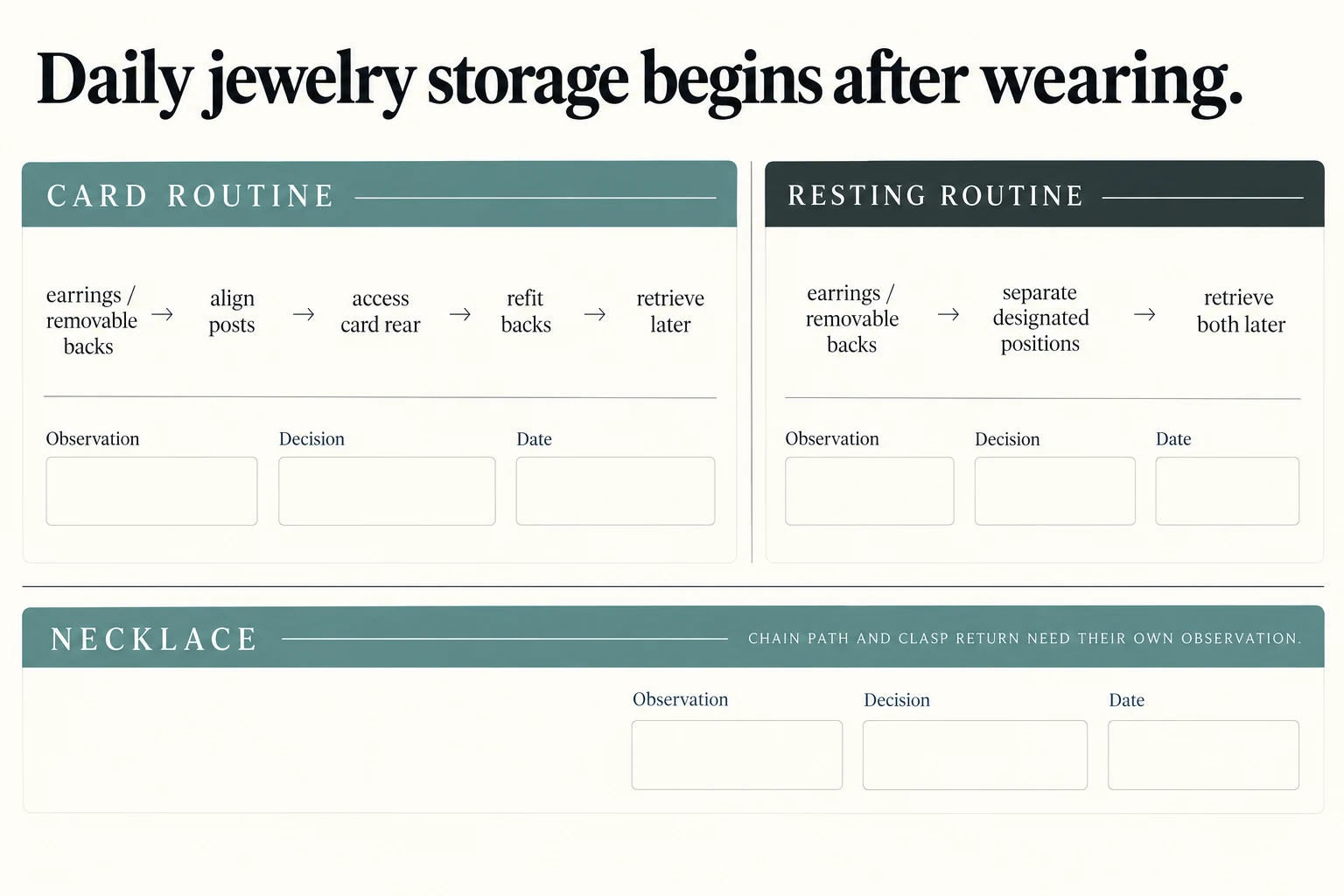
Give the card routine and separate resting routine different instruction references. In this hypothetical observation plan, the earrings and removable backs keep their own positions through storage and later retrieval. No task has actually been observed.
Scroll horizontally if columns extend beyond the view.
| Scenario scope | Exact object or route | Hypothetical input or output | Calculation or record boundary |
|---|---|---|---|
| Instruction version | CARD_ROUTE | Unobserved; actual fields blank | Name intended card routine and exact instruction |
| Instruction version | REST_ROUTE | Unobserved; actual fields blank | Name intended resting routine and exact instruction |
| Absent factory resource | USER18 | Unobserved; actual fields blank | Original ties/card attachments/tools not presumed available |
| Open comparison | USER18 | Unobserved; actual fields blank | Compare after-wear storage and later retrieval; actual choice blank |
For the card route, record post alignment, access to the rear and refitting the backs separately. For the resting route, record where the earrings and backs are placed and later retrieved. Leave the observed action, assistance, pauses, deviation, decision and date blank until a permitted user observation provides them.
A necklace needs separate chain-path and clasp-return records; an earring demonstration cannot resolve those actions. This comparison helps prepare the routine question without declaring either route easier, scratch-resistant or suitable for all intended users. Repeated-hinge evidence remains another requirement.
Download the jewellery box daily storage record (.csv). It covers the original scenarios and this added comparison. HYPOTHETICAL rows are invented planning examples. Actual quantity, value, configuration, method, owner, observation, condition, decision, evidence and dates are blank because no actual project record has been obtained. Copy a relevant row and replace its type with ACTUAL only when entering permitted project evidence; keep the example and actual record separate. ACTUAL_BLANK is an empty starting row. A blank is unknown, never approval.
The related Write Mounting Instructions With Front and Back Views guide concerns a separate requirement. Use this record for the specific comparison above rather than treating that guide as evidence of a completed result.
A different household storage job belongs in the keepsake conversion brief. Keep repeated-opening evidence separate with the finished-hinge life explanation.
Source scope checked 16 October 2026: the original public references remain within their stated general guidance or manufacturer-example scope. The new numbers and task records are original hypothetical analysis, not observed supply, trials, inventory, prices or performance.
What this changes in a packaging enquiry
If the packaging is also intended for daily storage, include replacement and removal of the jewelry in the sample brief, not only the first presentation. Specify the closure, chain route and accessible support. That intended second use is a design requirement to review, not proof of repeated-use life. A relevant configuration to compare is the Jewelry box with fitted insert; it is a concept reference, not confirmed suitability.
Discuss this packaging specification with Packrivo. We coordinate independent suppliers. MOQ: 500 pieces per product/design; illustrative quantities are not production offers. Confirm materials, samples, price and timing for your project.