
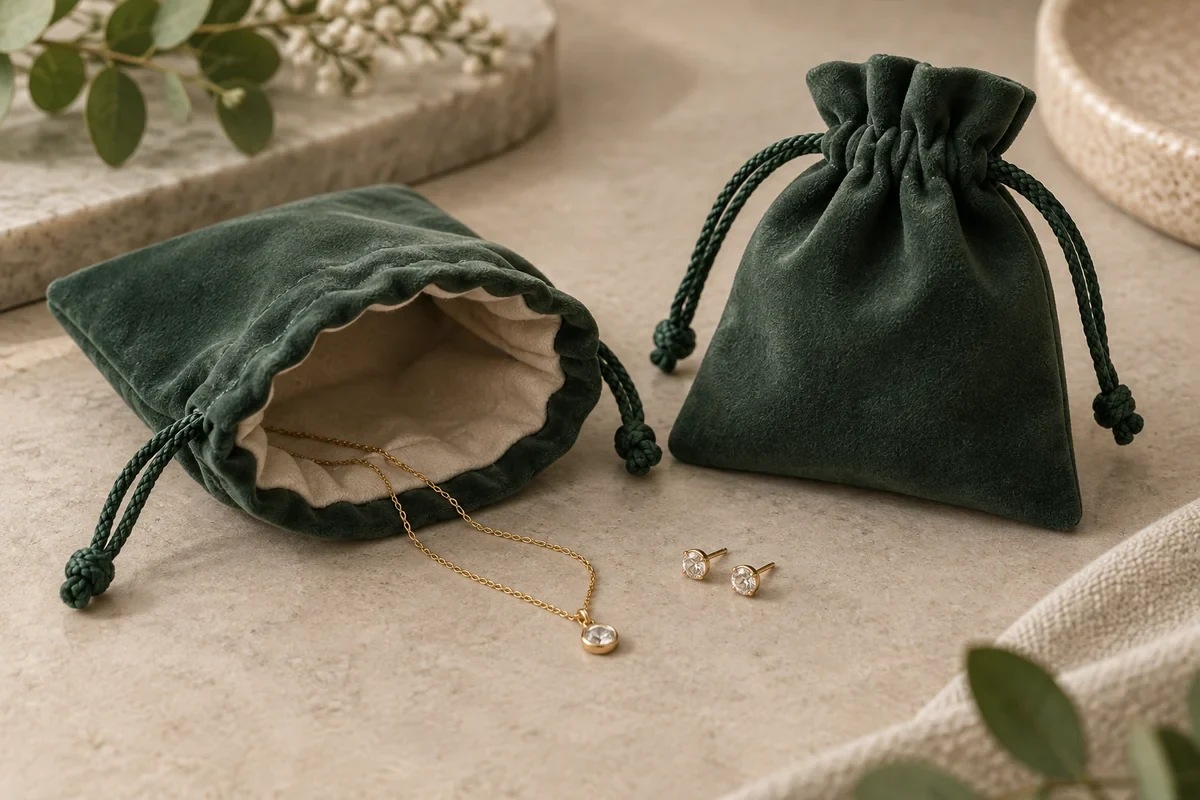
A jewelry pouch brief needs the item, opening, closure and use before it needs a fabric name. Measure the jewelry in the position it enters the pouch, including its card or clasp. State whether the pouch sits in a box, is handed to a customer, or is intended for storage; then sample the complete construction.
In this guide
Measure the opening as well as the body
Record the longest, widest and thickest points of the packed item. Add any card, tag or protective wrap that enters with it. An interior size alone can mislead if the drawstring channel narrows the mouth. Ask the supplier to identify finished usable interior dimensions and the usable opening after seams and lining.
Try the actual loading motion in a sample. If a chain catches on the seam, a larger body may not solve the problem; the opening or item orientation may need to change. If the item slides around, a card or box insert may be more useful than simply shrinking the pouch.
Specify the use and closure
Write one sentence describing the pouch’s job. A branded presentation layer, a storage accessory and a pouch inside a rigid box pose different questions. Then identify the intended closure, logo position, lining, cord or flap, and any item that must be packed with it.
Scroll horizontally if columns extend beyond the view.
| Brief field | Buyer input | Supplier evidence to request |
|---|---|---|
| Fit | Item and card dimensions, orientation | Finished pouch and opening size |
| Material | Preferred hand feel and color reference | Fiber composition, weight and swatch |
| Construction | Seam, lining and closure preference | Finished sample with closure in use |
| Branding | Logo location and intended method | Proof on the proposed material |
| Set | Box or card dimensions | Packed set sample |
Material names and photographs cannot prove scratch resistance, anti-tarnish behavior, fiber composition or color match. Ask for the exact material statement and evidence relevant to the intended jewelry surface. Keep an unconfirmed claim out of customer copy.
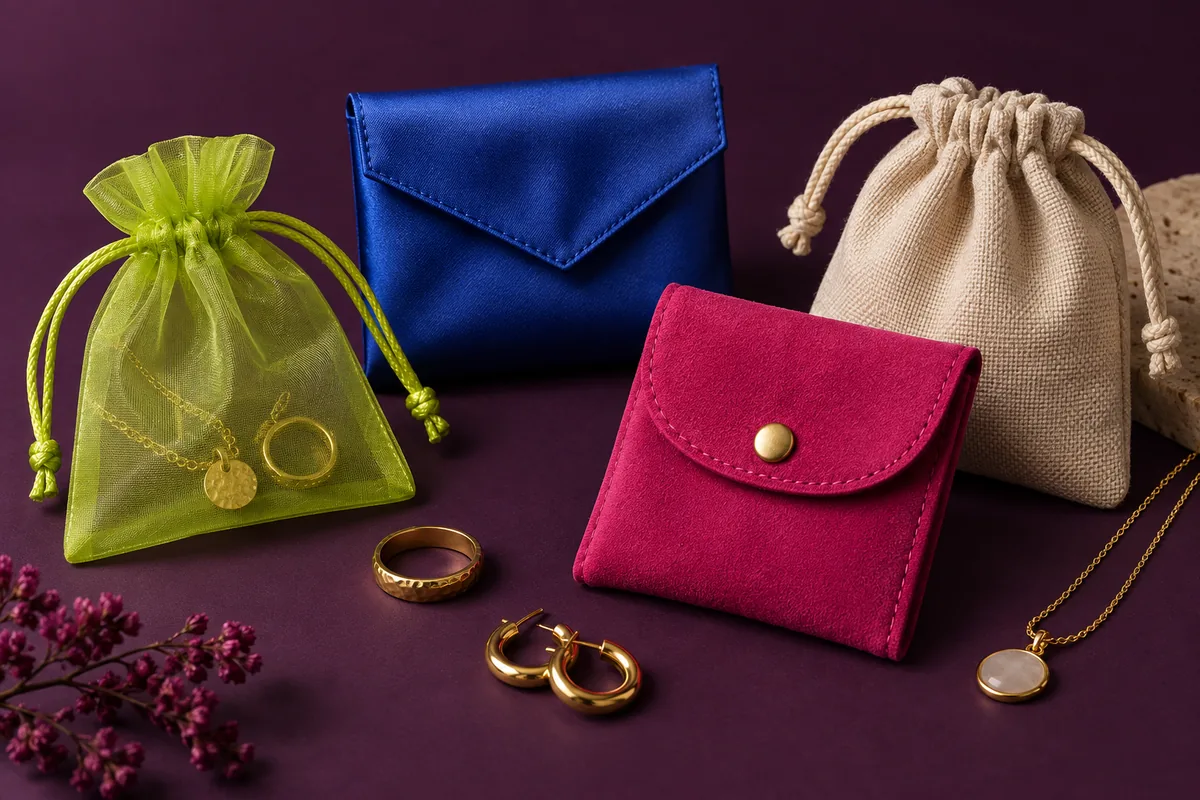
AI-assisted concept / Not a physical sample. The image shows possible pouch directions and verifies no fabric composition, finished size or supplier availability.
Request the sample that answers the open question
A swatch can help judge feel and color. A finished pouch is needed to check seam, lining, logo position, opening and product removal. If the pouch belongs inside a box, review the two together. The jewelry box structures guide can help name the outer form; the inquiry brief holds the measured requirements. Construction and availability still need supplier confirmation.
Check the jewelry pouch entry route before choosing a size
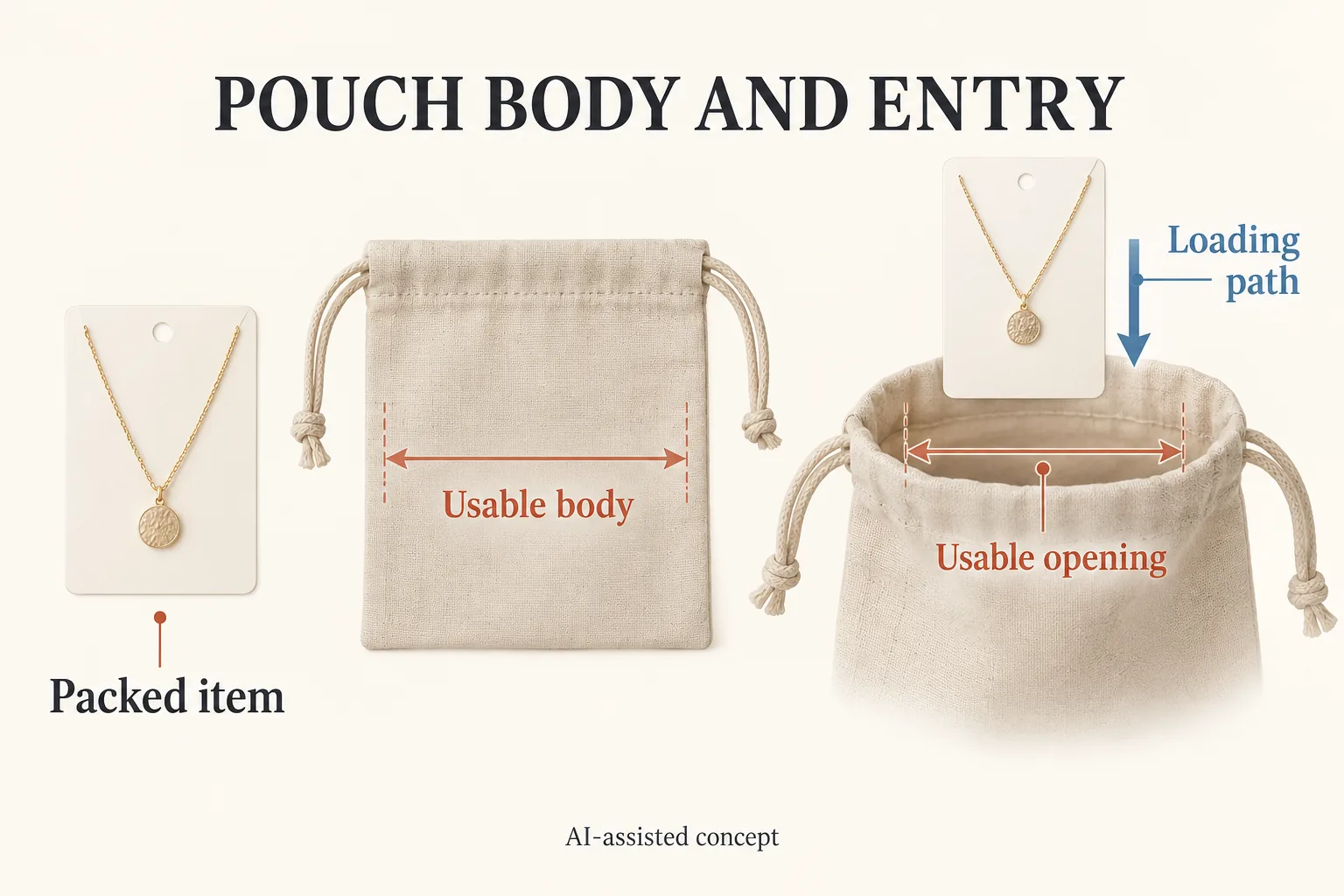
Measure the item in the state that enters the pouch. A carded necklace can have a narrow chain but a much wider backing card. A ring may have a projecting setting. Those features belong in the opening record, even when the soft pouch body seems generous.
| Review stage | Record | What to observe |
|---|---|---|
| Before loading | Packed item and card envelope | Widest or catching feature |
| At the mouth | Usable opening with closure relaxed | Entry without force or snagging |
| Seated | Item orientation and lining | Seam contact, bunching and unwanted movement |
| Closed | Actual contents and drawstring state | Pressure, cord route and final body shape |
| Removal | Intended customer grip | Access without pulling a delicate part |
Consider a hypothetical carded pendant. Its card fits within the proposed body width, but the drawstring channel reduces the usable mouth. The useful supplier question is about the entry route and finished opening. Enlarging only the pouch height would not describe that problem.
A swatch cannot demonstrate that entry. Request a finished candidate with the intended seam, lining, closure and logo method. Review it with the same packed item used in the dimensions. Record whether a substitute card or jewelry sample was used, and what still needs a final-item check.
For a pouch used inside a box, review the closed pouch as a new packed envelope. Cord ends and gathered fabric occupy space. Link the pouch version to the box sample rather than approving each part in isolation.
Use the jewelry fit measurement guide when an insert is also involved. For silver, the jewelry tarnish review addresses the separate materials-and-storage question. Softness and a clean appearance do not establish anti-tarnish performance.
Download the custom jewelry pouch specifications project record (.csv). The file has named planning fields and blank project rows. It contains no preset acceptance limits or approved results.
Questions buyers ask
How much larger should a pouch be than the jewelry?
There is no universal allowance. Item shape, fabric, seam, lining and closure change the usable space. Measure the packed item and check the proposed finished sample.
Can a pouch replace a box?
It can fill a different presentation or storage role. Decide whether the item also needs display support or a separate outer shipping pack. Test the full arrangement for its actual use.
Does a fabric photo confirm its composition?
No. Request a material specification and swatch for the proposed construction. A finished sample helps check how that material behaves at the seam and opening.
What if one pouch must hold several jewelry pieces?
List each piece and its packed orientation. Ask whether they need separate cards or positions to prevent contact and tangling. Sample the complete set, not just the largest item.
Send the current configuration for review
Bring the completed record, actual product or component references, requested quantity by design and destination to Packrivo’s packaging inquiry. Name the specific open decision above so the next sourcing discussion can address it. Packrivo coordinates sourcing questions; material, sample, price and delivery terms need project confirmation.