
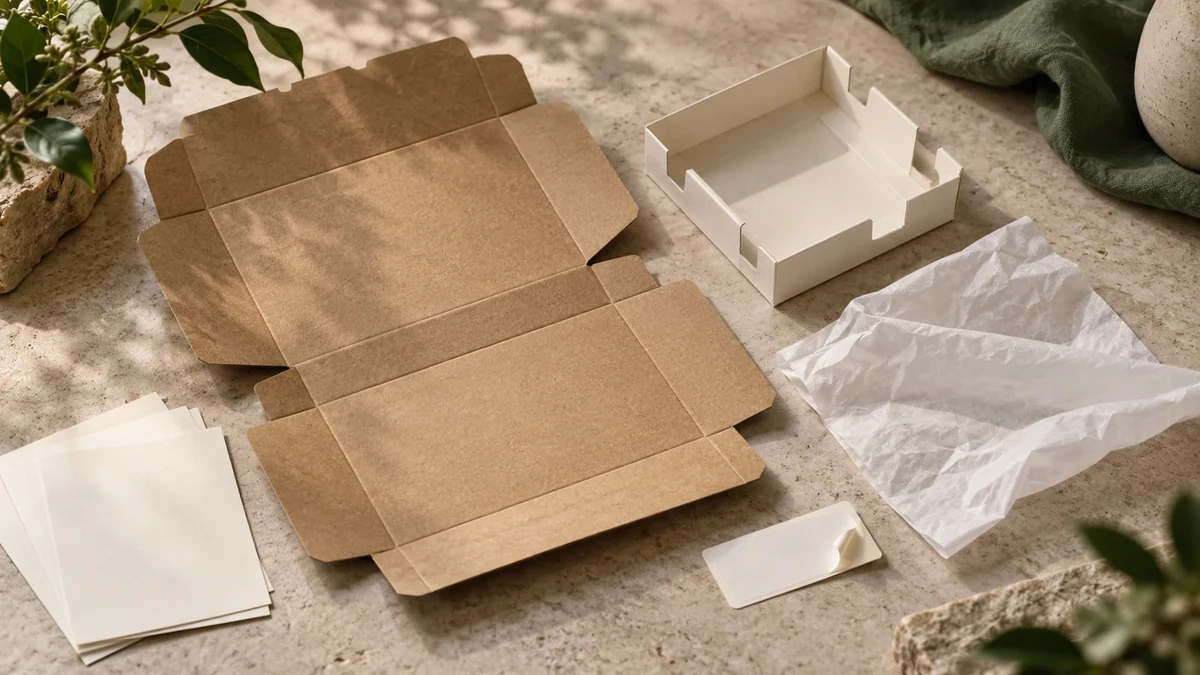
Review a packaging material claim against the exact component, supplied configuration and destination market before adding it to artwork. Record who issued the evidence, what it covers and who approves the wording. A useful claim record connects each proposed statement to the relevant documents and leaves unresolved questions visible.
Small brands often receive several documents for one packaging project: a board specification, an insert proposal, a label sheet and a statement about tissue. Start by identifying which component each document describes. Then decide whether the proposed wording accurately describes that component or the assembled package.
Start with the component and the exact wording
Write down the statement you want customers to read. “Recycled paperboard in the box base” has a defined subject. A general statement about the entire pack asks a broader question, particularly when the pack also contains an insert, adhesive, coating or label.
Separate the components in the bill of materials. Give each one a working reference and record the proposed material, finish and assembly state. Include the destination market because the wording and evidence requirements may differ between markets and uses.
The FTC Green Guides summary explains how environmental marketing claims should be substantiated and qualified in the United States. It distinguishes attributes such as recycled content and recyclability. Use the relevant guidance to frame the review, then have the responsible reviewer approve the actual market wording.
Ask for evidence that matches the supplied configuration
A document title is a starting point. Check its issuer, covered entity or site, date, product reference and scope against the quotation and sample configuration. Record validity or expiry where it applies, and ask the issuer to clarify an uncertain status. If the supplier changes the board, finish or source after review, return the claim to the person responsible for deciding whether the evidence still applies.
For a certification-related statement, ask which entity holds the certificate, which product or product group it covers and how the proposed artwork will be authorized. FSC describes chain-of-custody certification as the system connecting forest-based materials through the supply chain to finished products. Follow that scope through the actual supplied packaging rather than approving a logo from a screenshot of a certificate.
Keep the supporting records together: the component reference, document, quotation version, sample reference and proposed wording. Where a record is missing, assign a specific next question, such as “Please identify the product group and material reference covered by this certificate.”
Keep different material questions separate
The same component may require several reviews. A sourcing statement, an end-of-life claim and a food-contact use each ask a different question. Keep their evidence and approvals in separate rows so one answer cannot silently stand in for another.
Swipe sideways to read every column on a small screen.
Scroll horizontally if columns extend beyond the view.
| Review question | Record the scope | Ask the responsible party |
|---|---|---|
| What is the stated recycled content? | Component, material reference, calculation basis and supporting evidence | Which supplied material and configuration does the statement describe? |
| Is proposed certification wording authorized? | Certificate holder, covered product group, supplied reference and artwork permission | Who can confirm the claim and label use for this packaging? |
| Is a recyclability or compostability statement suitable? | Component or assembled pack, destination, conditions and evidence | What wording and qualifications have been approved for the intended market? |
| Is a food-contact use intended? | Actual contact component, contact configuration and destination | Which documents and review apply to this intended use? |
For an intended food-contact component, use the buyer document checklist to prepare the configuration and questions. Food-contact evidence addresses a different use question from a sourcing or environmental statement.
For EU projects, use Regulation (EU) 2025/40 as the primary legal text for packaging and packaging waste. The Commission guidance published on 10 June 2026 interprets selected provisions. Use those sources and the Packrivo PPWR buyer checklist to identify the questions for the actual component, role and market. The responsible market reviewer should approve the wording and its scope before print approval.
Use one record to move the review forward
Download the blank material-claim evidence worksheet. Add one row per component and proposed statement. The record should identify the missing answer and the person who will close it, alongside any documents already received.
Here is an illustrative planning example. It describes a document gap, not a verified material claim or completed client project.
Swipe sideways to read every column on a small screen.
Scroll horizontally if columns extend beyond the view.
| Component | Proposed wording | Current record | Next action |
|---|---|---|---|
| Box base, reference BX1 | Recycled-content statement for the board | Supplier material reference received; supporting basis still pending | Ask the supplier for evidence covering that exact board reference |
| Insert, reference IN1 | Wording still undecided | Material and finish are being compared | Choose the configuration, then identify the statement and evidence to review |
| Printed pack artwork, revision A1 | Claim panel held for review | Component evidence is not yet complete | Ask the named market reviewer to approve the final wording and its scope |
Keep completed supplier documents in private project records. The public worksheet is a blank tool; the facts and questions you share in a brief should be the ones you can disclose.
Close the wording review before approving artwork
Before print approval, match the proposed claim to the current component specification and artwork revision. Record the wording, qualifications, reviewer and decision date. Reopen the review when a relevant material, supplier, configuration or market changes.
If the project still needs a component specification, start with the packaging brief guide. Packrivo can help organize the brief and coordinate supplier questions so the appropriate people have a clearer record to review.
Sources reviewed on 2 October 2026. The linked FTC guidance concerns US environmental marketing claims, FSC explains its certification system, and the EU regulation and Commission guidance provide legal context and selected interpretations. None of these sources certifies a Packrivo product or approves the example above.
Reopen one claim when the supplied reference changes
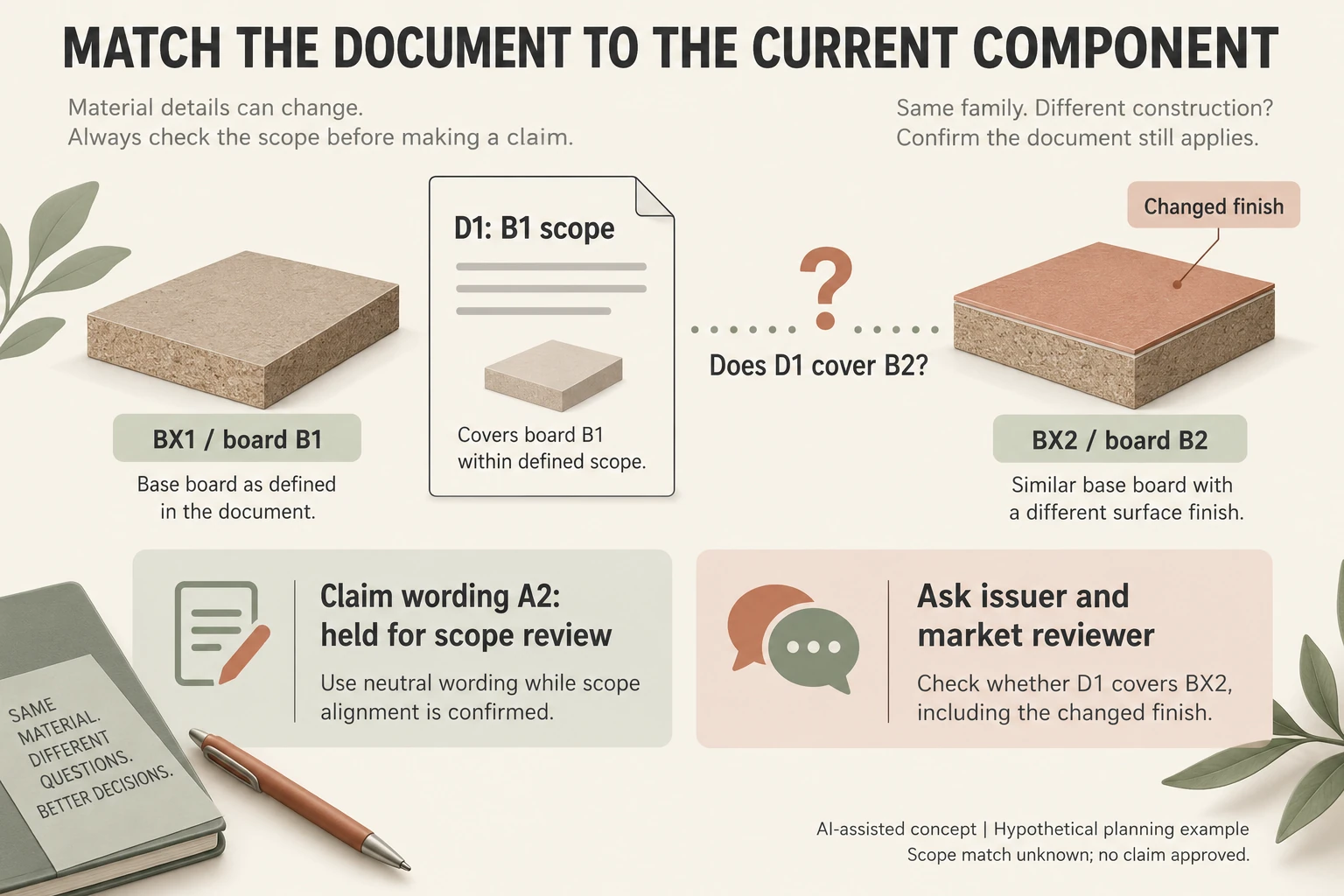
An invented record connects box base BX1, board B1 and document D1, then compares proposed BX2 using B2 with a changed finish. Assume only that fictional D1 names B1. There is no real certificate, content percentage or approved claim.
Scroll horizontally if columns extend beyond the view.
| Field | Invented entry | Status and next question |
|---|---|---|
| Wording | Box-base recycled-content statement proposed | Exact words and qualifications pending |
| Document | D1 names B1 | Does issuer confirm B2 coverage? |
| Configuration | BX2 / B2; changed finish | Match exact supplied scope |
| Market/artwork | US proposal / A2 | Reviewer and presentation pending |
| Print release | Claim panel held in example | Material sheet is not wording approval |
A finish change raises a scope question; it does not automatically invalidate every document. Ask the issuer whether D1 covers B2 and retain the actual answer under its reference. A response about base board remains distinct from one covering the complete decorated component.
Even a confirmed material scope leaves the market reviewer to decide whether the exact printed wording and nearby symbols communicate it accurately. The CSV therefore separates document-match status from wording approval, both open here. FTC guidance concerns substantiation and qualification of US environmental marketing claims; it approves neither this example nor EU compliance. This record follows a changed reference through evidence and artwork, rather than treating recycled content and recycling after use as the same question.
Download the packaging material claim evidence record (.csv). HYPOTHETICAL rows are invented examples. Use ACTUAL_BLANK for permitted project inputs; replace that row label only when recording actual facts. Empty evidence, observation and date fields mean unknown or not performed, never acceptance. Keep checkpoints and revisions separate.
Send the changed material and finish, exact intended statement and document gap to the issuer and responsible market reviewer. Prepare the identified scope for a Packrivo inquiry. Packrivo coordinates independent suppliers. These records establish no supplier offer, service availability or MOQ exception; its published baseline is 500 pieces per product/design.