
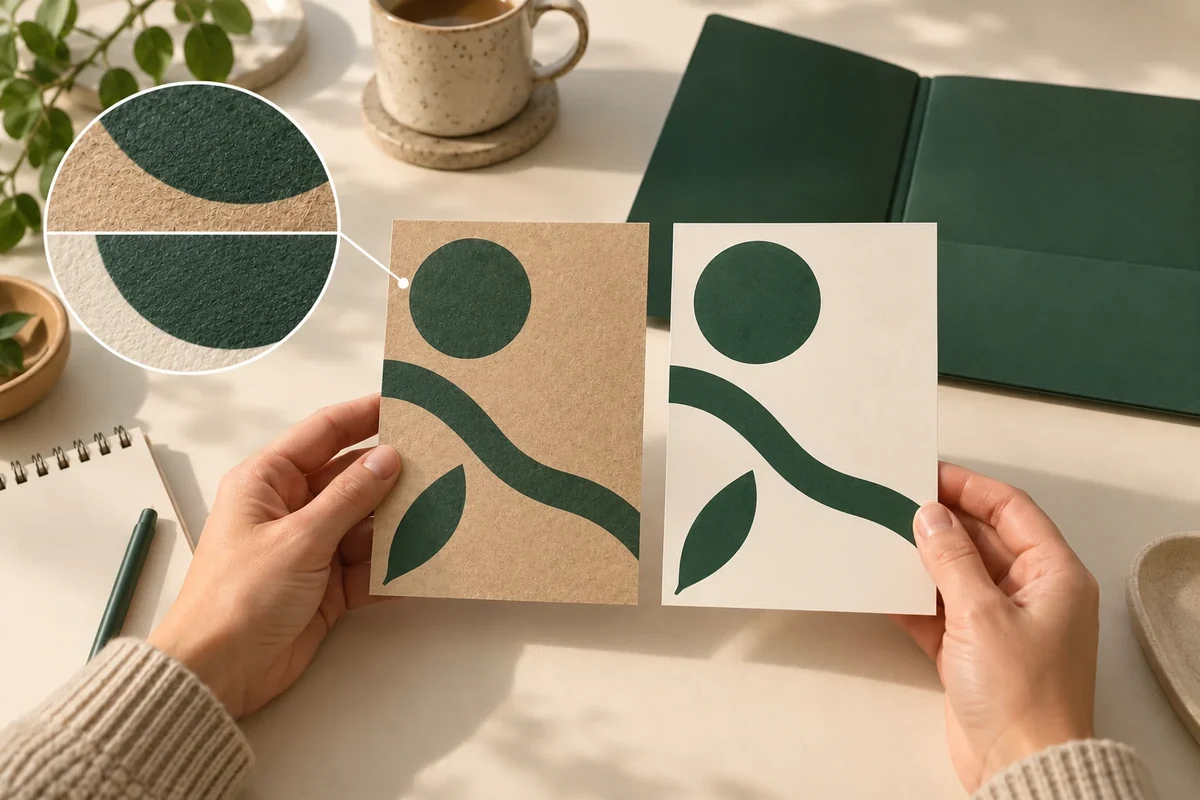
Review artwork on the proposed uncoated paper, with the sample’s material identity and proof scope recorded. Compare specific elements such as fine copy, pale colour and solid areas under consistent viewing conditions. A screen proof or a print on another paper can communicate layout but leaves the intended surface unresolved.
A buyer’s comment that a proof ‘looks different’ gives the printer little to locate. Naming the element, material and view makes the next question usable. You can do that without claiming an instrument-based colour result.
Identify the material and proof scope
Holmen’s technical information records surface roughness and ink absorption as distinct paperboard properties. Use that distinction to avoid treating the paper surface as an unnamed background. It doesn’t predict the appearance of your artwork on every uncoated paper.
Ask for the proposed grade, maker where known, print process and any added treatment. Record whether the proof uses that material or a substitute. If the source can only provide a substitute at this stage, keep its limitation attached to the proof.
State which decision the proof is meant to settle. Layout, colour direction, small-copy legibility and final surface appearance are different questions. One sample may cover several, but its role should be stated.
The colour approval guide covers the broader reference agreement. This worksheet narrows the review to named artwork elements on one proposed uncoated substrate.
Choose the artwork elements that matter
Select a small set of locations on the actual file. Give each an ID and describe it, such as A1 for small black care copy or A2 for a pale ivory panel. Keep the IDs unchanged if the artwork is revised.
Include elements that the reader must use, not only the largest decorative area. A care instruction that looks weak in one view deserves its own observation. Avoid converting that impression into a universal minimum type size without a printer’s specification.
Use consistent viewing conditions for the comparison. Record the light, viewing distance and whether the material is flat or formed. If a later photo uses a different light, say so rather than treating its appearance as a direct comparison.
Build an element-by-element proof page
Keep a wider sample photograph with the close views. The table ties an observation to a location and to the decision still open.
| Element ID | Artwork feature | Proof evidence | Next decision |
|---|---|---|---|
| A1 | Required fine copy | Actual paper, viewing distance and observed readability | Printer review or revised proof |
| A2 | Pale colour area | Named physical reference and sample view | Accept appearance or request comparison |
| A3 | Large solid area | Location and visible surface observation | Clarify print or paper proposal |
| Material | Grade and treatment | Confirmed or substitute substrate | Resolve any final-material gap |
| Proof scope | What this sample represents | Printer’s stated role and date | List decisions it cannot close |
Do not fill the evidence column with ‘good’ or ‘bad’ alone. A located description gives the printer something to assess against the same sample.
Work through a hypothetical care-card proof
Suppose a gift brand proposes an uncoated care card with a pale background and small black instructions. A digital proof confirms the panel order. The physical paper proof is then reviewed for A1, the instructions, and A2, the pale area.
The buyer records that the instructions are readable at the intended distance in the stated light. The pale area remains an appearance question because the physical reference has not yet been agreed. Those are two separate decisions, even on one card.
If a second proof changes paper grade as well as artwork, keep both changes in the record. Ask for a comparison that clarifies which proposal is intended for production. Avoid comparing unrelated proofs while describing them as only a colour revision.
For a formed component, repeat the relevant viewing position after folding or assembly. A panel partly hidden by the pack cannot be judged only from the flat card. Keep this step tied to actual use rather than expanding it into a generic print checklist.
Give each proof element its own decision
For the hypothetical care card, A1 can have the status ‘layout confirmed, readability observation recorded’ while A2 remains ‘physical colour reference required’. Keep the proof’s material identity beside both rows. These statuses describe the evidence available, not a blanket production approval.
Ask the artwork owner which information must remain readable in the actual pack. If the card is partly covered by a holder, identify that installed view separately from the flat proof. A fine-copy observation at the desk and an access observation inside the pack answer different questions.
The next printer request should name the unresolved element: ‘Please provide A2 on the proposed uncoated grade against the agreed physical reference.’ A new screen image can update layout but won’t close the named substrate comparison.
If another paper is proposed, create a new material row rather than overwriting the original identity. Keep the same element IDs so the team can compare the relevant observations. A proof review becomes useful when each accepted decision has a scope and each open one has a source, element and next response, without forcing the whole card into a single good-or-bad label.
Send the proof gap to the printer
Provide the element IDs, proof scope, material reference and located observations through Packrivo’s enquiry. The useful next action is to resolve the unconfirmed substrate or element with the responsible printer, then review that specific revised evidence.
Keep the proof comparison separate for every element and view
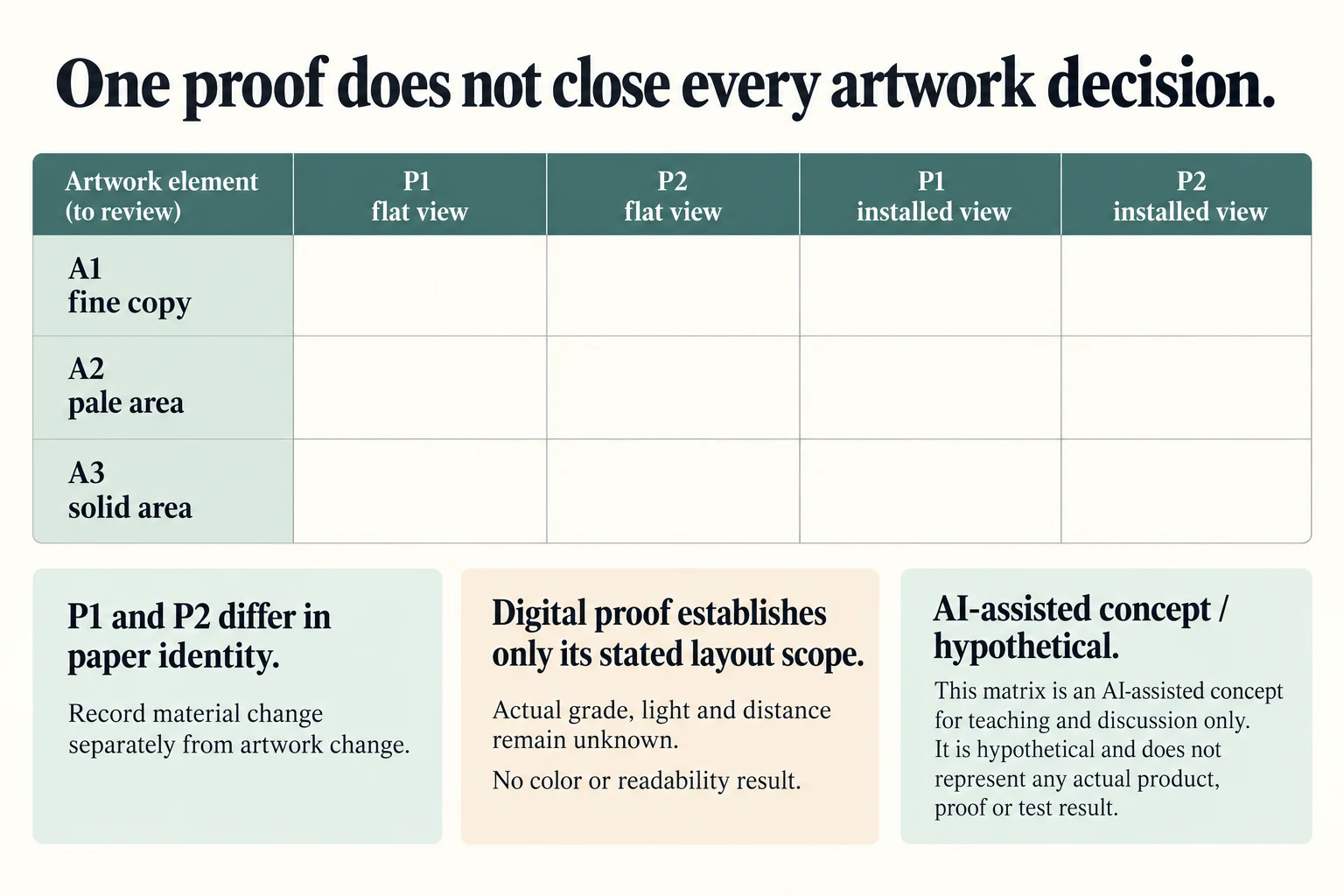
Use two new hypothetical proof references: P1 represents the proposed uncoated substrate and P2 represents a substitute. A1 fine copy, A2 pale area and A3 solid area keep the same IDs. The actual grade, printing and observations remain unknown.
Scroll horizontally if columns extend beyond the view.
| Scenario scope | Exact object or route | Hypothetical input or output | Calculation or record boundary |
|---|---|---|---|
| Separate element view | P1_PROPOSED_A1 | Unobserved; actual fields blank | P1_PROPOSED A1 flat view; observation and decision unrecorded, material identity and viewing conditions required |
| Separate element view | P1_PROPOSED_A1 | Unobserved; actual fields blank | P1_PROPOSED A1 installed view; observation and decision unrecorded, material identity and viewing conditions required |
| Separate element view | P1_PROPOSED_A2 | Unobserved; actual fields blank | P1_PROPOSED A2 flat view; observation and decision unrecorded, material identity and viewing conditions required |
| Separate element view | P1_PROPOSED_A2 | Unobserved; actual fields blank | P1_PROPOSED A2 installed view; observation and decision unrecorded, material identity and viewing conditions required |
| Separate element view | P1_PROPOSED_A3 | Unobserved; actual fields blank | P1_PROPOSED A3 flat view; observation and decision unrecorded, material identity and viewing conditions required |
| Separate element view | P1_PROPOSED_A3 | Unobserved; actual fields blank | P1_PROPOSED A3 installed view; observation and decision unrecorded, material identity and viewing conditions required |
| Separate element view | P2_SUBSTITUTE_A1 | Unobserved; actual fields blank | P2_SUBSTITUTE A1 flat view; observation and decision unrecorded, material identity and viewing conditions required |
| Separate element view | P2_SUBSTITUTE_A1 | Unobserved; actual fields blank | P2_SUBSTITUTE A1 installed view; observation and decision unrecorded, material identity and viewing conditions required |
| Separate element view | P2_SUBSTITUTE_A2 | Unobserved; actual fields blank | P2_SUBSTITUTE A2 flat view; observation and decision unrecorded, material identity and viewing conditions required |
| Separate element view | P2_SUBSTITUTE_A2 | Unobserved; actual fields blank | P2_SUBSTITUTE A2 installed view; observation and decision unrecorded, material identity and viewing conditions required |
| Separate element view | P2_SUBSTITUTE_A3 | Unobserved; actual fields blank | P2_SUBSTITUTE A3 flat view; observation and decision unrecorded, material identity and viewing conditions required |
| Separate element view | P2_SUBSTITUTE_A3 | Unobserved; actual fields blank | P2_SUBSTITUTE A3 installed view; observation and decision unrecorded, material identity and viewing conditions required |
| Proposed substrate | P1 | Unobserved; actual fields blank | Actual proposed grade, maker, process and treatment unknown |
| Substitute substrate | P2 | Unobserved; actual fields blank | Substitute grade is a separate material identity, not just a color correction |
| Physical reference | A2 | Unobserved; actual fields blank | Agreed physical appearance reference not supplied |
Record flat and installed views separately for each element on each proof. A printer response about P1/A1 readability does not close P1/A2 appearance, P2’s substrate gap or access when the card sits behind a holder. The table leaves those observations and decisions empty.
Retain the original digital layout evidence under its stated role. If both artwork and paper change between P1 and P2, describe both changes before comparing them. The next request can then name one element, one substrate and one view without pretending that a screen image or a substituted grade proves the final surface.
Download the printing on uncoated packaging paper record (.csv). It covers the original scenarios and this added comparison. HYPOTHETICAL rows are invented planning examples. Actual quantity, value, configuration, method, owner, observation, condition, decision, evidence and dates are blank because no actual project record has been obtained. Copy a relevant row and replace its type with ACTUAL only when entering permitted project evidence; keep the example and actual record separate. ACTUAL_BLANK is an empty starting row. A blank is unknown, never approval.
The related Packaging Color Approval Starts With a Physical Reference guide concerns a separate requirement. Use this record for the specific comparison above rather than treating that guide as evidence of a completed result.
Preserve changed evidence in the sample-version comparison. Carry the scoped result into the artwork handoff record.
References retain their stated general-guidance or manufacturer-example scope. Worked figures and records are teaching examples, not observed orders, stock, prices or measured performance.
Discuss this packaging specification with Packrivo. We coordinate independent suppliers. MOQ: 500 pieces per product/design; illustrative quantities are not production offers. Confirm materials, samples, price and timing for your project.