
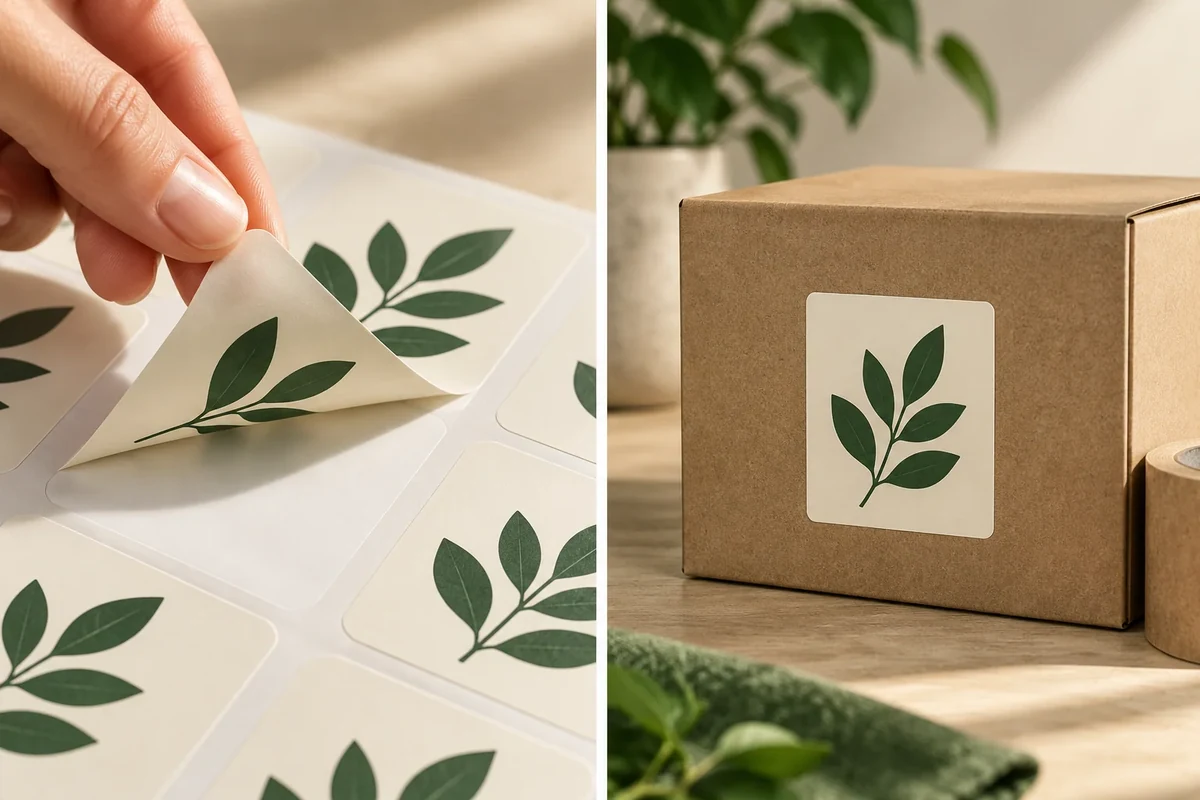
Review liner release through the intended hand or applicator route before treating the final surface bond as accepted. Record the label face, adhesive and liner identities plus the actual dispensing observation. Release from the backing and adhesion on the product are different interfaces that need separate evidence.
Identify the liner’s role before peeling
The original UPM liner explanation describes the liner as protecting the adhesive and carrying the label through converting and application. That supports recording the liner alongside the face and adhesive rather than identifying a label only by its visible paper or film.
Ask the converter for the offered face/adhesive/liner construction and drawing reference. State whether labels will be applied by hand, through a selected applicator or through another confirmed route. The peel or dispensing path is an input to the review, not a universal property of every liner.
Keep the actual target surface and product state identified too, but retain its applied-bond result separately. A label leaving its liner clearly does not by itself answer the subsequent adhesion question.
Record dispensing under the intended route
The Primera AP550 manual identifies its label/roll and sensing requirements. Where an applicator is selected, its qualified operator should confirm the applicable instructions and setup. This article gives a decision record, not machine calibration or repair directions.
Use the agreed label construction and application route for the observation. Record a label remaining on the liner, an observed edge problem, liner damage or another visible dispensing issue by its location and conditions. Ask the converter and application owner to assess that specific evidence.
If the proposal changes the liner or adhesive, retain the old construction and the revised identities. A response saying that the label is easier to peel should still identify the actual proposed component and evidence. Keep the later applied-surface test at its own sample reference.
Use a release and application-route log
This original Packrivo aid separates the two interfaces in a hypothetical candle-label plan.
| Interface or field | Example input | Next evidence or owner |
|---|---|---|
| Construction | Face F1, adhesive A1 and liner L1 | Converter supplies offered grade identities |
| Release route | Selected hand or applicator path | Packing owner records actual route |
| Machine reference | Applicable model/specification if used | Qualified operator confirms requirements |
| Release observation | Located liner/label issue during dispensing | Attach evidence and converter response |
| Applied surface | Finished candle container in named conditions | Keep a separate applied-label sample |
| Revised proposal | Changed liner/adhesive identity if offered | Retain earlier result and next review owner |
Compare an illustrative release question
Imagine the artwork and visible label face are approved, but the packing owner records a dispensing problem. Start with the offered construction and actual release route. The converter’s next answer should address those identities rather than recommending a stronger final adhesive without explaining the dispensing question.
If a revised liner is proposed, compare the release evidence using the intended route. Then carry the revised construction into the separate applied-surface review. This keeps an improvement at one interface from being mistaken for approval of the whole label system.
Handoff release and adhesion as linked records
Use the label adhesion and surface-condition method for the applied product surface. The roll-or-sheet guide records the broader application arrangement, while the sample revision record keeps a changed construction visible.
The converter confirms layer identities. The application owner reports the actual release observation. The buyer retains separate dispensing and applied-bond decisions with the evidence they use. If a field remains unresolved, keep its next owner and required response explicit.
Bring the face/adhesive/liner map and actual release question through your packaging brief. MOQ is 500 pieces per design; label construction, samples and commercial details are confirmed for the project.
Give the revised liner its own release and applied-bond records
Compare two hypothetical constructions with the same F1 face and A1 adhesive: the earlier L1 liner and proposed L2 liner. The four comparison records separate release from each liner and bond to the finished container. None has actual test evidence.
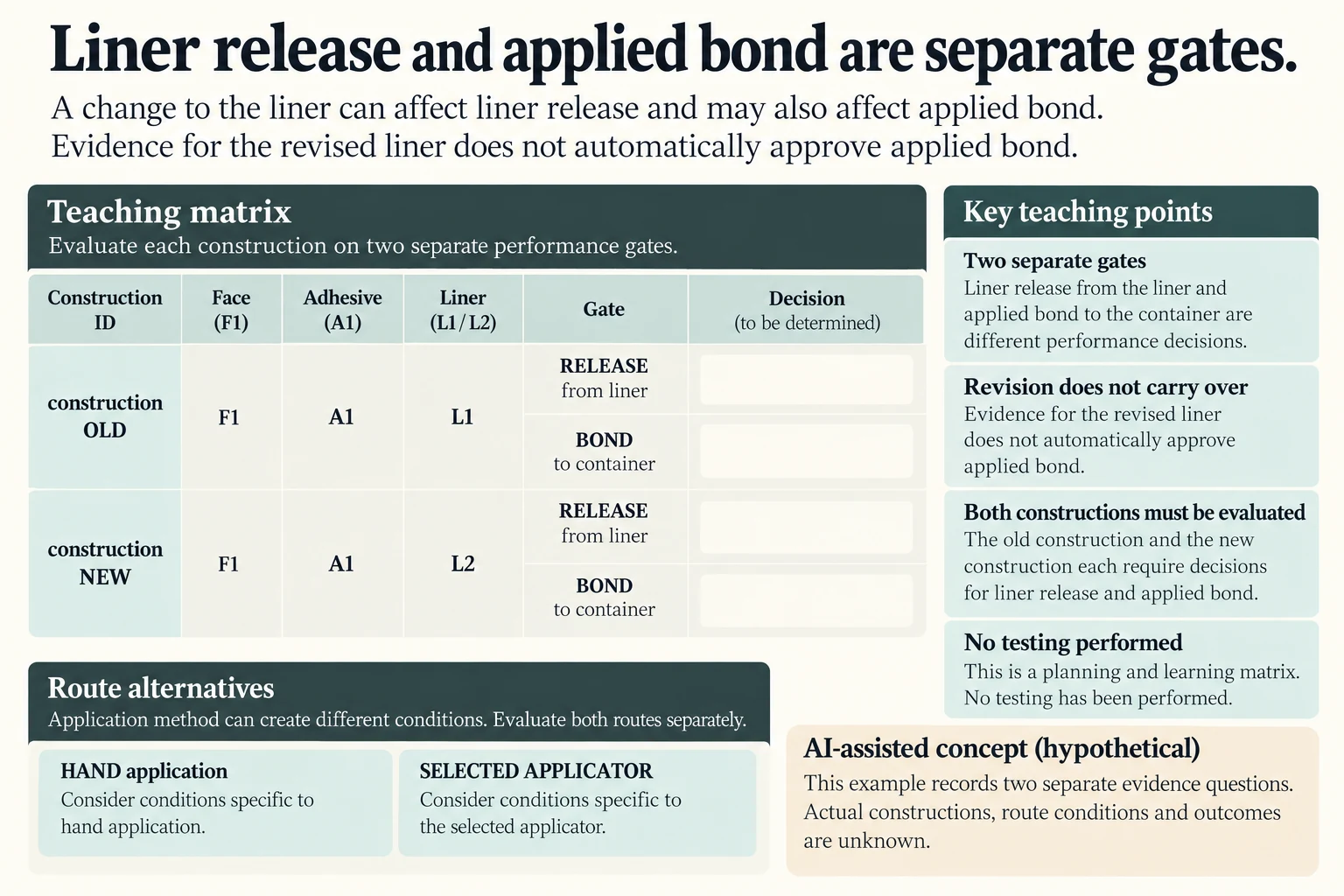
Scroll horizontally if columns extend beyond the view.
| Scenario scope | Exact object or route | Hypothetical input or output | Calculation or record boundary |
|---|---|---|---|
| Release | OLD_F1_A1_L1 | Unobserved; actual fields blank | New comparison matrix row; no release or applied-bond approval has been obtained |
| Applied bond | OLD_F1_A1_L1 | Unobserved; actual fields blank | New comparison matrix row; no release or applied-bond approval has been obtained |
| Release | NEW_F1_A1_L2 | Unobserved; actual fields blank | New comparison matrix row; no release or applied-bond approval has been obtained |
| Applied bond | NEW_F1_A1_L2 | Unobserved; actual fields blank | New comparison matrix row; no release or applied-bond approval has been obtained |
A converter’s L2 proposal answers a construction question. It does not establish easier dispensing under the intended route, and a release observation would not by itself approve the later applied bond. Preserve the earlier construction and surface sample references instead of replacing them with one whole-label status.
Hand application and a selected applicator have different condition records. The CSV also retains the original alternative of an adhesive change, not only the new liner case. Machine requirements remain with the qualified operator and actual maker instructions; no calibration, peel setting or performance threshold is prescribed.
Download the label liner release vs adhesion record (.csv). It covers the original scenarios and this added comparison. HYPOTHETICAL rows are invented planning examples. Actual quantity, value, configuration, method, owner, observation, condition, decision, evidence and dates are blank because no actual project record has been obtained. Copy a relevant row and replace its type with ACTUAL only when entering permitted project evidence; keep the example and actual record separate. ACTUAL_BLANK is an empty starting row. A blank is unknown, never approval.
The related Label Adhesion for Packaging Needs Surface and Use Details guide concerns a separate requirement. Use this record for the specific comparison above rather than treating that guide as evidence of a completed result.
Applied seam geometry is another question in the applied wrap-overlap map. Keep unused construction and storage identities in the leftover component register.
Source scope checked 16 October 2026: the original public references remain within their stated general guidance or manufacturer-example scope. The new numbers and task records are original hypothetical analysis, not observed supply, trials, inventory, prices or performance.
Discuss this packaging specification with Packrivo. We coordinate independent suppliers. MOQ: 500 pieces per product/design; illustrative quantities are not production offers. Confirm materials, samples, price and timing for your project.