
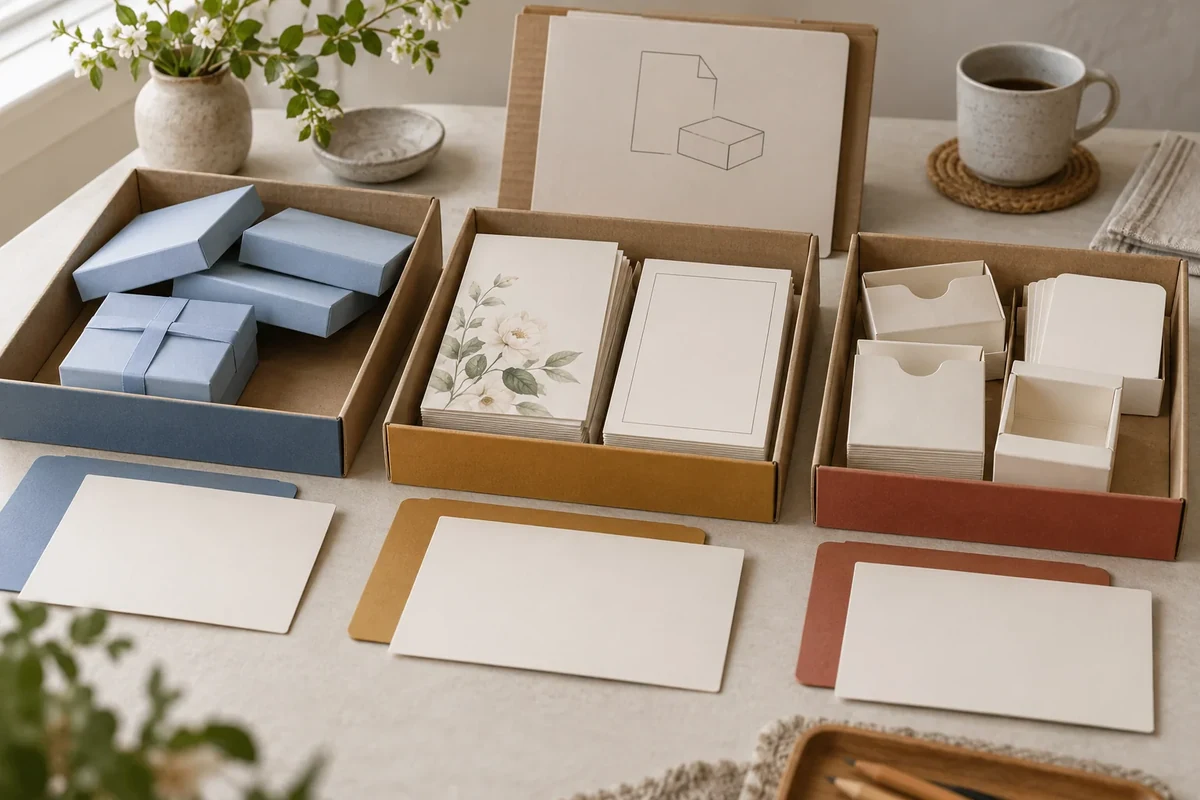
Record leftover packaging by component, version, condition and actual storage instructions before deciding how it affects a reorder. Give each remaining batch a keep, review or hold status with a named owner. A surplus quantity alone does not establish that it still matches the current product configuration.
Match the remaining component to the current baseline
The existing packaging reorder checklist establishes the version-first reorder route. This original register adds the physical remaining count and condition to that baseline rather than treating all leftover packaging as interchangeable stock.
Identify the component, drawing/artwork revision and available lot. Compare it with the current product, insert, care card and closure configuration. State which identity is confirmed and which field still requires a supplier or packing-owner response.
Count the remaining units under the agreed project method and record the observed condition. Keep uncertain quantities or mixed versions separate instead of forcing them into one total. A component that looks similar may still carry an earlier artwork or fit arrangement.
Use storage instructions only for the actual component
The original IPG tape technical sheet includes storage and shelf-life information for its named tape grade. It is a specific example of a component carrying maker instructions, not a storage rule for all boards, labels, holders or packaging leftovers.
Request the actual offered maker’s instructions when they apply to the remaining component. Keep the grade, instruction reference and any relevant known storage history attached to that batch. Leave a missing instruction or uncertain condition as a named review question.
If the component has a superseded version, record that status before considering its use. The buyer can retain it for a confirmed purpose, request another compatibility review or exclude it from the reorder plan. Do not calculate assumed savings or expiry from an unrelated material example.
Use a leftover-version disposition register
This hypothetical gift-pack record is an original planning aid, not a real warehouse stock report.
| Remaining batch field | Illustrative entry | Next decision |
|---|---|---|
| Component identity | Gift lid L1_r01, supplied lot field | Compare with current accepted lid revision |
| Remaining count | Verified count or unresolved quantity | Packing owner records the actual basis |
| Condition | Located observation/photo of remaining components | Buyer or supplier defines required review |
| Storage reference | Actual maker instructions if applicable | Retain grade-specific document and known history |
| Version compatibility | Earlier card or holder relationship | Review against current complete pack |
| Disposition | Keep/review/hold/exclude from reorder | Named owner and accepted use reference |
Resolve an illustrative superseded-card batch
Imagine remaining care cards use an earlier layout while the holder and gift-box height have changed. The count can be known, yet the cards’ use remains a configuration question. Retain the old card identity and compare its final placement with the current set.
The buyer may approve a specific use or keep the batch on hold while the revised fit is reviewed. The reorder line should then state whether those cards are excluded or intentionally part of the plan. A general instruction to use surplus does not resolve the version or condition.
Handoff the remaining batch before ordering
Use the drawing-change record for changed component dependencies and sample revision records when physical compatibility needs another review.
The packing owner supplies actual remaining quantity and condition. The supplier supplies applicable component facts and storage instructions. The buyer decides accepted use and the reorder exclusion or quantity scope. Keep the decision with the exact version rather than marking the whole packaging family reusable.
Share the register, current baseline and unresolved leftover questions through your packaging brief. MOQ is 500 pieces per design; actual component quantities, materials, sampling and commercial conditions are confirmed for the project.
Separate the counted remainder from the eligible contribution
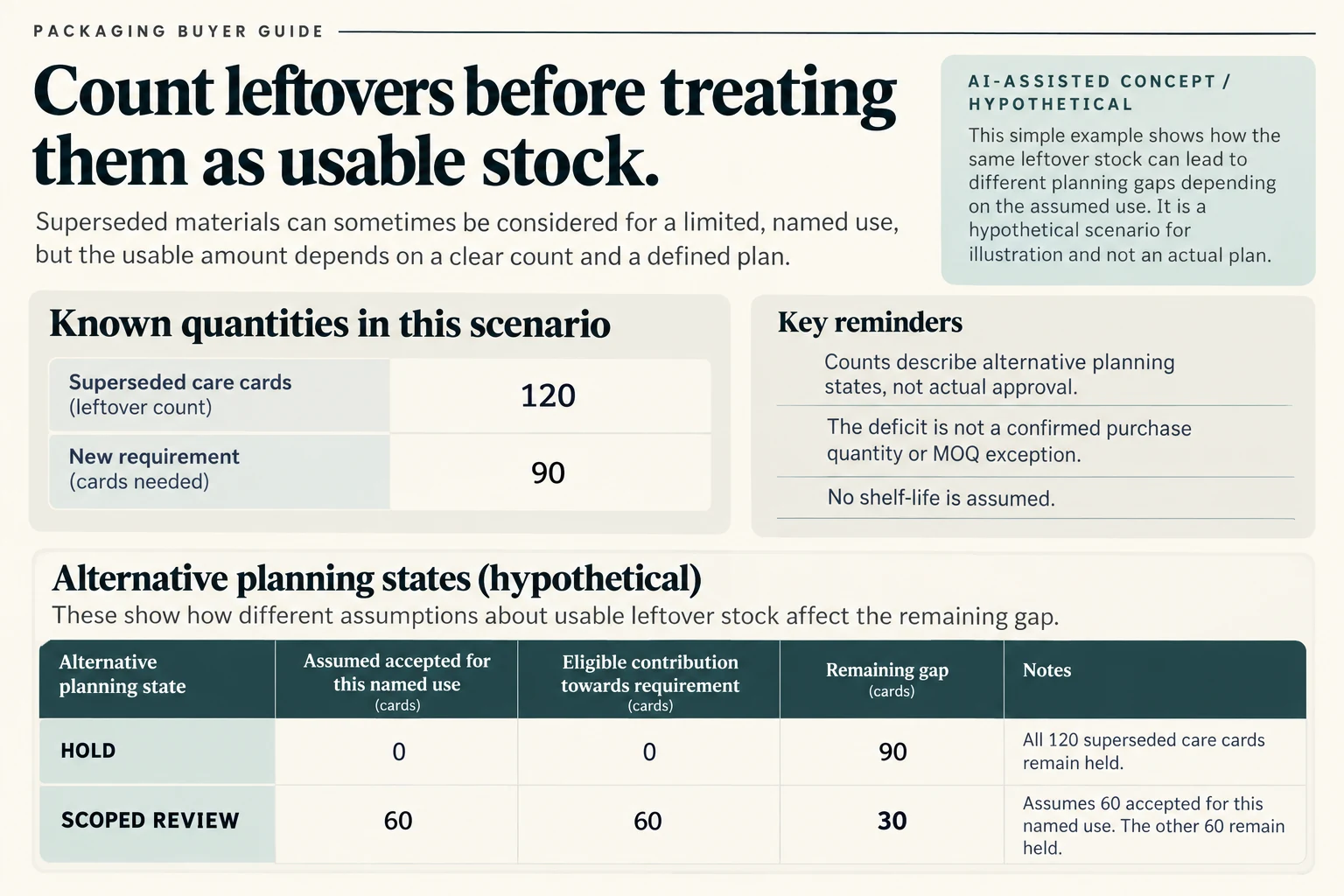
Assume a new hypothetical count of 120 superseded care cards and a current requirement for ninety. Compare two mutually exclusive planning states: all old cards remain held, or a responsible review hypothetically permits sixty for this named use. No real approval, stock count or review has occurred.
Scroll horizontally if columns extend beyond the view.
| Scenario scope | Exact object or route | Hypothetical input or output | Calculation or record boundary |
|---|---|---|---|
| Count input | OLD_CARDS19 | 120 cards | New invented counted old-card quantity, not observed stock |
| Requirement | CURRENT_USE19 | 90 cards | New fictional current-use need |
| Eligible contribution | HOLD_ALT19 | 0 cards | min(90 required, 0 assumed accepted); acceptance and contribution are separately recorded |
| Remaining requirement | HOLD_ALT19 | 90 cards | 90-0 |
| Eligible contribution | SCOPED_ALT19 | 60 cards | min(90 required, 60 assumed accepted); acceptance and contribution are separately recorded |
| Remaining requirement | SCOPED_ALT19 | 30 cards | 90-60 |
| Other cards still held | SCOPED_ALT19 | 60 cards | 120-60; no automatic release of remainder |
| Open commercial question | CURRENT_USE19 | Unobserved; actual fields blank | 90or30 deficit is not an available custom order quantity; MOQ500pieces/product/design remains |
| Assumed accepted input | HOLD_ALT19 | 0 cards | All-held alternative assumes no cards accepted for this use |
| Assumed accepted input | SCOPED_ALT19 | 60 cards | Alternative fictional scoped review permits60 for this use only, not an actual approval |
| Held remainder | HOLD_ALT19 | 120 cards | All120 oldcards still held in this branch |
The all-held route contributes zero and leaves ninety required. The scoped-use route contributes sixty, leaves a thirty-card requirement and keeps the other sixty old cards held. Do not subtract all 120 simply because the physical count exceeds the requirement.
The ninety- and thirty-card gaps are needs to resolve, not confirmed custom purchase quantities or MOQ exceptions. Keep the old card, changed holder and changed box height with their own references; apply only the actual component maker’s storage instructions. Neither an unrelated tape shelf life nor a familiar appearance establishes those cards’ eligibility.
Download the leftover packaging inventory reorder record (.csv). It covers the original scenarios and this added comparison. HYPOTHETICAL rows are invented planning examples. Actual quantity, value, configuration, method, owner, observation, condition, decision, evidence and dates are blank because no actual project record has been obtained. Copy a relevant row and replace its type with ACTUAL only when entering permitted project evidence; keep the example and actual record separate. ACTUAL_BLANK is an empty starting row. A blank is unknown, never approval.
The related Packaging Reorder Checklist: Control the Version First guide concerns a separate requirement. Use this record for the specific comparison above rather than treating that guide as evidence of a completed result.
Eligibility is separate from whether stock is already committed in the shared-stock reservation map. If corrective work is proposed, evaluate accepted output with the accepted recovery cost comparison.
Source scope checked 16 October 2026: the original public references remain within their stated general guidance or manufacturer-example scope. The new numbers and task records are original hypothetical analysis, not observed supply, trials, inventory, prices or performance.
Discuss this packaging specification with Packrivo. We coordinate independent suppliers. MOQ: 500 pieces per product/design; illustrative quantities are not production offers. Confirm materials, samples, price and timing for your project.