
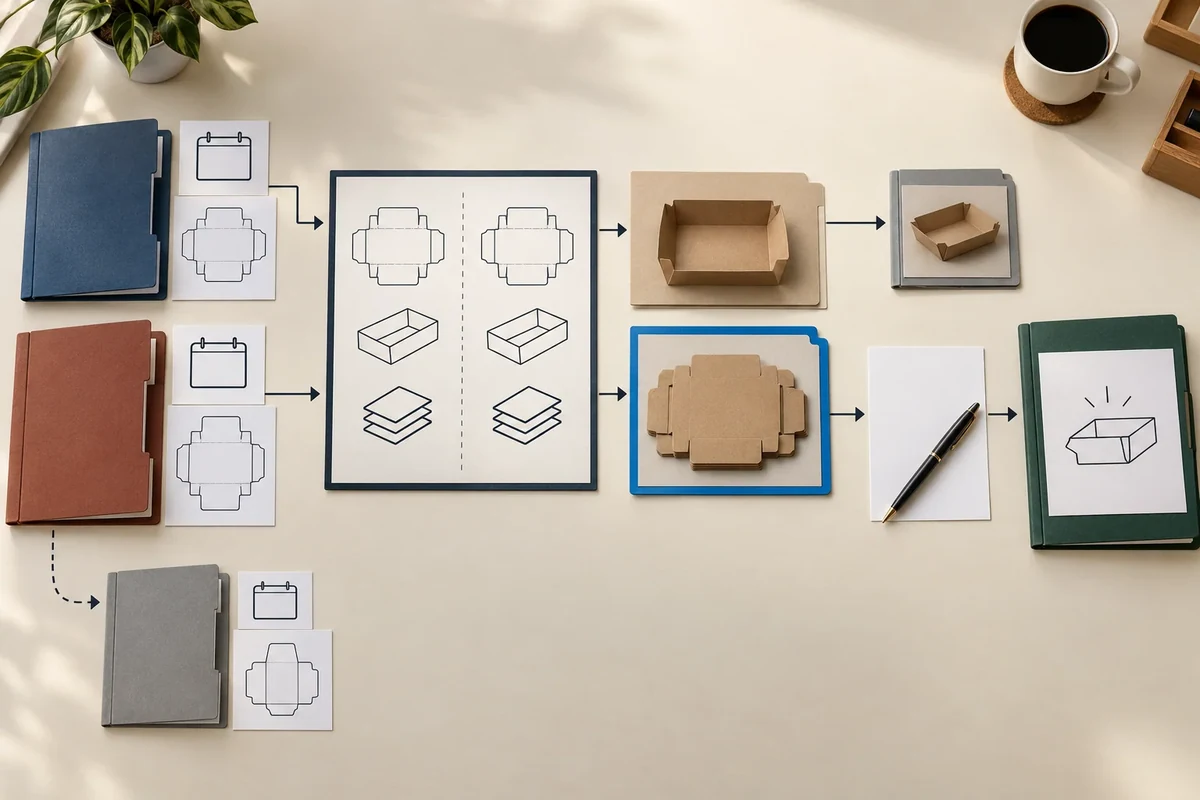
Compare dated replies from different suppliers only after their scope, units and versions are aligned. When two values are mutually exclusive for one packaging decision, record the selected scope and value, the alternatives not selected and who authorized that choice. Then transfer the selected basis to the ordinary clarification workflow for execution.
Build a common comparison scope first
This is an original Packrivo selection tool for cross-supplier decisions. It does not rate suppliers or determine that an unselected proposal is false. The required output is an authorized basis for one defined packaging decision.
Give the comparison a scope ID containing component/drawing revision, material or configuration, quantity unit, supplied state and the decision being made. Retain each supplier identity and dated reply separately. A later date does not automatically make one proposal the accepted baseline.
Check units and reference versions before calling the values conflicting. Convert only when the actual units and quantity basis permit it. A response about another drawing or set definition remains outside the same-scope comparison until the difference is resolved.
Classify apparent differences before selecting
Equal values in different units are not a conflict. Different revisions or different item/set units are a scope mismatch. Two aligned proposals can also be valid alternatives whose values cannot both appear in one selected packing instruction.
Where the common scope is genuinely aligned and values are mutually exclusive for the decision, retain the supporting references and select through the named project authority. If evidence is insufficient, record no selection and assign the missing comparison input. Do not replace uncertainty with the newest supplier statement.
| Hypothetical compared replies | Comparability result | Action before selection |
|---|---|---|
| Supplier A, Day1:14cm; Supplier B, Day3:140mm | Same measured feature/unit basis: equivalent values | Normalize units; no conflict to select |
| Supplier A cites drawing r01; Supplier B cites r02 | Reference versions differ | Resolve common scope; keep outside like-for-like decision |
| A proposes factory-formed T1; B proposes flat-kit T1 for local setup | Aligned SC1, mutually exclusive supplied-state choices | Select one scope/owner arrangement, retain other as not selected |
Output the selected scope and rejected alternative
Record the exact selected value with its supplier/date/evidence and the scope under which it applies. State why another comparable alternative was not selected and preserve its reference. The reason should describe the actual project choice or requirement, not a fabricated supplier-quality score.
Name the authorization owner and decision date, any conditions still open and the instruction or brief revision this selection enables. Keep a previous master baseline identified if the choice still requires a separate approved revision.
| Selection-record field | Hypothetical completed basis |
|---|---|
| Common scope SC1 | T1/r02, same set unit and contents; choose one supplied-state/packing-responsibility plan |
| Candidates | Supplier A/Day1/evidence A1:formed; Supplier B/Day3/evidence B1:flat kit |
| Selected value | Illustrative choice:flat kit with named local setup, subject to confirmed instructions |
| Not selected | Formed alternative A1 retained; project chose local preparation for SC1 |
| Authorization | Named buyer owner/date in actual project record; example is not a real approval |
| Selected scope limits | Only T1/r02 and stated unit/conditions; other components remain separate |
| Execution handoff | Selection SR1 and selected brief revision sent into ordinary clarification rows |
Send the selected basis to the clarification workflow
The existing supplier clarification matrix obtains missing facts and tracks the follow-up. This selection record comes before that execution step: it establishes a common comparison key, normalized/equivalent or excluded values, an authorized chosen scope and retained alternatives.
Transfer SR1’s selected supplier/value/scope into the brief and ask the chosen supplier to confirm outstanding instruction fields. Avoid continuing to ask every supplier which earlier reply now applies after the buyer has selected a different proposed arrangement.
Use the sample revision record when the authorized selection changes a candidate sample. Bring the comparison key, actual dated proposals and unresolved selection conditions to your packaging brief. MOQ is 500 pieces per design; offered construction, sample scope and commercial terms are confirmed for the project.
Equivalent units and exclusive supply plans are different questions
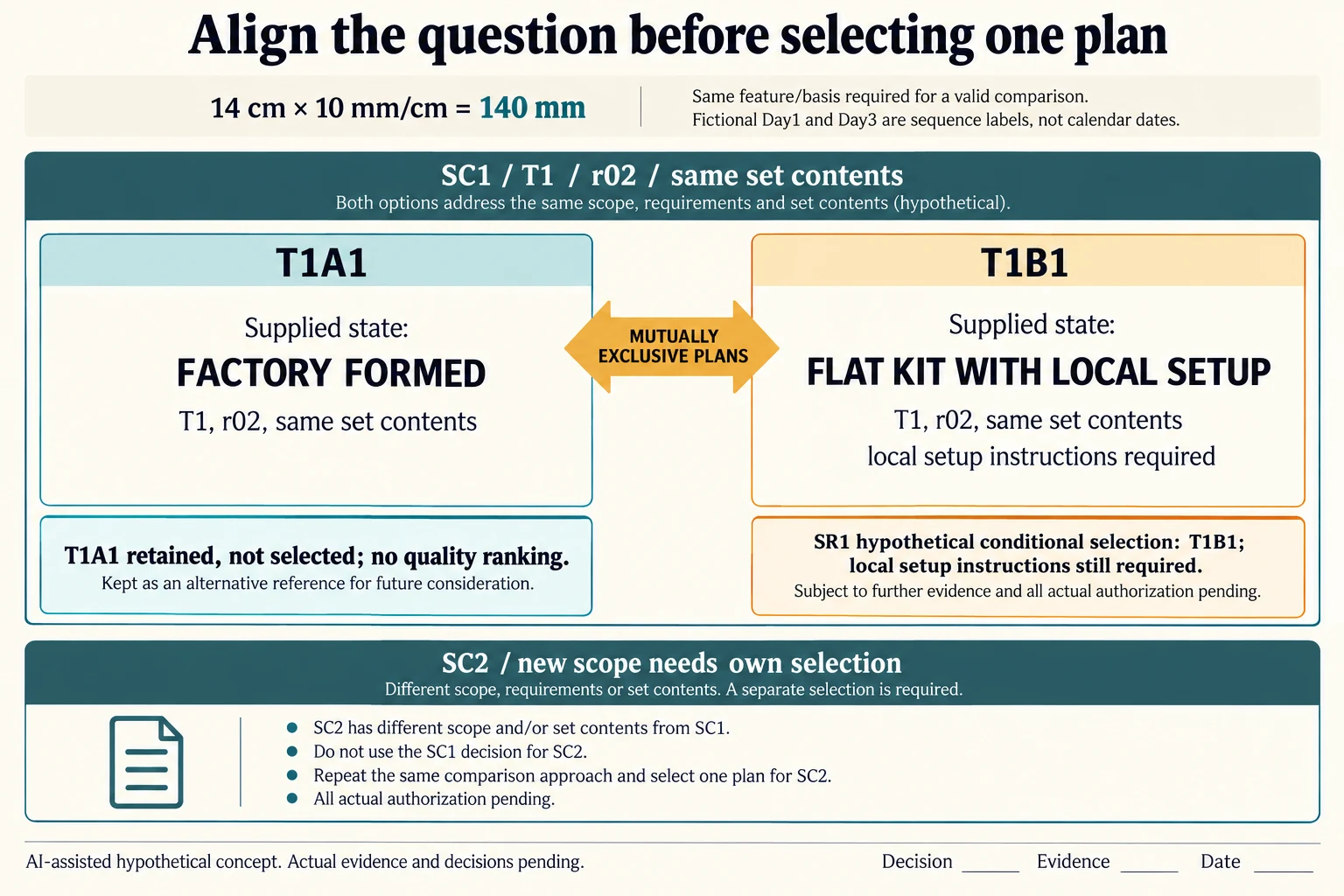
First compare the original numerical descriptions under a stated common-feature assumption: source A says 14 cm on fictional Day 1 and B says 140 mm on fictional Day 3. The conversion factor is 10 mm per cm, so 14×10=140 mm. The numeric day ordinals are example sequence labels, not actual calendar dates. Equivalent units resolve that numerical difference only after the feature, measurement basis and configuration match.
Scroll horizontally if columns extend beyond the view.
| Hypothetical configuration | Named object | Relationship | Input or next scope |
|---|---|---|---|
| EQUIVALENCE26 | SOURCE_A | assumed reported value | SAME_FEATURE_IF_CONFIRMED; 14 cm |
| EQUIVALENCE26 | SOURCE_B | assumed reported value | SAME_FEATURE_IF_CONFIRMED; 140 mm |
| EQUIVALENCE26 | SOURCE_A | calculated from | DAY1_VALUE*CM_FACTOR; 140 mm |
| ALIGNED26 | T1A1 | has component | T1 |
| ALIGNED26 | T1A1 | has drawing | r02 |
| ALIGNED26 | T1A1 | has contents | SAME_SET_CONTENTS |
| ALIGNED26 | T1A1 | has state | FACTORY_FORMED |
| ALIGNED26 | T1B1 | has component | T1 |
| ALIGNED26 | T1B1 | has drawing | r02 |
| ALIGNED26 | T1B1 | has contents | SAME_SET_CONTENTS |
| ALIGNED26 | T1B1 | has state | FLAT_KIT_LOCAL_SETUP |
| ALIGNED26 | T1A1 | mutually exclusive with | T1B1 |
| ALIGNED26 | SR1 | fictional selected plan | T1B1 |
| ALIGNED26 | T1B1 | requires | CONFIRMED_LOCAL_SETUP_INSTRUCTIONS |
| SC2_CHANGED26 | SC2 | does not inherit | SR1_FOR_SC1 |
A reply for r01 versus r02, or a count in pieces versus sets, needs its scope aligned before selection. For the added record, use T1A1 as an alias for supplier A/evidence A1 and T1B1 for supplier B/evidence B1. Their fictional reply days remain Day 1 and Day 3. These aliases can be competing plans for the same SC1 decision: T1 on r02 with the same set contents, supplied factory formed or as a flat kit with local setup. Their different supplied states are the alternatives being chosen, not a reason to lose the original same-decision comparison. They cannot both become the current packing instruction.
Retain the hypothetical SR1 selection of T1B1 as conditional on confirmed local setup instructions. T1A1 stays in history as not selected, without a claim that it was false or inferior. The CSV gives each plan its own component, drawing, contents, state and decision relationship, plus a mutual-exclusion link. All actual selection owners, decisions, instruction evidence and dates remain empty.
A later SC2 scope does not inherit SR1 automatically. Name what changed and seek the responsible selection for that scope. Likewise, recording SR1 does not itself revise the master drawing or authorize production; carry any required baseline change through its own record. If the basis is insufficient, keep no selection rather than use the latest date as authority.
Download the supplier reply scope selection matrix record (.csv). It includes the original table fields and scenarios alongside the added relationships. HYPOTHETICAL rows are editorial examples or required review scopes, not actual records. Actual quantity, configuration, component and file identities, materials, process, specification, copy, method, condition, observation, owner, decision, evidence and dates are blank. ACTUAL_BLANK is a separate empty starting row; enter permitted project evidence before using an actual record. A blank means unknown.
Use the Turn Supplier Replies Into a Clarification Matrix for its separate question. Use the Packaging Dieline Changes Need an Impact Record for its separate question. Use the Sampling Units Need Their Own Lines Before a Production Order for its separate question.
References apply to the materials, processes or guidance named in each source. Worked configurations and dimensions are teaching examples, not tested specifications or production limits. Use the project’s material specification, drawing and formed sample for approval.
Discuss this packaging specification with Packrivo. We coordinate independent suppliers. MOQ: 500 pieces per product/design; illustrative quantities are not production offers. Confirm materials, samples, price and timing for your project.