
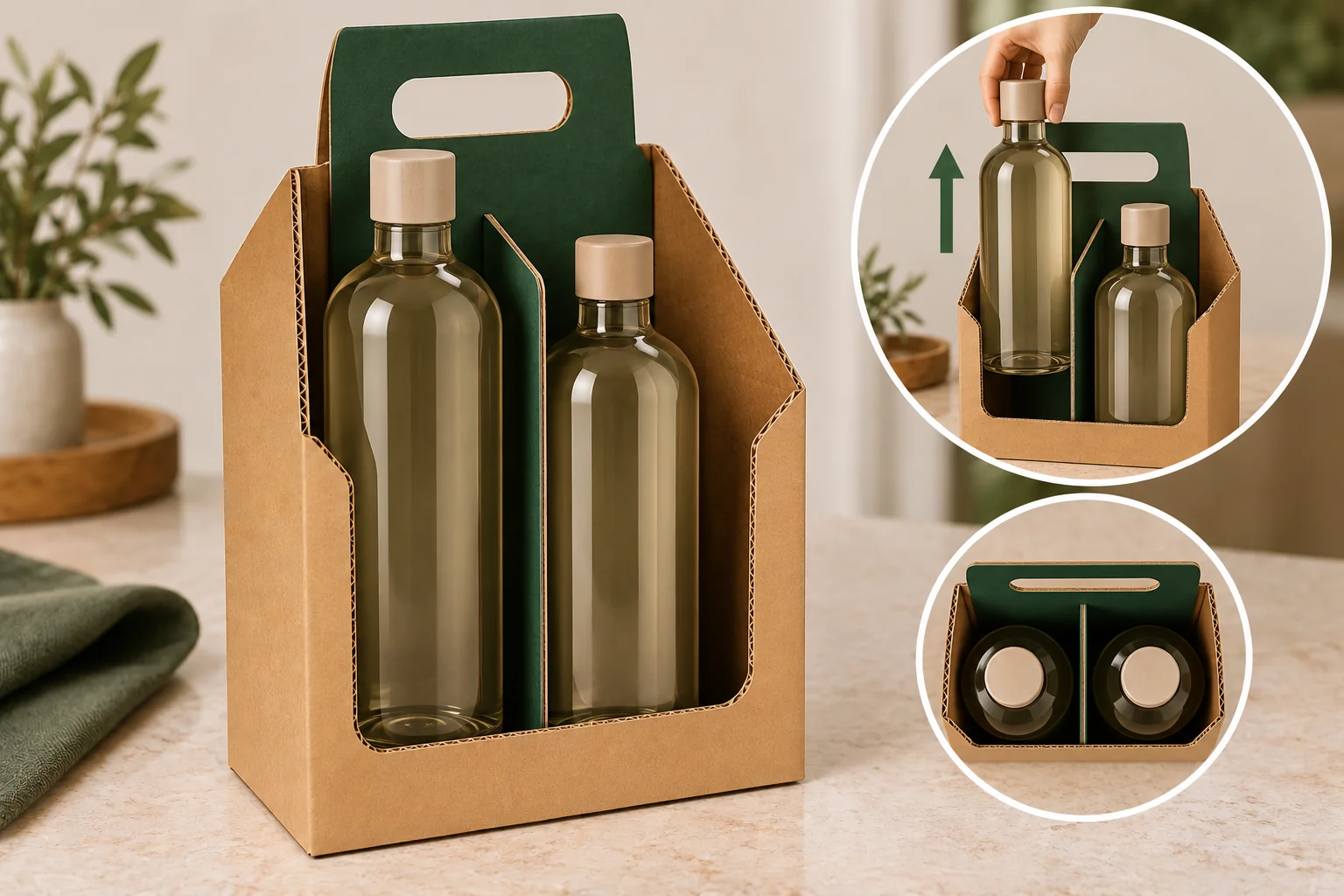
Use this concept for a project brief, with the actual structure and proposed load confirmed by the responsible supplier. No liquid, food-contact or protective performance is implied by the illustration.
Define every container in the arrangement
The corrugated bottle carrier reference identifies a multiple-container option with a handle. Provide the actual maximum container outline, including cap or lid, and the complete weight. State whether all containers are identical.
Show each cell and divider on a top view. If an accessory or care card shares a space, include it in that layout. A bottle count alone doesn’t define the separation or removal job.
For a hypothetical pair of dry gift containers, one might be taller than the other. Mark both top heights and their orientation. Ask whether the proposed divider locates their bodies while leaving their lids accessible.
Review handle access with the complete load
Show the handle shape, attachment or retaining proposal and the intended hand position. The grip area should be reviewed around the actual container tops. Ask the supplier to identify any reinforcement rather than inferring it from a thick-looking concept.
Place the complete contents in the proposed cells and review the handoff action within an agreed safe sample scope. Record how the carrier is supported and where fingers enter. Do not infer a rated carrying capacity from a short demonstration.
Remove each container individually afterwards. A divider that separates bodies may still meet a projecting lid during removal. Record the container, cell and action stage at that contact.
Use a cell and handoff record
One row should connect one container or grip interface to its evidence. Keep the proposed material and sample identity attached.
| Interface | Input to provide | Review question |
|---|---|---|
| Container to cell | Body, lid and packed weight | Which part locates or contacts? |
| Container to neighbour | Complete arrangement | Are intended gaps and dividers present? |
| Hand to handle | Grip route and proposed joint | Is access clear when fully loaded? |
| Container removal | Named cell and direction | Does lid or body meet the divider? |
| Outer distribution pack | Carrier outside envelope | What separate packing system is proposed? |
Keep the wider pack-system brief available if the gift carrier also travels through a delivery network. The carry action and distribution assessment need different evidence.
Confirm assembly and delivered state
Ask whether the carrier, handle features and dividers arrive prepared or as separate parts. State who forms the body and inserts the dividers before loading. Counts and matching components belong in the supply scope.
For the hypothetical unequal-height pair, label the cells C1 and C2. A reviewer should not swap the containers to make the handle easier to grip without recording the changed layout. The next supplier question should name the cell or handle relationship actually observed.
Inspect the joints and separators after the agreed actions. Any load, repeated-use or distribution requirement needs a defined evaluation by the responsible party, with the complete contents and material identified.
Send the full carrier configuration
Bring container details, cell map, handle proposal, quantity and destination to Get a Quote. Packrivo’s minimum is 500 pieces per design. Final structure, materials, sample scope and commercial terms require project confirmation.