
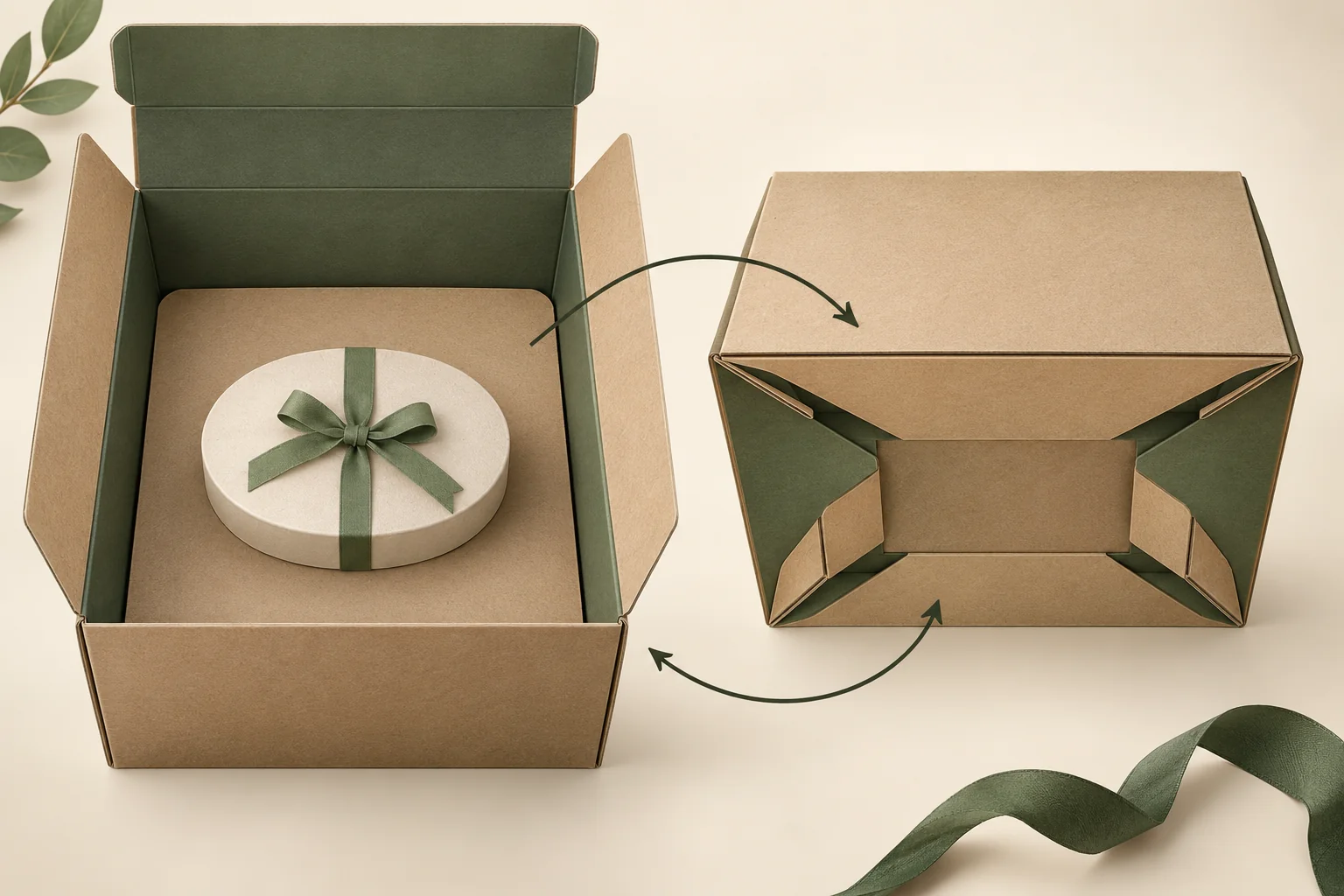
This packaging concept requires supplier confirmation of the offered base drawing and material proposal; the illustration explains the coverage interface.
Locate the coverage flap inside the formed carton
The full-flap auto-bottom reference names this construction. Esko also illustrates full-flap auto-bottom carton configurations in its ArtiosCAD style catalogue. Use those references to identify the idea, then obtain the actual blank offered for your gift. The position and shape of its coverage flap must be visible on that drawing.
Ask for an inside base view and an underside view. Mark the coverage flap, its fold, the underlying prepared joints and any exposed overlap. Those views answer different questions: the underside explains erection, while the inside shows what the loaded product touches.
Measure the product footprint in its finished primary packaging. Include a projecting candle-jar rim, a jewelry backing card or any separate accessory. State which object sits directly on the base and which object is carried by an insert. That contact map helps avoid approving a neat empty carton that behaves differently after loading.
Separate erection from product contact
Compare the auto-bottom carton when the main concern is the prepared base opening into position. The full-flap configuration adds a coverage and overlap decision. It deserves its own page only when the offered drawing and actual product contact make that additional decision meaningful.
Start the sample review with the carton empty. Form it using the supplied instructions, photograph the interior flap position, then load the complete set in the intended order. Record whether a flap edge catches the contents, whether a corner rests on an overlap and whether an insert changes the contact location. Leave any load or distribution evaluation as a separately agreed task.
Use a coverage and contact record
The following entries are a hypothetical candle-gift planning example. Replace them with the proposed drawing and observations; they are not completed sample results.
| Base interface | Example brief entry | Evidence to request |
|---|---|---|
| Coverage flap B1 | Show B1 beneath the jar and identify its fold | Offered blank plus inside base view |
| Prepared joint J1 | Identify factory preparation separately from B1 | Underside view and supplied state |
| Jar footprint | Finished jar is the direct contact item | Product dimensions and contact map |
| Accessory insert | Card holder sits beside the jar | Loaded interior photograph |
| Overlap question | Keep any catching edge open for review | Named observation and proposed revision |
Give the next question to the right owner
The converter should supply the flap and joint drawing. Your packing owner should confirm the erection and loading order, including whether the carton arrives prepared or needs an additional action. The buyer then decides which observed contacts need a revision or a further sample. A single closed-carton photograph cannot replace these three records.
Use the folding carton option to compare the broader box choice, and the flat and assembled delivery method to record preparation responsibility.
Send the offered base view, product footprint, insert arrangement and open overlap question through Get a Quote. Packrivo’s minimum is 500 pieces per design. Structure, material, sample scope and commercial terms are confirmed for the project after those inputs are clear.