
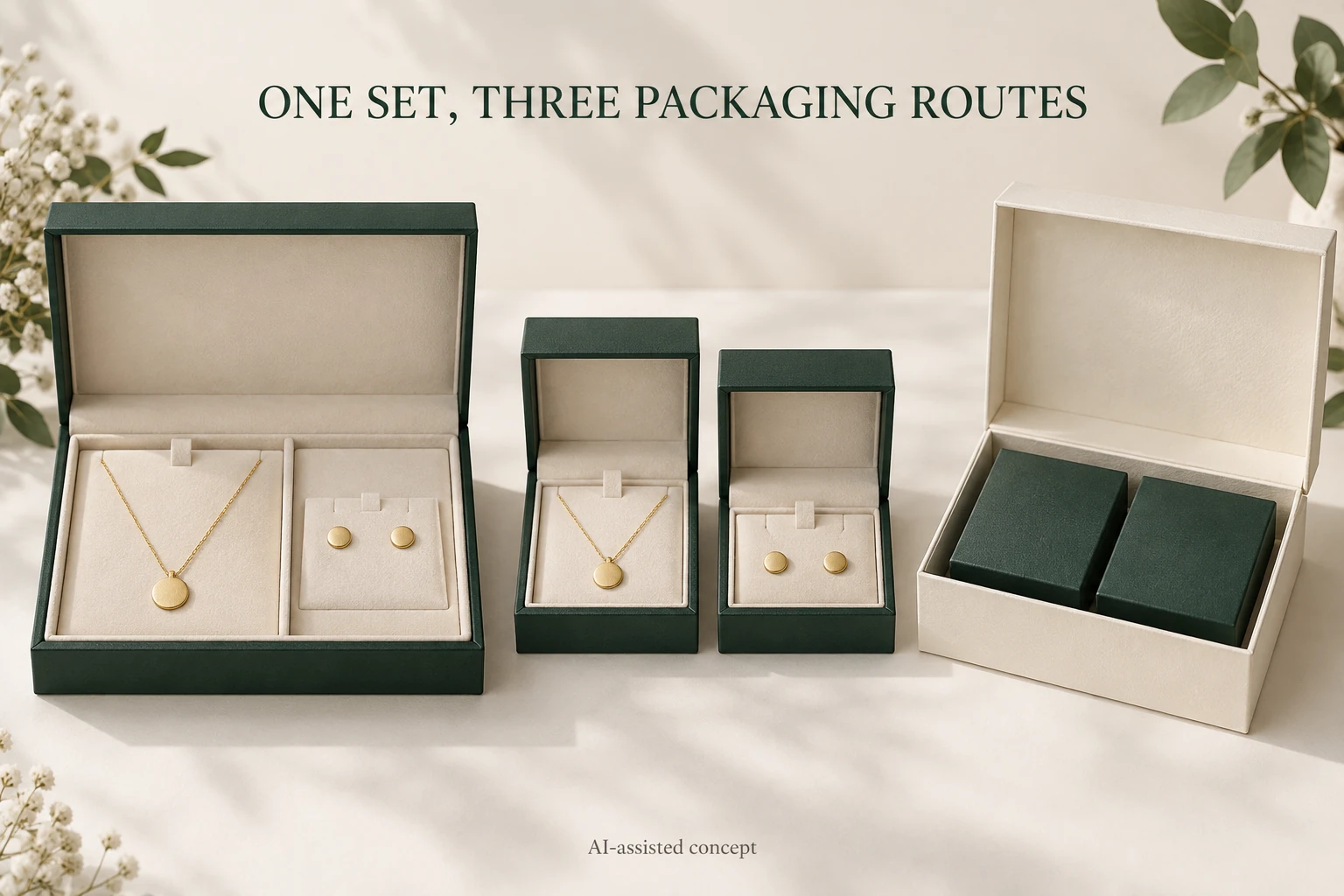
For a matching necklace and pair of earrings sold as one set, choose a shared presentation box when the gift should open as one display. Choose two gift-ready item boxes when the pieces need independent handoffs. Add an outer set box when both separate gifts and one coordinated set presentation matter.
Start with how the jewelry set will be given
This decision concerns one matching necklace and one pair of earrings offered together as a single sale. Decide what the recipient should receive when that set is purchased.
Ask whether the recipient is expected to open a single box and see the necklace and earrings together. That can be important when the matching relationship is the gift itself. Alternatively, the buyer may want to hand the earrings to one person and the necklace to another, or retain two finished boxes for separate storage after the gift is opened. A set can be sold together without requiring the contents to remain in the same container.
Write one sentence describing the required first opening and one sentence describing what should remain useful afterward. Those two statements give a packaging supplier a clearer purchasing decision than a photograph labeled “luxury jewelry set.”
Compare three complete packaging offers for the same set
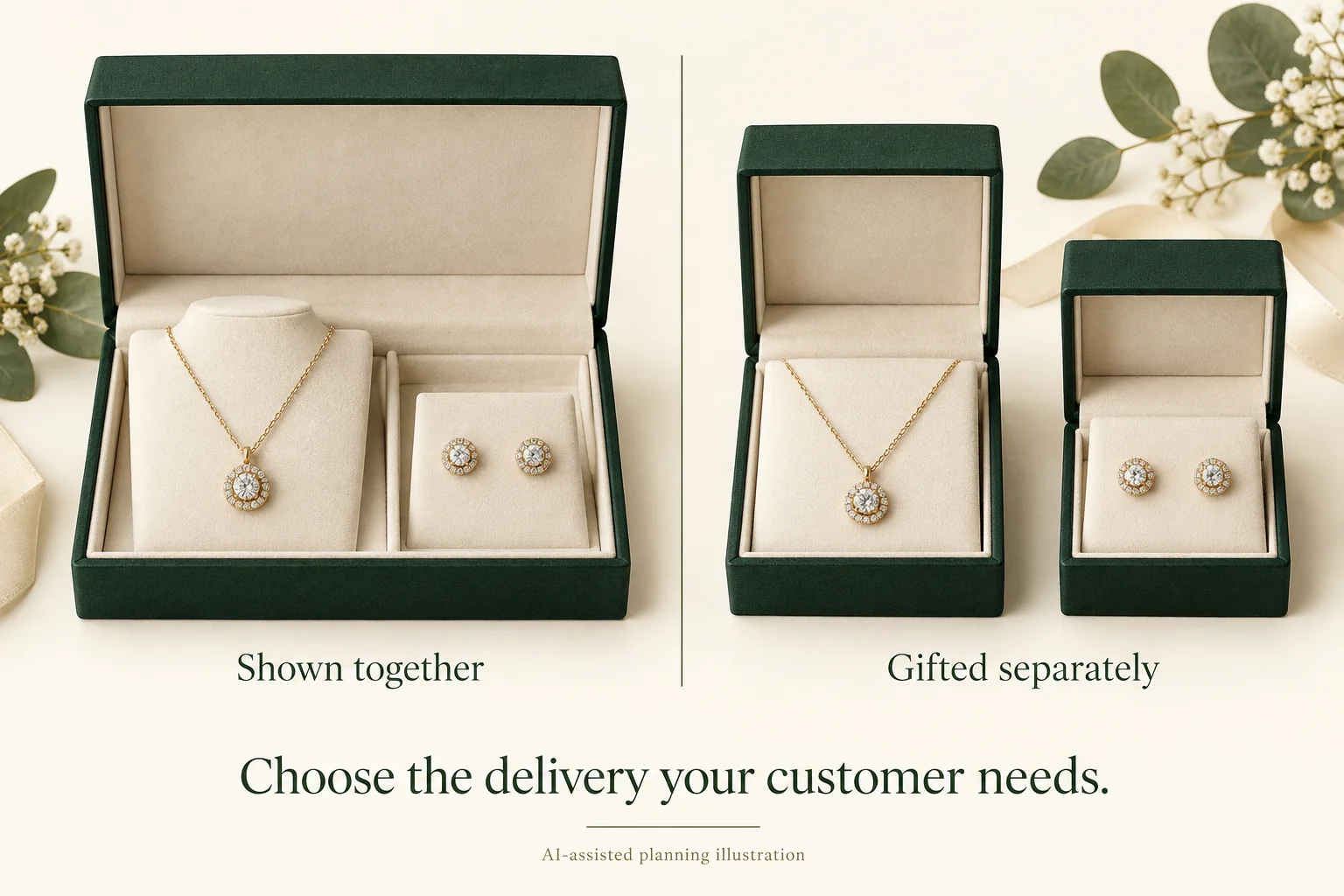
Option A is one dedicated presentation box containing the necklace and earrings on a shared display. The recipient opens one box to see the complete matching set. There is no promise that either piece will have a separate gift-ready container once removed. This option deserves consideration when the combined reveal is the nonnegotiable requirement.
Option B is a necklace box and an earring box, each finished and presentable on its own. The two boxes are sold as one set, but they are not enclosed in an additional customer-facing set box. The seller still needs a clear method for identifying and dispatching both as a single order. This option works when independent handoffs matter more than one unified opening moment.
Option C keeps the same two independently gift-ready boxes and places them inside a coordinated outer set box. The recipient first sees the set packaging, then opens the two item boxes. It creates a unified gift while allowing each piece to leave with its own container. It also adds an outer component whose dimensions, branding, handling, and purchase quantity must be defined.
| Buying question | A: Shared presentation box | B: Two item boxes | C: Two item boxes plus outer set box |
|---|---|---|---|
| First gift opening | Both pieces displayed together | Two independent reveals | Set reveal followed by two independent reveals |
| Separate gift-ready containers | Not included by default | Yes, one per item | Yes, inside the outer set box |
| Existing single-item boxes | May not be reused | Can be proposed for reuse | Can be proposed for reuse |
| Customer-facing box components per set | One shared box and its holder | One necklace box and one earring box | Both item boxes and an outer set box |
| Main unresolved question | Does a shared display meet later-use needs? | How is one set identified and kept together? | Does the extra outer box earn its role? |
These are configuration choices, not cost or protection rankings. Sellers such as Ed’s Box & Supply list combination jewelry boxes, demonstrating that multi-piece presentation units exist. Their catalog does not prove that a listed design suits this particular necklace and earrings or that it is the right choice for a custom project.
Reuse single-item packaging only when it still serves the set
A brand that already sells the necklace and earrings separately may have developed individual boxes and approved artwork for each. Reusing those boxes can reduce the number of new presentation decisions to make, but the brand must confirm that the existing designs suit the matching set. The box versions, marks, accompanying cards, and intended customer presentation still matter.
If a shared configuration is shortlisted, the necklace-and-earring concept page addresses its separate holder, removal, box, and parcel questions after this purchasing decision.
GIA’s jewelry care guidance recommends suitable, separated storage for jewelry and recognizes individually padded positions. That is relevant when asking what recipients can do with pieces after opening. It does not certify a presentation box for transport or establish that a particular box material is safe for every jewelry finish.

Request the full purchase scope for the chosen configuration
Ask a supplier to describe the complete set of packaging components, not just the item called “jewelry box.” For A, define the shared presentation box, its holder or display component, required branding, and any supplied cards or sleeves. For B, define the necklace box, earring box, and how two completed boxes are identified as one sale. For C, include those two boxes plus the outer set box and anything needed to position or group them.
For general box directions, use the jewelry box collection as a starting point, not as proof of configuration feasibility.
Keep customer-facing packaging separate from the protective parcel used to ship the order. An outer set box is part of the gift presentation; it is not automatically a transport carton. If the selected offer will be mailed, ask what complete shipping configuration and evidence are proposed. The ISTA test procedure overview distinguishes different distribution-test purposes. It does not grant a test result to any of these three configurations.
Compare proposals per one completed saleable set. A supplier response should identify which components are included, whether they are assembled or delivered separately, and which designs and quantities require their own purchasing terms. Two item boxes should not be compared with one shared box by ignoring an additional outer box, assembly operation, or parcel component.
The buyer should also ask which artwork and component specifications can actually be retained. A common logo does not mean three physical box components share one manufacturing specification. If the business later wants different combinations of necklaces, earrings, and rings, use the separate multi-SKU fit matrix for that wider question rather than expanding this one-set decision into a product-family redesign.
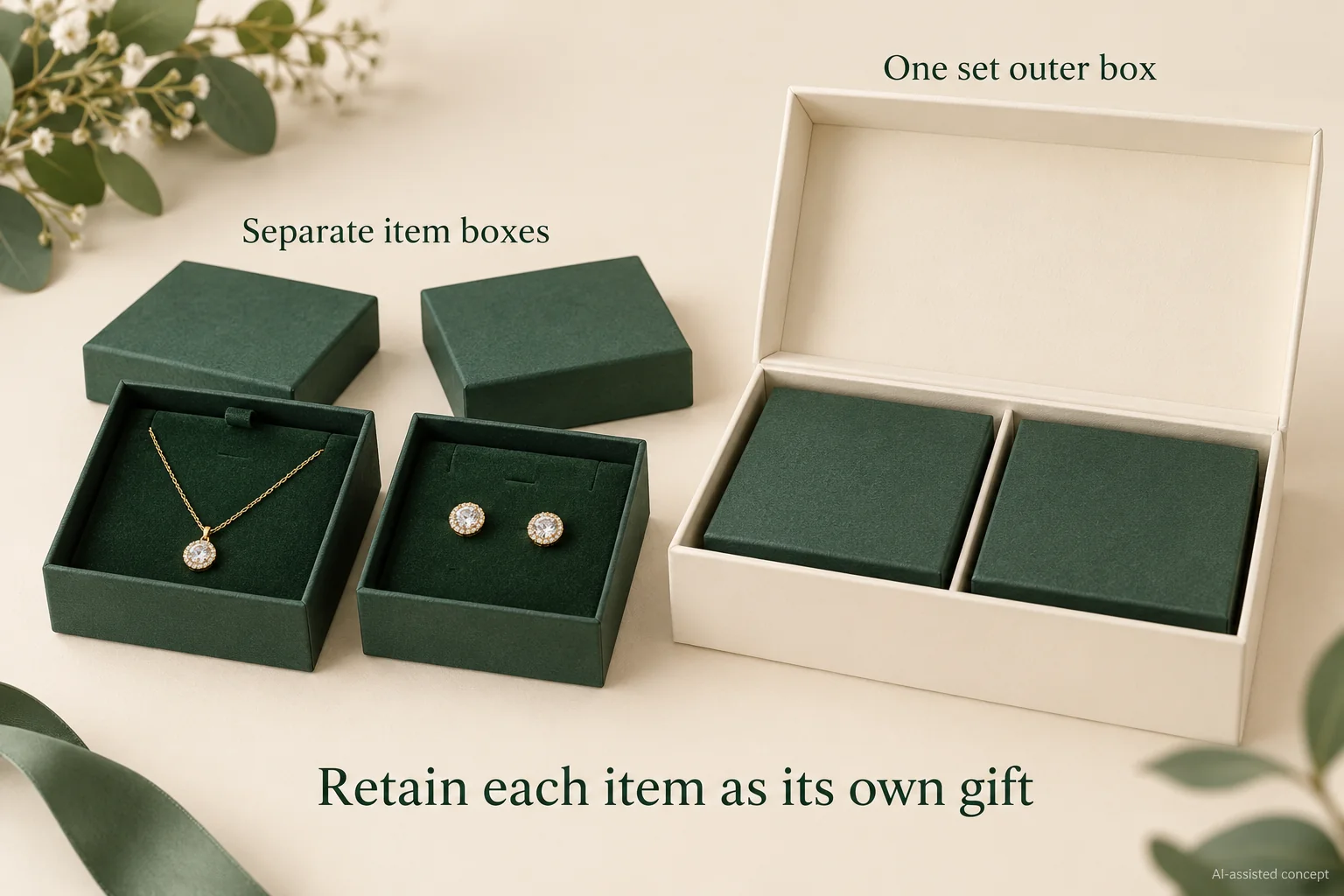
A hypothetical brand chooses two boxes inside one set box
Consider a fictional independent jewelry brand preparing a matching necklace and stud-earring gift set. Both items are also available individually. The brand already has distinct gift-ready boxes for each product, and its stated seasonal offer requires one visually coordinated present. It also wants the recipient to be able to pass either piece on as an independent gift. This is an invented planning brief, not a client case, customer survey, or sample result.
Option A delivers the strongest single-view reveal of both pieces, but it fails the brand’s requirement that each item remain in its own gift-ready box. Option B retains both approved item-box directions and supports separate giving, but it does not deliver the requested single outer gift presentation. The brand therefore selects Option C for a design and sourcing proposal: one necklace box and one earring box, grouped within one outer set box.
That selection is meaningful without being final production approval. The brand still needs to establish whether the existing two boxes can be presented together in a suitable outer box, whether their finished exteriors require changes, and how all three pieces are supplied and packed. If a proposed outer box compromises the desired presentation or purchase scope, the brand can reconsider B rather than forcing C into production.
The brand’s purchase statement is now specific: “One matching necklace and one pair of earrings are sold together. Retain two independently gift-ready item boxes and propose one coordinated outer set box. Show all three components in the purchase scope. Do not replace the individual boxes with a shared holder.” It is a clear decision for the next proposal, not evidence of feasibility.
Leave with a configuration decision and named open questions
Before requesting a proposal, record the intended option and the one requirement that made it preferable. “We want premium packaging” is not a decision. “We require two gift-ready item boxes inside one customer-facing set box” identifies an offer a supplier can discuss. The next record should name the jewelry contents, the packaging components per sold set, which existing box designs may be reused, and the open questions about supplier scope.
Use four output statuses: Shared Box Selected, Separate Boxes Selected, Separate Boxes With Outer Set Box Selected, and Hold. Select does not mean approved for manufacture. Hold is appropriate when the brand has not decided whether separate gifting or one combined reveal is essential, or when an indispensable component cannot yet be scoped.
Selection is not sample acceptance. Review the actual jewelry with the proposed presentation components, then assess any required shipping configuration separately. Attach observations to the specific component versions.
Packrivo helps small brands organize packaging briefs and coordinate sourcing questions with independent suppliers. Material, component availability, quantity terms, sample acceptance, and delivery commitments require project-specific confirmation. Bring one chosen configuration and the unresolved question that prevents a complete comparison.