
The moisture state of corrugated board can affect a carton's compression response even when its dimensions and imposed load arrangement stay the same. A compression result obtained under one identified condition shouldn't be treated as an unchanged capacity in every storage environment.
For a candle or gift brand comparing cartons, keep material state alongside construction and loading. A lower result doesn't automatically prove that the supplier reduced board weight; a different moisture history is another variable to investigate.
A matching board specification doesn't fix its moisture state
Corrugated board is paper based and can exchange moisture with its surroundings. Nominal board identity and current moisture state therefore describe different inputs. Matching material names don't establish matching conditions at the time of evaluation.
Gary Ashton Brown's 2019 Clemson University thesis abstract reports compression evaluation of industry-supplied corrugated boxes under multiple relative-humidity conditions. It identifies a moisture-content relationship within the tested range. That original research supports investigating the variable, not transferring its reduction factors to an untested carton.
Ambient relative humidity and moisture content are also different quantities. A room reading doesn't establish the water held by a particular box at that instant. Its earlier exposure and material response remain relevant.
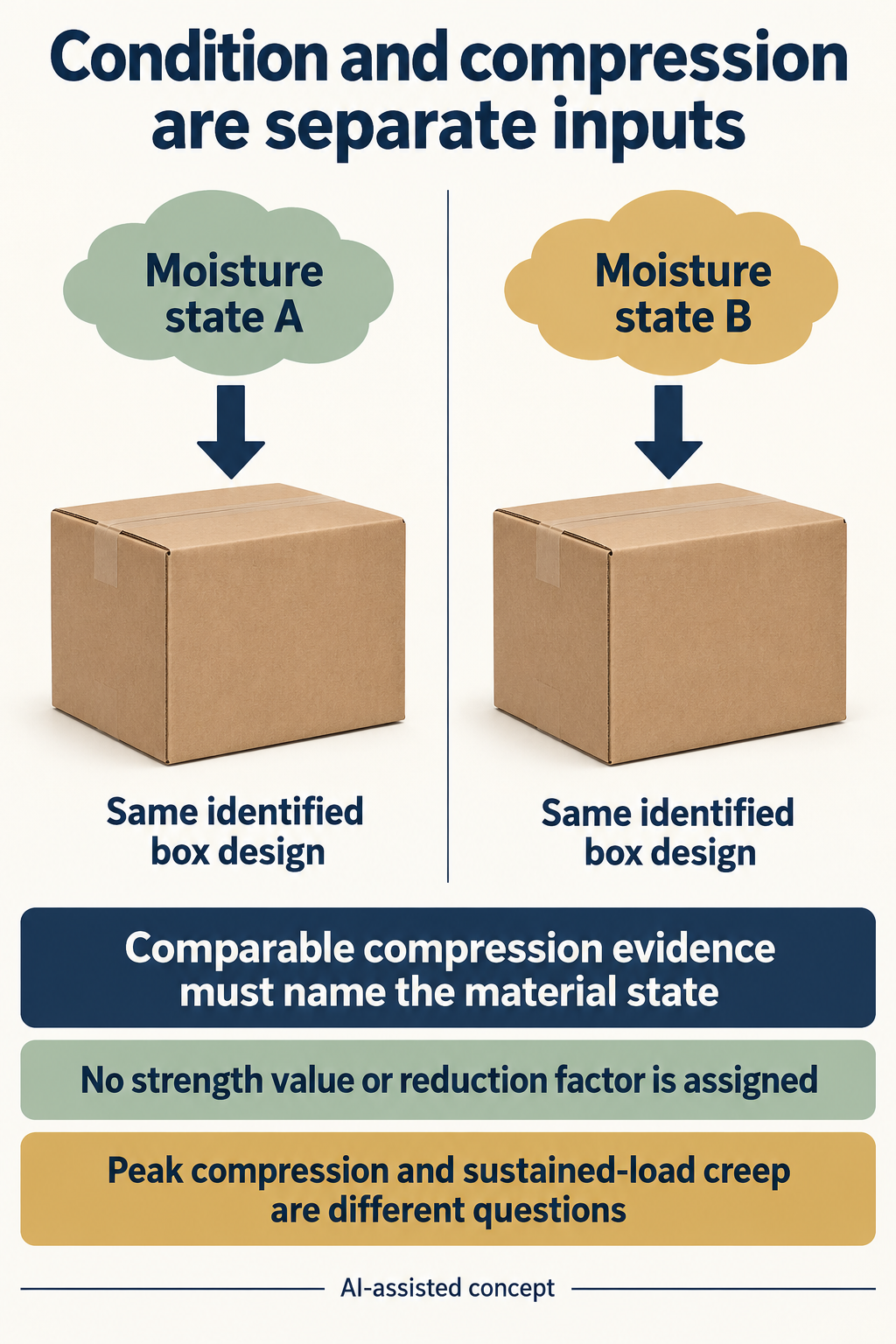
Peak compression and sustained loading are different observations
A compression evaluation describes a specified object and loading arrangement. ASTM D642's public scope concerns compressive resistance of shipping containers, components and unit loads. The complete paid method was not reviewed here.
The moisture state can be relevant to the response measured during that evaluation. A long-term stack adds a time-dependent question: how the system behaves under sustained loading and its actual environmental history.
Neither a peak result nor a moisture relationship alone gives a safe stack height. The load path, filled configuration, duration and relevant acceptance criteria still need an appropriate technical assessment.
Packrivo's edge crush and box compression guide explains the different test objects and quantities. This article adds the material-state question within a comparison, rather than converting board edge strength into container strength.
Follow a hypothetical same-design comparison
Suppose two cartons share one identified design and board construction. One has a documented conditioning history; the other has an unknown storage interval before testing. The comparison is hypothetical and includes no measured strength values.
If their results differ, the matching design doesn't eliminate the second carton's unknown condition as a possible contribution. Equally, that gap doesn't prove humidity caused the difference. Construction, damage and test setup may still require examination.
The buyer can first decide whether the comparison adequately controls the relevant material state. If not, the next evidence request should address the missing history and suitable preparation for the intended evaluation. It shouldn't begin with an assumed board downgrade or a guessed percentage loss.
If a report instead provides a result at an identified condition, preserve that scope. Moving a shipment into another environment creates a question about transferability, not permission to apply an arbitrary multiplier.
Conditioning records make the mechanical comparison interpretable
ASTM D4332's public description addresses conditioning containers, packages or components for testing. Its role is to define preparation within an applicable evaluation; it isn't a universal humidity setting for every gift warehouse.
The brand's comparison should retain the actual sample identity, preparation and test conditions. Keep an agreed target separate from a measured or documented condition. Missing history should remain marked unknown rather than replaced with a convenient room description.
The packaging conditioning guide helps organize those records. It doesn't determine a particular carton's compressive response or supply the full requirements of a formal method.
Choose the revision after identifying the variable
If applicable evidence points to inadequate response under the relevant material state, a carton revision may deserve evaluation. That could involve the board, construction or other aspects of the packed system. The evidence should identify which question the revision is intended to resolve.
If the only difference is an unexplained result from samples with unlike or unknown histories, first make the comparison interpretable. A stronger nominal board specification won't explain the missing condition, and it doesn't by itself establish the finished shipment's performance.
No humidity target, conditioning duration, strength-loss percentage or safe stack count follows from this article. The useful decision is whether the received compression evidence represents the carton state and loading question the buyer actually needs answered.
A changed loading arrangement prevents a humidity-only attribution
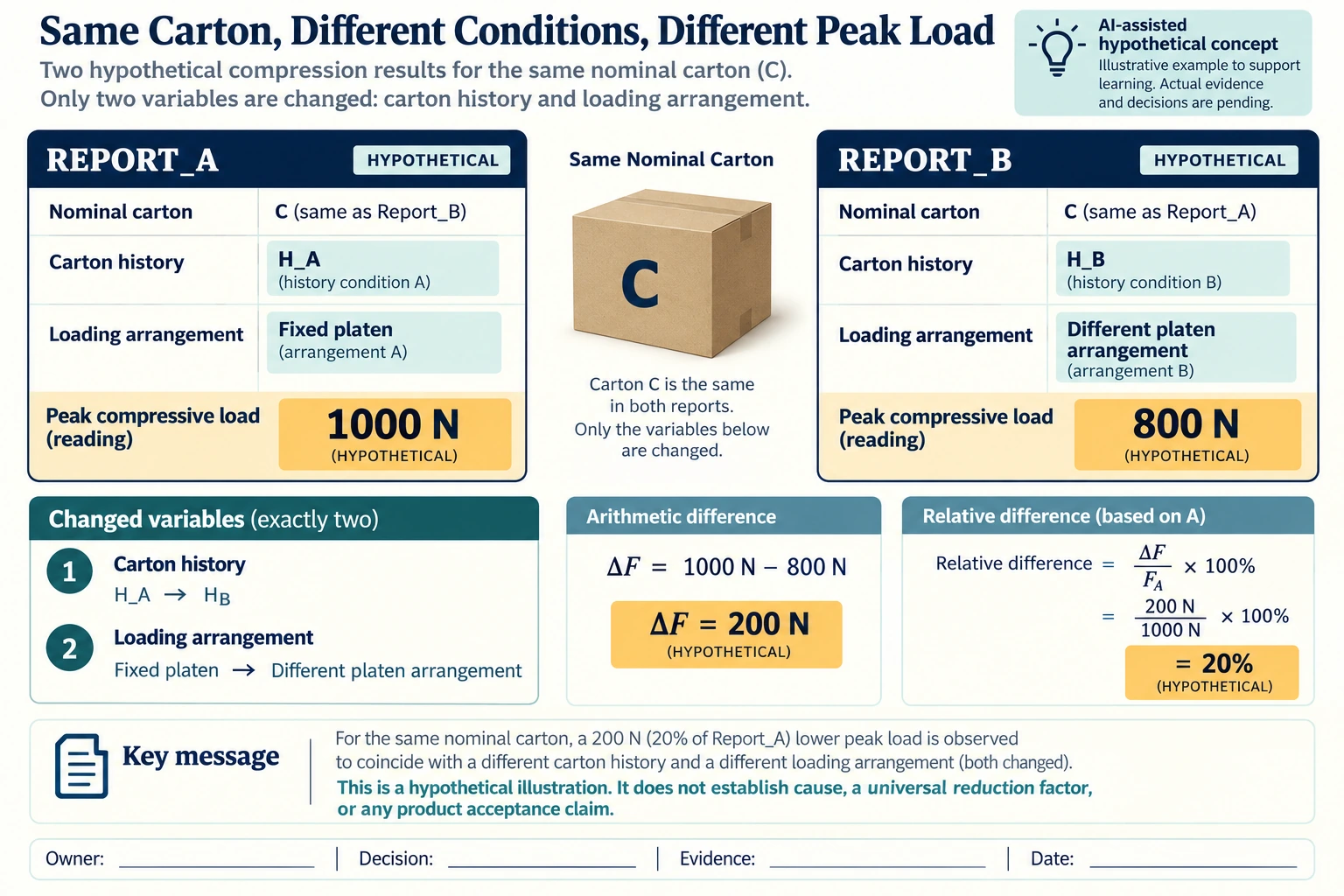
Use invented report summaries for the same nominal carton design. REPORT_A names history H_A, a fixed-platen arrangement and a 1000 N peak. REPORT_B names H_B, a different platen arrangement and an 800 N peak. The 200 N difference is 20% of A’s value, but both condition history and loading arrangement changed.
Scroll horizontally if columns extend beyond the view.
| Hypothetical configuration | Named object | Relationship | Input or next scope |
|---|---|---|---|
| REPORT_A | REPORT_A | names nominal carton | C |
| REPORT_A | REPORT_A | names history | H_A |
| REPORT_A | REPORT_A | names arrangement | FIXED_PLATEN |
| REPORT_B | REPORT_B | names nominal carton | C |
| REPORT_B | REPORT_B | names history | H_B |
| REPORT_B | REPORT_B | names arrangement | DIFFERENT_PLATEN |
| REPORT_COMPARISON | A_MINUS_B | calculated from | REPORT_A_PEAK-REPORT_B_PEAK; 200 N |
| REPORT_COMPARISON | DIFFERENCE_RELATIVE_TO_A | calculated from | PEAK_DIFF/REPORT_A_PEAK*100; 20 percent |
| REPORT_COMPARISON | HISTORY_AND_PLATEN | both changed | NO_HUMIDITY_ONLY_CAUSAL_ATTRIBUTION |
| REPORT_COMPARISON | INVENTED_PEAKS | not a | SAFE_STACK_OR_STANDARD_TEST |
The arithmetic does not identify humidity as the cause or establish a universal reduction factor. Nor do matching design names prove identical material state, damage or specimen preparation. Keep the two changed fields visible and ask the technical reviewer what comparison can address the intended material-state question.
D642-25 concerns compression, while D4332-22 concerns conditioning. Its public scope points to D685 for quantifying box compression at standard atmosphere; special laboratory conditioning does not necessarily reproduce field conditions. The correct preparation and actual loading arrangement must be established together, rather than substituting a condition log for a strength result.
The Clemson 2019 abstract supports investigating moisture as a variable, not transferring the study’s factors into these invented peaks. No test is prescribed or performed here. A revision to board or structure should follow relevant evidence for the complete intended system, not a 20% label applied to an unexplained two-variable comparison.
Download the carton compression conditioning platen comparison confound record (.csv). It includes the original table fields and scenarios alongside the added relationships. HYPOTHETICAL rows are editorial examples or required review scopes, not actual records. Actual quantity, configuration, component and file identities, materials, process, specification, copy, method, condition, observation, owner, decision, evidence and dates are blank. ACTUAL_BLANK is a separate empty starting row; enter permitted project evidence before using an actual record. A blank means unknown.
Use the Agree Conditioning Before Comparing Packaging Samples for its separate question. Use the Packaging Distribution Tests: Define the Packed System for its separate question.
Source scope checked 17 October 2026: The Clemson 2019 thesis abstract supports moisture as a variable within the study, not transfer of raw results or loss factors. ASTM D642-25 compression and D4332-22 conditioning public scopes differ; D4332 points to D685 for standard-atmosphere box-compression quantification. Paid methods, actual strengths and stack limits were not established. The added configurations and calculations are hypothetical, with actual evidence and decisions pending.
Discuss this packaging specification with Packrivo. We coordinate independent suppliers. MOQ: 500 pieces per product/design; illustrative quantities are not production offers. Confirm materials, samples, price and timing for your project.