

Peak-season packing plans should distinguish familiar operators from people still learning the actual sequence. Use stage-specific evidence and include supervision work. Adding temporary staff does not justify copying the experienced operator’s cycle time across the whole team.

Define what independent work means
Use the current box, insert, contents and instructions. The front-and-back mounting guide illustrates how important actions can remain hidden in a finished presentation photo.
Record whether a new operator can identify components, follow the sequence, recognise an exception and complete the required handoff without undocumented help. Training hours alone don’t establish those abilities.
Compare a mixed team under assumed timings
Suppose each of two operators has 240 productive minutes. The experienced operator’s hypothetical cycle is 90 seconds; a new operator’s planning scenario is 150 seconds. The example is not an observed learning curve.
Scroll horizontally if columns extend beyond the view.
| Operator scenario | Productive minutes | Assumed cycle | Complete gifts |
|---|---|---|---|
| Experienced, without supervision deduction | 240 | 90 seconds | 160 |
| New operator | 240 | 150 seconds | 96 |
| Experienced, after 30 minutes assisting | 210 | 90 seconds | 140 |
With the stated assistance deduction, combined output is 236 gifts, not 320. That assumes the new operator’s 240 minutes already covers the intended work without another duplicate training deduction.
If assistance also removes time from the new operator’s productive window, show that scenario separately. Keep both people’s raw observations rather than removing pauses from one time and retaining them in the other.
Keep task eligibility visible
A new operator may be ready for forming while personal-message matching still requires support. Assign only the tasks supported by the actual training and supervision arrangement.
Shared tools, device queues or a serial station can create another bottleneck. The staffing estimate does not replace a task-balance assessment or prove that people working together produce the sum of isolated trial rates.
OSHA’s warehousing guidance identifies repetitive work, awkward postures and related risks. A production target should not be treated as proof of safe pace or workstation suitability.
Plan from the stage actually reached
Use non-sensitive practice material and the intended instruction, then record what help is required. Update capacity assumptions when evidence changes. The output should state the available experienced time, supervised tasks and remaining uncertainty, so a busy-period promise doesn’t rely on unverified instant proficiency.
Sources and scope
Australian Government supports the stated general concepts within this scope: General inventory categories, reorder points and stocktake. Access checked 14 October 2026.
OSHA supports the stated general concepts within this scope: US warehousing ergonomic hazards. Access checked 14 October 2026.
The worked scenario is original editorial analysis with assumed inputs, not a supplier offer, customer record or measured Packrivo result. Commercial feasibility and physical suitability remain project-specific.
Place the coaching event inside both work windows
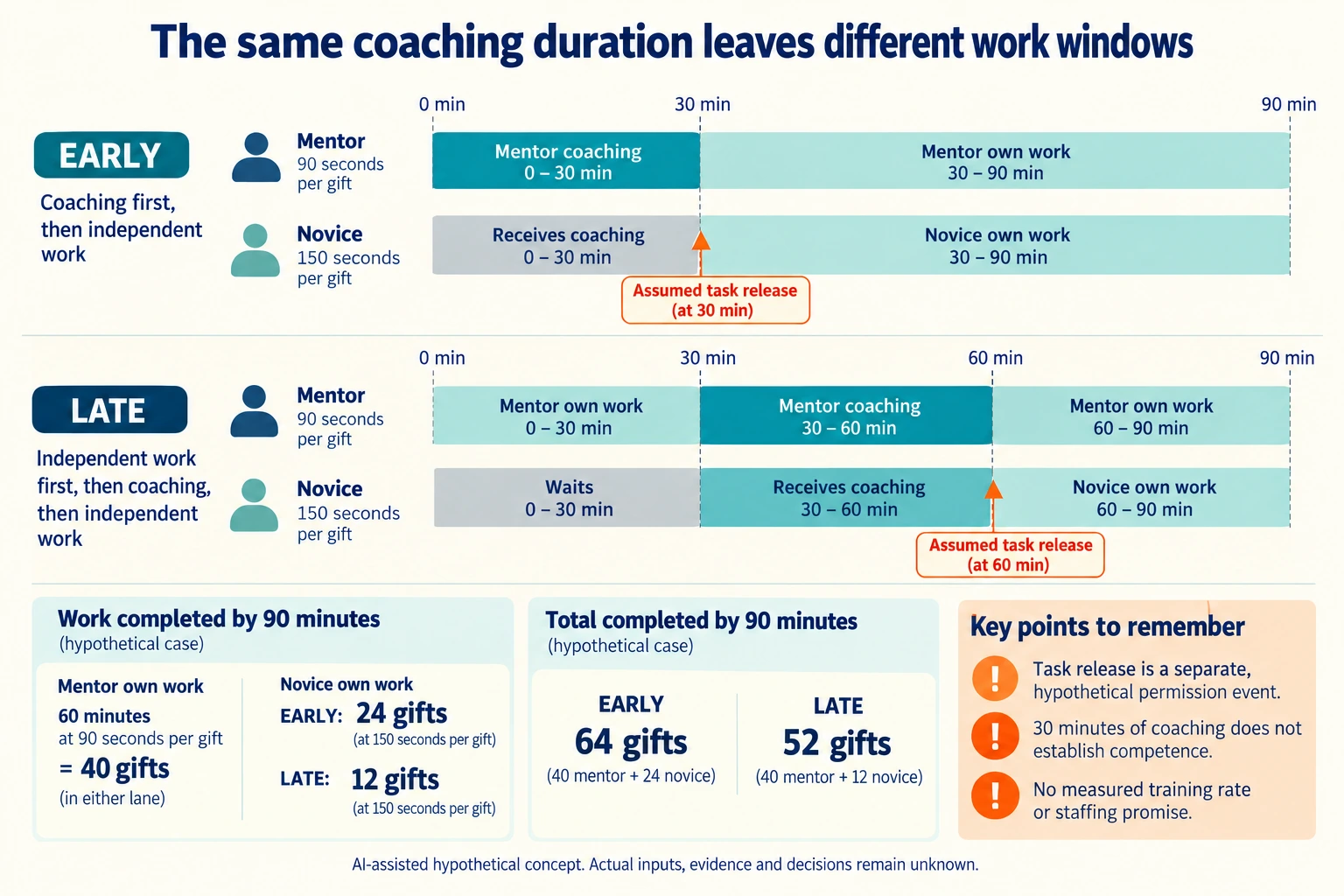
Use a new 90-minute window, distinct from the original two 240-minute allocations. Assume the mentor spends 30 minutes coaching and otherwise takes 90 seconds per gift. The novice takes 150 seconds per gift only after a separately assumed task-release event. Thirty minutes of coaching does not itself establish competence or permission.
Scroll horizontally if columns extend beyond the view.
| Hypothetical scenario | Item or operation | Planning relationship | Assumed input or calculation |
|---|---|---|---|
| EARLY33 | MENTOR_OWN_WORK_TIME | calculated from | WINDOW-COACHING; 60 minutes |
| EARLY33 | NOVICE_POST_RELEASE_TIME | calculated from | WINDOW-EARLY33_RELEASE; 60 minutes |
| EARLY33 | MENTOR_OUTPUT | calculated from | floor(EARLY33_MENTOR_TIME*60/MENTOR_CYCLE); 40 gifts |
| EARLY33 | NOVICE_OUTPUT | calculated from | floor(EARLY33_NOVICE_TIME*60/NOVICE_CYCLE); 24 gifts |
| EARLY33 | COMBINED_OUTPUT | calculated from | EARLY33_MENTOR+EARLY33_NOVICE; 64 gifts |
| LATE33 | MENTOR_OWN_WORK_TIME | calculated from | WINDOW-COACHING; 60 minutes |
| LATE33 | NOVICE_POST_RELEASE_TIME | calculated from | WINDOW-LATE33_RELEASE; 30 minutes |
| LATE33 | MENTOR_OUTPUT | calculated from | floor(LATE33_MENTOR_TIME*60/MENTOR_CYCLE); 40 gifts |
| LATE33 | NOVICE_OUTPUT | calculated from | floor(LATE33_NOVICE_TIME*60/NOVICE_CYCLE); 12 gifts |
| LATE33 | COMBINED_OUTPUT | calculated from | LATE33_MENTOR+LATE33_NOVICE; 52 gifts |
In EARLY, coaching occupies minutes 0–30 and the assumed release occurs at minute 30. The mentor then has 60 production minutes, giving 40 gifts; the novice also has 60 minutes, giving 24. In LATE, the mentor works for 0–30, coaches for 30–60 and works again for 60–90. The novice waits before coaching and is released at minute 60, leaving 30 production minutes and 12 gifts. Combined output is 64 versus 52 under these assumptions.
Both routes contain the same coaching duration and 60 mentor production minutes. Their novice windows differ. Keep the waiting, coaching and permission events visible rather than subtracting training twice or inferring a learning curve. Actual task eligibility, working method, interruptions and acceptable output remain unknown; neither plan is a staffing promise.
Download the packing mentor coaching timing task release window record (.csv). It includes the original table fields and scenarios alongside the added relationships. HYPOTHETICAL rows are editorial examples or required review scopes, not actual records. Actual quantity, configuration, component and file identities, materials, process, specification, copy, method, condition, observation, owner, decision, evidence and dates are blank. ACTUAL_BLANK is a separate empty starting row; enter permitted project evidence before using an actual record. A blank means unknown.
Use the Record a Packing Trial Without Promising a Universal Speed for its separate question. Use the Adding Packing Operators Requires a Task Balance Across Stations for its separate question.
Source scope checked 17 October 2026: Workplace guidance is not a training qualification or production-rate formula. Task release is a separate hypothetical event; actual competence and permitted work remain unresolved. The added configurations and calculations are hypothetical, with actual evidence and decisions pending.
What this changes in a packaging enquiry
If training time affects the choice between packaging proposals, compare the actual forming and loading instructions provided with each. Ask for the delivered component state and a sample configuration to trial. A familiar operator's timing cannot establish the capacity of new staff or the training support a supplier provides.
Discuss this packaging specification with Packrivo. We coordinate independent suppliers. MOQ: 500 pieces per product/design; illustrative quantities are not production offers. Confirm materials, samples, price and timing for your project.