
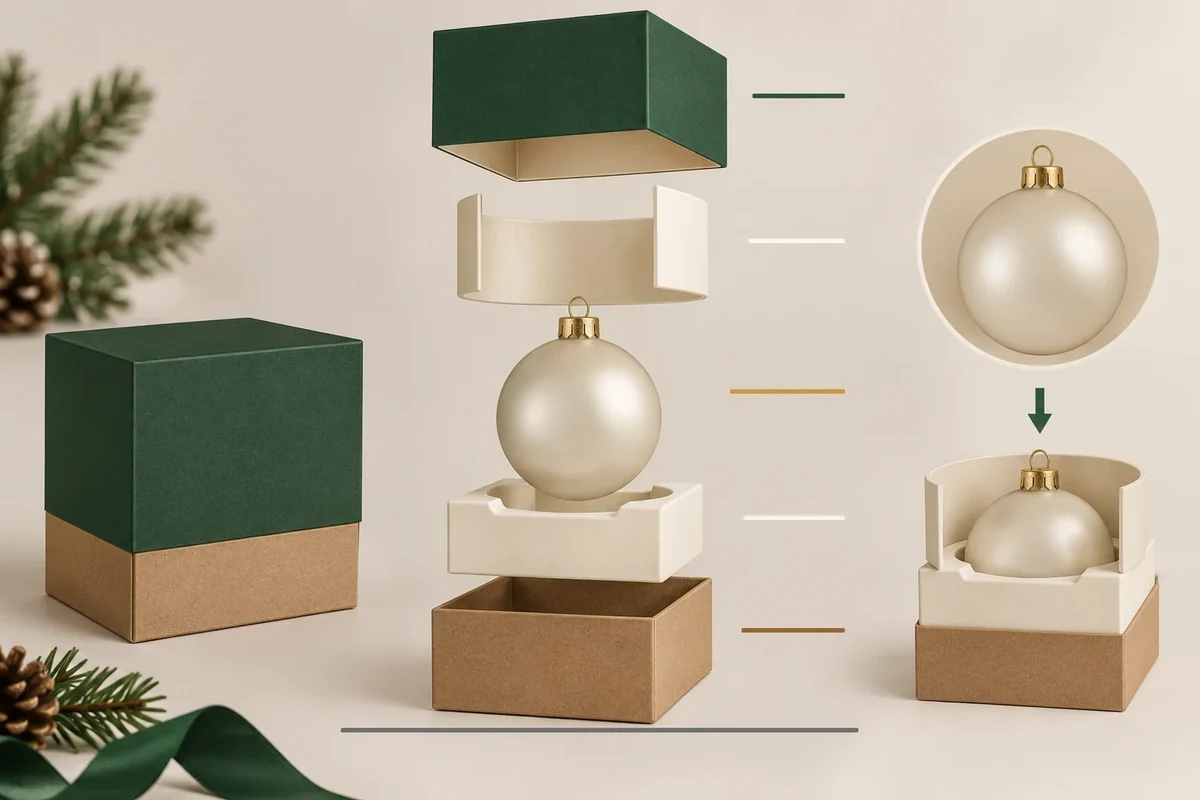
Set the product’s displayed position before confirming the neck in a rigid box. Record the base, holder, product and neck as a height stack, then review the lid in the closed state. A taller visible neck doesn’t by itself define where the product sits or how much of it the customer sees.
The opening view is the useful starting point. Choose what should be visible when the lid comes off, then ask for a construction that places the complete product and holder accordingly.
Separate neck height from product display height
PakFactory’s shoulder-neck structure explanation describes an added neck portion and its relationship to the closed box. Use that component distinction without adopting its protection claims or assuming a specific overlap.
Ask the supplier to identify the base, neck, lid and holder in a side section. Establish a common datum, such as the finished inside base surface. Each height should be labelled against that datum rather than against a different outside edge.
Record which part of the product should appear above the holder or neck. A decorative face, clasp or top cap may be the view that matters. The maximum product height still belongs in the closed-lid review even if it is not the display focus.
The dimension acceptance guide helps define measurement state. This height stack narrows that agreement to one layered opening and closure relationship.
Build the stack from the actual contents
Start with the complete sale-ready product, including attached cards or ties. Show its position in the proposed holder. Record the holder’s installed height, not only its loose-part thickness.
Add the proposed neck position and the lid’s inside envelope to the section. Ask whether dimensions describe finished wrapped parts. A bare structural model and a wrapped assembly should have different sample-state notes.
Keep the open display goal separate from the closed fit goal. A product can look well placed when open while still leaving a lid contact question. Conversely, a closed pack can fit while the product sits lower than the intended opening view.
Use a height-stack record
Give the section a fixed orientation and datum. Fill measured or proposed values with their source; the table provides fields rather than invented dimensions.
| Layer or state | Record | Evidence |
|---|---|---|
| Datum | Finished inside base reference | Marked side section |
| Holder | Installed support and visible opening | Loaded sample before lid placement |
| Product | Display feature and highest packed point | Same oriented product in holder |
| Neck | Proposed upper edge relative to datum | Supplier drawing and formed view |
| Open state | Desired visible product area | Customer-view photograph |
| Closed state | Lid inside envelope and contact questions | Loaded closure review |
Keep the source beside each value. If a datum or holder changes, identify every dependent height that needs another review.
Follow a hypothetical ornament presentation
Suppose a brand wants the face of a round ornament visible when the lid is removed. The holder initially places it below the neck’s top edge. The buyer records the display feature and the proposed layer heights in a section.
The team can discuss raising the holder, revising the neck or changing the desired view. Those options should be compared with the complete product height and lid proposal. Raising the product may reopen the closed-lid question.
After a supplier proposes a revision, review the loaded opening view and then the closed state on the same sample. Do not use a photo with one holder for display and a different holder for closure while calling them one approved set.
The height stack is a buyer communication tool. It doesn’t prescribe universal clearances or establish that a neck protects the product. Any support or handling requirement needs separate evidence.
Record changes against the common datum
For the hypothetical ornament stack, call the inside-base datum D0, the installed holder H1 and the product’s desired visible face PV1. Keep the proposed neck edge and highest packed product point referenced to D0. This prevents values copied from different views being mistaken for directly comparable heights.
Ask the supplier: ‘Please show PV1 in the proposed open state and the highest packed point inside the matching closed lid.’ It requests two views of one linked configuration. A raised display rendering with no lid section leaves the closure relationship open.
If the holder is raised, record its revision and review every height that depends on it. The neck can stay unchanged while the closed lid question changes. If the neck is revised instead, keep the holder identity fixed so the next comparison remains understandable.
Use proposed and observed fields separately. A dimension on a drawing is a proposal until its agreed sample and measurement evidence are linked. The height stack can carry both without turning a concept illustration into a measured result. Close the open view and closed fit under their own scopes, then preserve that paired revision for reorder discussion.
Send one linked open-and-closed brief
Submit the datum section, holder and product details, desired display feature and lid questions through the packaging enquiry. Ask the supplier to confirm the linked geometry. Keep the accepted stack with its sample and drawing revision so a later holder change doesn’t bypass the lid review.
Compare a raised holder with a lower neck under one stated model
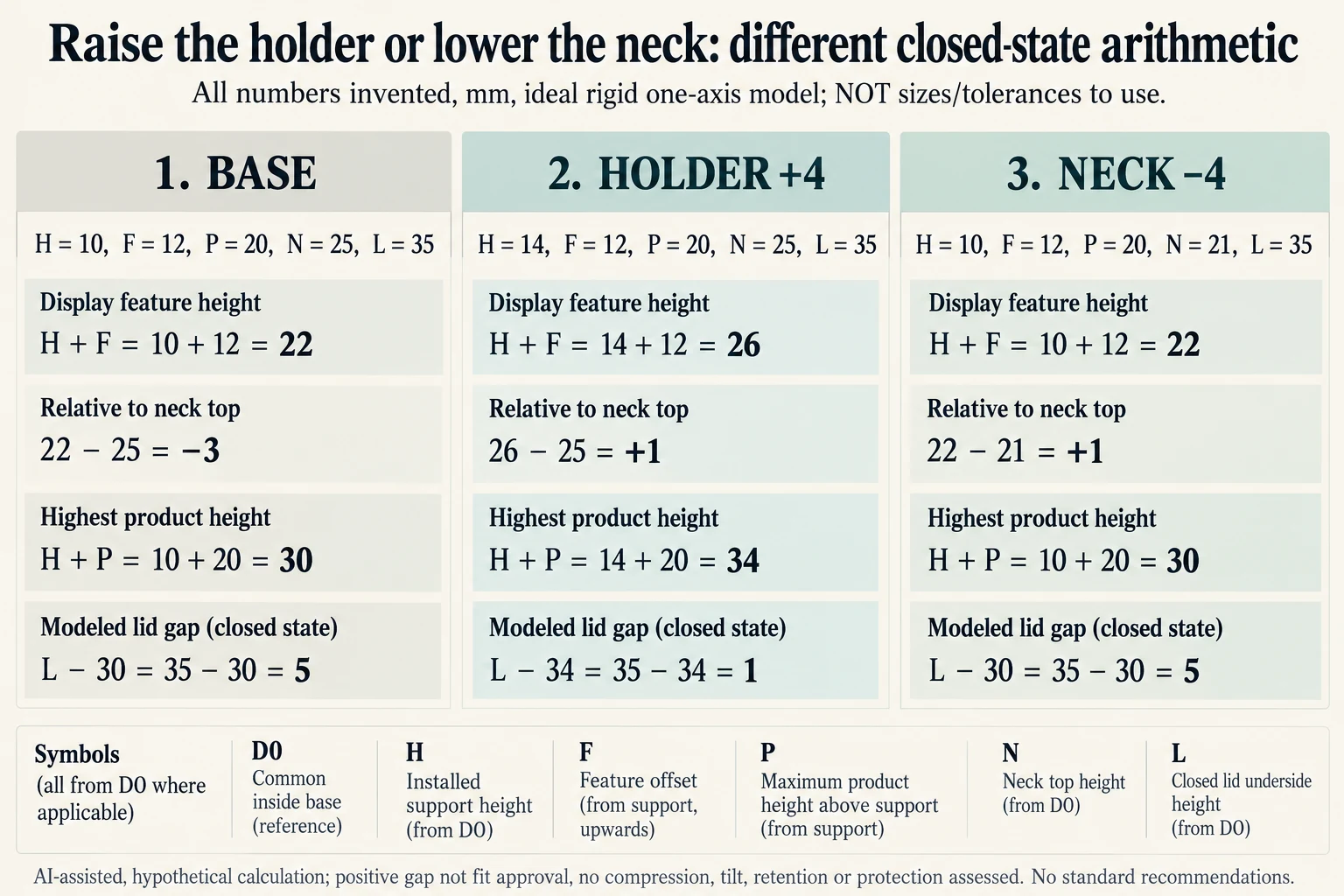
Use an idealized rigid, vertical one-axis example to see why two display changes can reopen different closed-state questions. All numbers below are invented millimetres, not recommended sizes, tolerances or supplier measurements. D0 is the finished inside-base datum. H is installed support height; F is the visible-feature offset above that support; P is the product's maximum height above it. N is neck-top height and L the closed lid-underside height from D0. For this model P includes the complete packed height, including any attached card or tie in the vertical path; changing that envelope creates another input.
Scroll horizontally if columns extend beyond the view.
| Hypothetical configuration | Named object | Relationship | Input or next scope |
|---|---|---|---|
| BASE22 | FEATURE | calculated from | H+F; 22 mm |
| BASE22 | RELATIVE_NECK | calculated from | H+F-N; -3 mm |
| BASE22 | HIGHEST | calculated from | H+P; 30 mm |
| BASE22 | LID_GAP | calculated from | L-H-P; 5 mm |
| HOLDER_RAISE22 | FEATURE | calculated from | H+F; 26 mm |
| HOLDER_RAISE22 | RELATIVE_NECK | calculated from | H+F-N; 1 mm |
| HOLDER_RAISE22 | HIGHEST | calculated from | H+P; 34 mm |
| HOLDER_RAISE22 | LID_GAP | calculated from | L-H-P; 1 mm |
| NECK_LOWER22 | FEATURE | calculated from | H+F; 22 mm |
| NECK_LOWER22 | RELATIVE_NECK | calculated from | H+F-N; 1 mm |
| NECK_LOWER22 | HIGHEST | calculated from | H+P; 30 mm |
| NECK_LOWER22 | LID_GAP | calculated from | L-H-P; 5 mm |
Assume H=10, F=12, P=20, N=25 and L=35. The feature height is H+F=22, or 3 below the neck. The highest product point is H+P=30, leaving modeled space L-H-P=5 beneath the assumed closed lid. Raising the holder by 4 makes H=14: the feature reaches 26, or 1 above the unchanged neck, while the highest point reaches 34 and the modeled space becomes 1. Lowering only the neck by 4 instead gives N=21: the feature remains22, now1above the neck; the highest point remains30 and modeled lid space stays5.
These are alternative model configurations, not two consecutive changes or evidence that a whole decorative face is visible. They hold the product orientation, feature offsets and closed-lid reference fixed. The model excludes compression, tilt, local contacts and construction changes. If changing the neck changes the lid's seated position, L must be replaced and the comparison recalculated; the old result cannot silently carry over.
The CSV stores each assumed input and calculated output numerically with millimetres, formula and exact input-scope references. Positive modeled space does not establish a suitable functional gap, side fit, closing action, product support or transport protection. The buyer still needs the same actual sample configuration reviewed open and closed, with its own display and fit decisions. Changing the desired visible feature is a third original option and should update the feature definition rather than reuse F unnoticed.
Download the rigid box neck product display height record (.csv). It includes the original table fields and scenarios alongside the added relationships. HYPOTHETICAL rows are editorial examples or required review scopes, not actual records. Actual quantity, configuration, component and file identities, materials, process, specification, copy, method, condition, observation, owner, decision, evidence and dates are blank. ACTUAL_BLANK is a separate empty starting row; enter permitted project evidence before using an actual record. A blank means unknown.
Use the Agree Packaging Dimensions and Acceptance Methods for its separate question. Use the Nominal Lid Clearance Can Disappear Across Component Dimension Ranges for its separate question. Use the Include Turned Paper Edges in Lid-Fit Reviews for its separate question.
References apply to the materials, processes or guidance named in each source. Worked configurations and dimensions are teaching examples, not tested specifications or production limits. Use the project’s material specification, drawing and formed sample for approval.
Discuss this packaging specification with Packrivo. We coordinate independent suppliers. MOQ: 500 pieces per product/design; illustrative quantities are not production offers. Confirm materials, samples, price and timing for your project.