
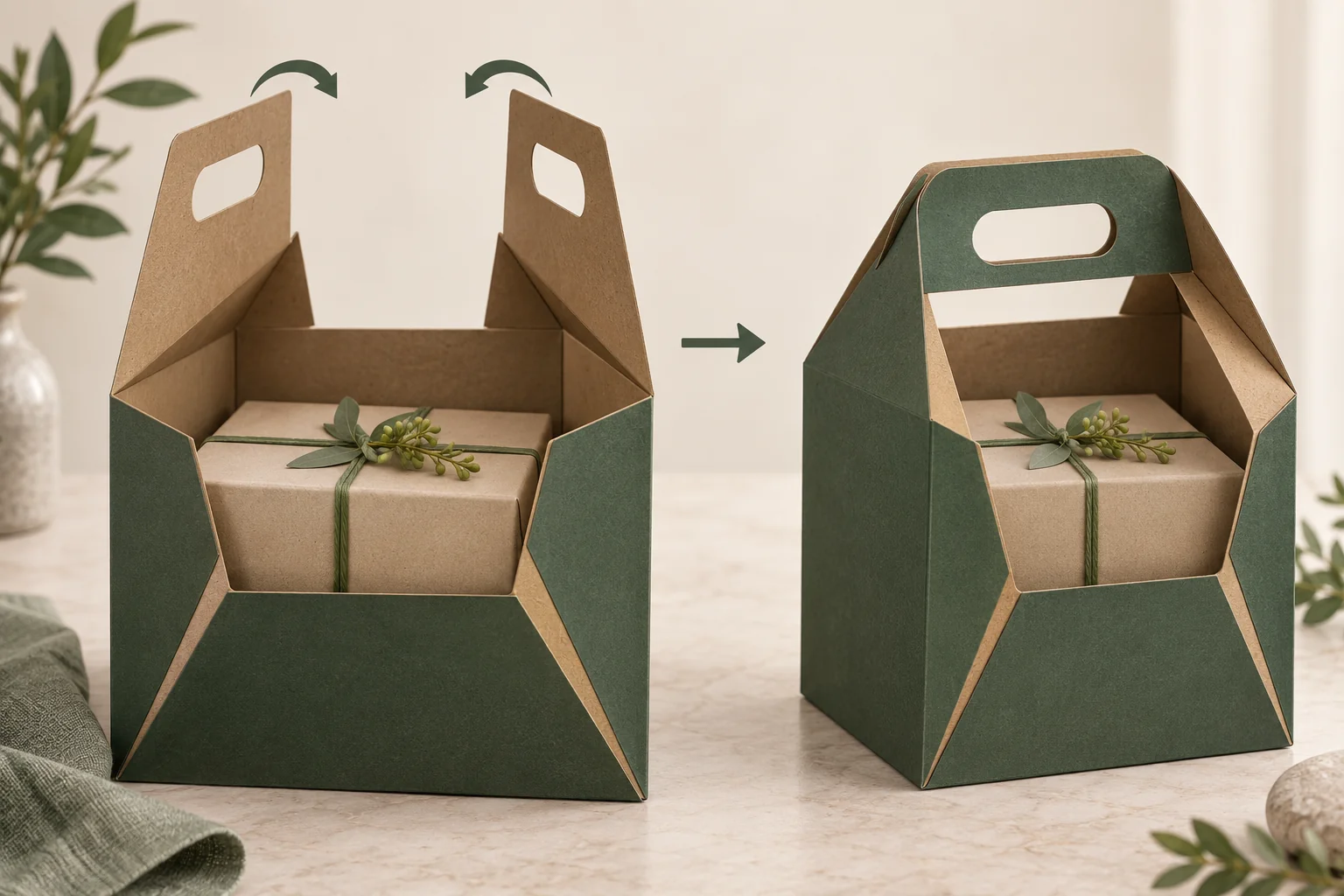
The illustration is a concept reference; the offered handle and base construction must be confirmed on the project drawing.
Mark the panels that become the handle
The cube carrier reference identifies a carton carrier with a handle. Request the flat blank and formed view so you can locate the panels that create the grip. Mark each fold, aperture and overlapping panel on the drawing. Handle visibility in a photograph is only a starting point for that identification.
Check where the hand enters the grip and where the free panel edges sit when paired. Describe the intended carrying use and provide the complete packed mass as an input. The converter can then propose the panel and board construction; a concept picture does not establish an allowable carrying load.
Treat the loading opening as a separate envelope. A gift box may fit inside the formed carrier yet need rotation to pass the handle panels. Include corners, ribbon bows and cards that project beyond the box. State whether staff load before or after closing the handle overlap.
Connect handle setup with the base sequence
Write the sequence as actual actions on the offered blank: form the base, place the boxed gift, arrange any tissue, close the required panels and form the handle. If the offered structure needs a different order, retain that instruction with its drawing revision. Review the intermediate state where the product enters, not only the finished carrier.
Compare a gable-top handle box when its roof-shaped head and handle folds may suit the gift. Compare the existing gift bag and tissue set when attached bag handles and a separate mouth are more suitable. Keep the same boxed gift in both comparisons so the structural actions remain visible.
Use an integral-handle loading record
This hypothetical candle-gift example records questions without assigning a carrying rating.
| Interface | Example input | Sample decision |
|---|---|---|
| Handle H1/H2 | Paired carton panels and aperture on blank | Check overlap and grip access |
| Loading opening | Finished candle gift box including tied ribbon | Review insertion before handle closure |
| Formed base | Named base folds and delivered preparation | Check the intended setup order |
| Tissue position | Tissue ends remain below handle movement | Observe catching or obstruction |
| Carry and set-down | Complete gift mass and intended use | Agree the required handling review |
Return the assembly evidence with the proposal
Ask the converter for a labeled handle/base drawing and the supplied state. The packing owner should return an empty setup view, a loading view and a completed grip view. A buyer can then decide whether the carrier’s opening route suits the boxed gift or whether a bag or gable structure needs another sample.
The folding gift-box specification guide helps retain dimensions and delivery state while comparing the forms.
Send the integral-handle panel map, boxed-gift envelope, complete packed mass and loading-order question through Get a Quote. MOQ is 500 pieces per design. The project’s board, handle details, sample scope and commercial terms are confirmed against these inputs.