Key takeawaysA divided jewelry bag may share space above its inner seam.Two inner bags can be closed separately, including inside an outer bag.A bag’s outside width does not establish its usable pocket width.A comparable jewelry-bag quote states the bag count, dimensions and closures.Plan your packagingPackrivo helps clarify your brief.Discuss your briefPublication dates unavailable.
What does a divided jewelry bag actually separate?
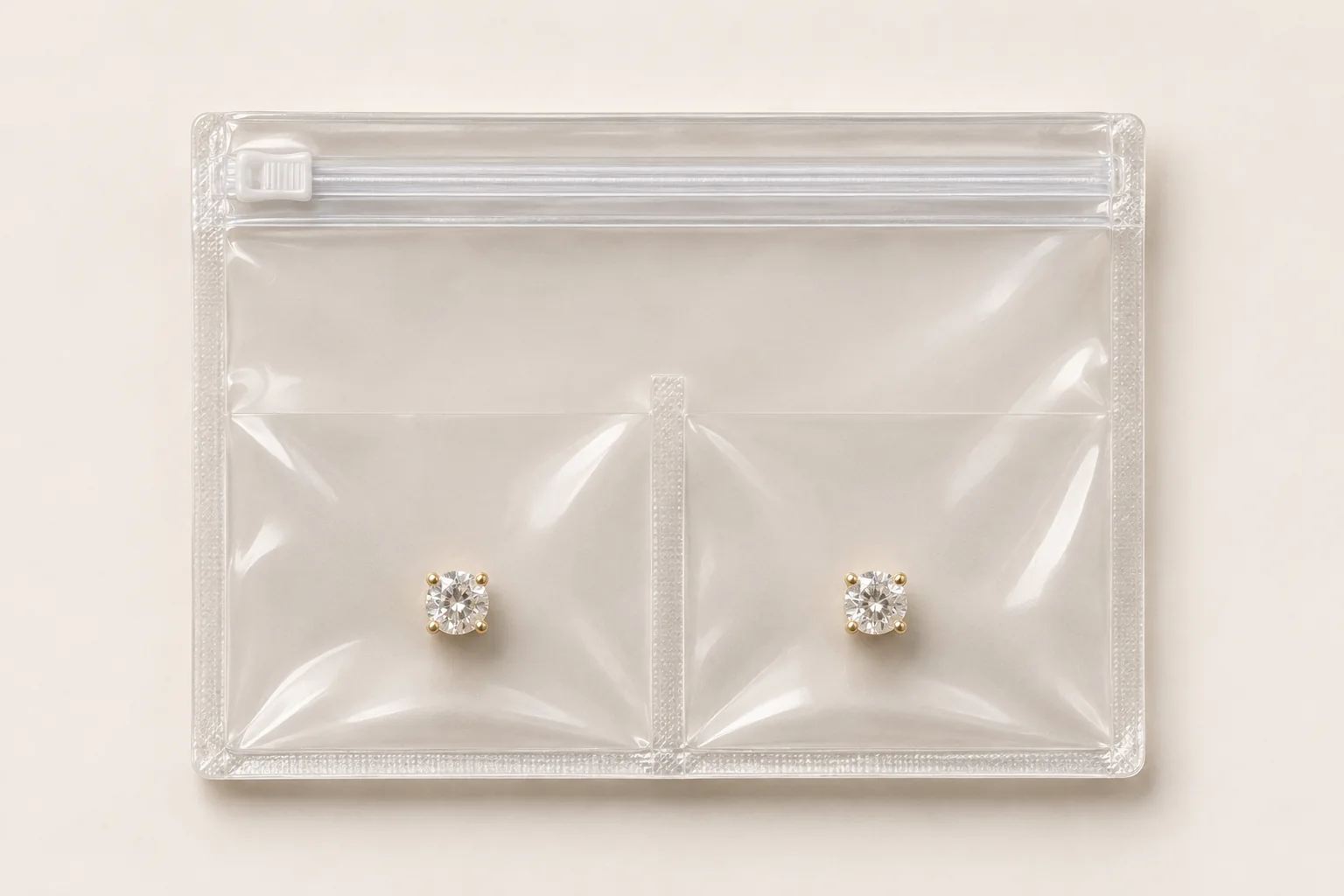
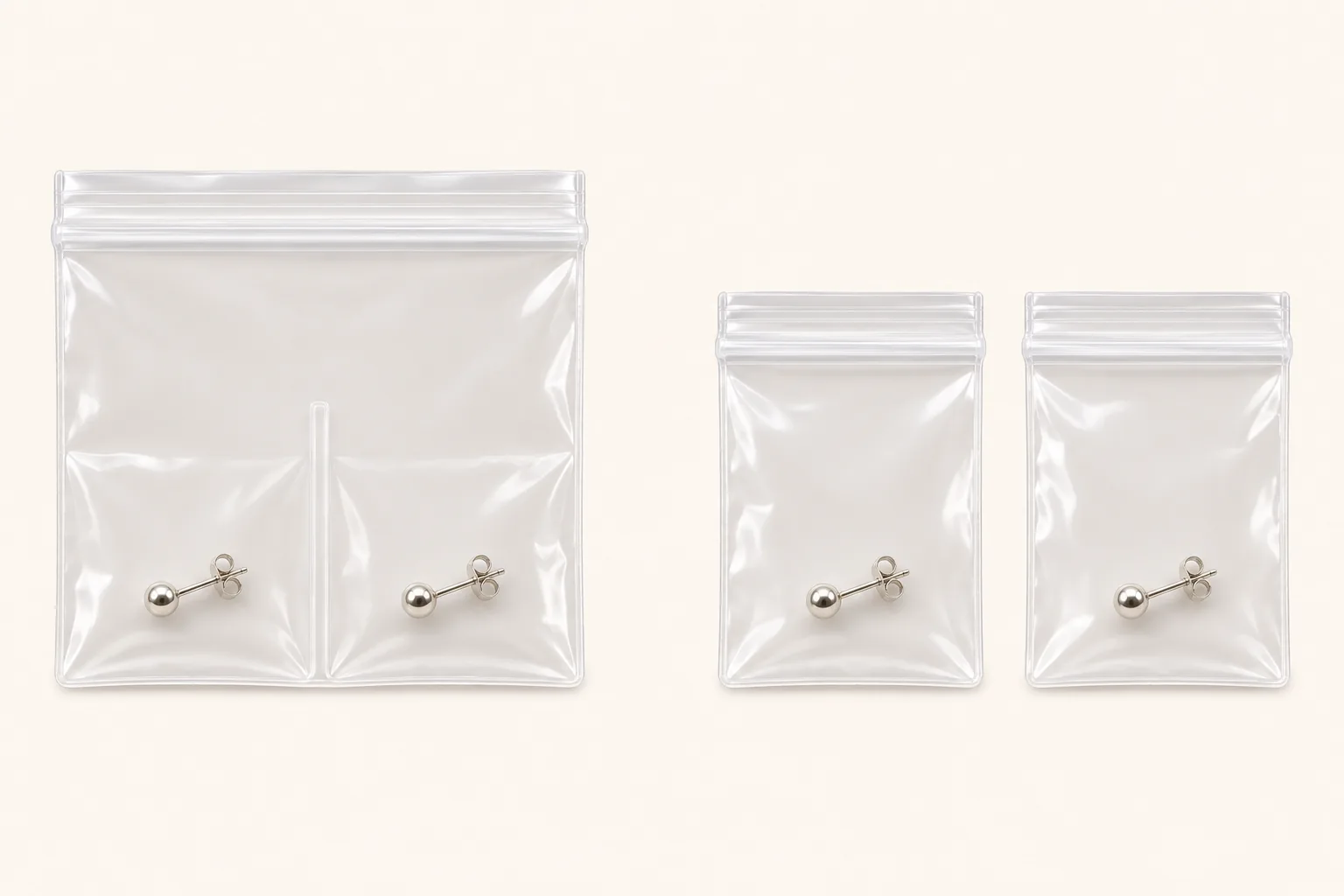
A divided jewelry bag separates the areas on either side of its internal seam, but the extent of that separation depends on where the seam begins and ends, so a shared space above the seam can remain even when the bag is described as having two compartments.
One named example makes the distinction visible in the specification: Interplas CZO20404 is described as a 4-by-4-inch bag with a 3-inch vertical middle seal that starts 1 inch below the zip top. Those numbers describe that supplier’s named product, not a universal design or a Packrivo specification.
Imagine laying one stud earring in each lower section. The seam separates their lower positions, but the area above the seam remains common to both sides. If a small loose backing reaches that area, the drawing alone does not establish where it will end up. The packing team needs to observe the actual loaded arrangement rather than infer a complete barrier from the phrase “two compartments.”
For a pendant and chain, think about which component is intended for each side and whether a length of chain passes through the common upper area. That route may be intentional. It is different from an instruction that each component must remain inside its own closed inner bag. The pendant chain routing guide covers the separate question of positioning a chain on a support.
When do two closed inner bags change the purchase?
Two individually closed inner bags change the purchase when the packing instruction requires each earring, or a specified jewelry component, to have its own closed bag, because a divided pocket with one shared outer zip does not create two independently closed bags.
In that arrangement, each item goes into its own inner bag and those bags can then be put into an outer bag or another agreed presentation. The extra outer bag keeps the pair together as one package; it does not turn the two inner bags into separate customer orders. Write the required result in the specification: “one left and one right earring, each in a closed inner bag, both contained in one outer bag.”
HSN’s vendor packaging manual, pages numbered 83–84, gives a divided-bag option and a bag-in-bag option for certain jewelry categories. That is one retailer’s documented packing route, not a rule for all brands, a claim about Packrivo stock, or proof that either route has passed a particular transit test.
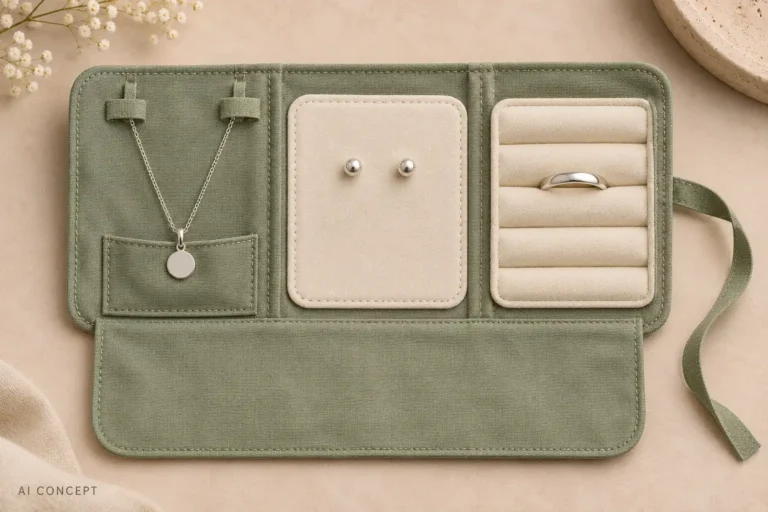
If your presentation also includes a textile jewelry pouch, identify it as a separate outer component in the brief; its fit around the inner bags remains to be checked.
The two approaches also create different packing tasks. A divided bag has one shared zip to open and close; the nested route requires the stated inner closures and the outer containment step. Whether one saves time depends on the actual bag, jewelry and operator. A complete comparison should retain both the packing sequence and the customer’s unpacking sequence.
| Decision point | One divided bag | Two closed inner bags plus outer bag |
|---|---|---|
| Separation | Depends on the seam’s path; a common upper area may remain. | Each item has its own inner bag when both inner closures are closed. |
| Closure to specify | Shared bag closure and position of the internal seam. | Two inner closures and the outer bag’s closure, if required. |
| Quote unit | One divided bag per pair, if that is the proposed scope. | Two inner bags plus one outer bag per pair, if that is the proposed scope. |
| Unresolved question | Can the intended pieces be loaded and removed through the shared area? | Do both closed inner bags fit inside the selected outer presentation? |
How should a brand size a compartment for actual jewelry?
Size each compartment around the intended jewelry and its loading path, not simply half the stated outside bag width, because side seals, the divider, opening geometry and the item’s projecting back or clasp can all affect what the supplier must demonstrate for the selected bag.
Start with the dimensions of the actual item, including the earring post and backing if those are packed together. Record the largest dimension across the display face and the projection behind it. For a chain and pendant, record the pendant’s envelope and how the chain will be arranged; the chain’s length does not by itself describe the space its folded route occupies.
Next, ask for the named bag’s outside dimensions, the usable width of each compartment and a front view showing the ends of the divider. Do not subtract a guessed seam allowance or treat the arithmetic half-width as an approved fit. RoyalBag’s RB0202.2SC description, for example, gives approximate compartment dimensions; the word “approximately” matters when a piece is close to the stated width.
Use a loaded sample to observe where the item enters, where it rests and how the backing is accessed on removal. If the intended stud cannot enter the pocket without forcing the post against a seal, the practical decision is to change the bag or the intended packing arrangement. The diagram is a planning illustration; it cannot prove fit or material compatibility.
For the next layer of the complete gift, the jewelry pouch and box handoff guide compares the presentation choices around the inner pack.
How can buyers compare non-equivalent jewelry bag quotations?
Compare quotations by the complete set required for one jewelry pair, including every inner bag, outer bag and closure, then keep the divided-bag seam and each compartment’s usable dimensions as separate fields so a lower line price is not mistaken for the same supply scope.
The table below shows a hypothetical comparison. The numbers describe pack counts only, not pricing, delivery times or a Packrivo offer. Both proposals hold one pair as a sales unit, but only the second has separately closed inner bags.
| Field for one pair | Proposal A: divided | Proposal B: nested |
|---|---|---|
| Included bags | One divided bag | Two inner bags and one outer bag |
| Inner containment | Two lower pockets; shared opening area as specified | Each earring in its own closed inner bag |
| Identify before choice | Seam position and usable pocket widths | Inner bag size and whether both fit the outer bag |
| Meaning of a quoted unit | One divided bag | Either a complete three-bag set or separately priced components; state which |
If your requirement is only that the pair be positioned in two pockets, proposal A can be considered for the actual jewelry. If your requirement is a separately closed bag for each member, proposal A’s shared opening does not meet that stated requirement merely because the supplier calls it divided. If proposal B leaves the outer bag unpriced, its total is not yet comparable to a complete set quotation.
A jewelry set may also need a decision about whether several pieces share a presentation box. That is a different level from choosing how the parts are bagged: see one shared jewelry set box or separate boxes.
What should a packing instruction show for a pair of earrings?
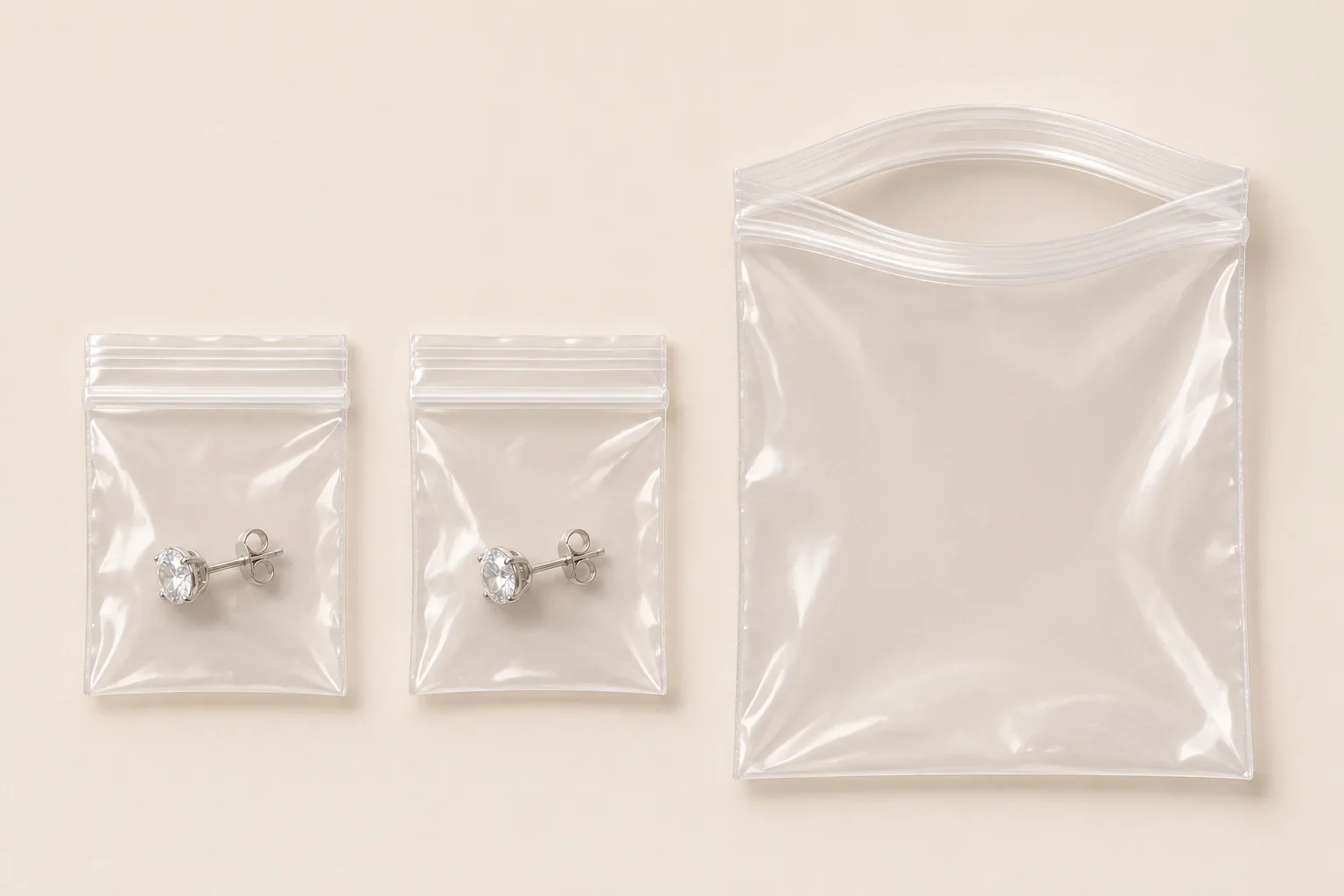
A useful instruction should show which earring and backing enter each pocket, whether the zip is shared or each inner bag closes separately, and how the recipient removes the pair, so the intended packaging purchase can be checked against the actual packing action.
For a divided bag, show the front of the bag, the divider’s end, and the intended side for each piece. If backs are detached, name where each one goes. If backs remain on posts, show the loaded projection and keep that version of the instruction with the sample being evaluated.
For nested bags, name which inner bag contains each piece and where the inner closures sit before the pair enters the outer bag. Show the order in which a customer opens the outer bag and retrieves each component. A front image of a finished outer pouch cannot show whether the two inner bags are independently closed.
Describe an observed problem by location. “The backing catches at the opening during removal” gives a more useful correction point than “bag does not work.” Retain the actual product and sample revision with that observation. Do not treat this handling check as a measured scratch-resistance or shipping test.
Frequently asked questions about jewelry bags
For jewelry bags, whether multiple pieces can share a pack, whether a stated size describes usable space, whether an earring card will fit, and whether a film suits gemstones all depend on the exact bag and jewelry, so compare the specified construction and materials instead of assuming every bag behaves alike.
Can multiple jewelry pieces go in one bag?
A bag may contain multiple pieces if its construction and your packing requirement permit it. If each piece needs its own closed inner bag, use separate closed bags; two compartments under a shared opening do not establish two independent closures.
Does the stated bag size tell me the usable interior space?
Not by itself. Measurement convention, seals, divider and opening all matter. Ask for or measure the usable space on the chosen bag; another supplier’s interior dimensions for a hanging-header bag do not establish those of a divided bag.
Will an earring card fit a bag with the same stated width and height?
Equal numbers alone do not establish a fit. Check whether the measurement is inside or outside, and review the loaded card, jewelry and opening on the actual sample. An answer for one bag is not a universal tolerance.
Can I use the bag with jewelry containing gemstones or crystals?
Do not infer compatibility from the divider or a claim about another bag. Identify the film and jewelry materials, then obtain evidence for the intended contact and conditions. This guide does not establish universal gemstone compatibility.
These questions adapt public customer questions about other jewelry bags: a 4-by-4-inch anti-tarnish bag and a resealable hanging-header bag. Their questions and descriptions do not establish specifications or safety for another product.
Bring your jewelry bag arrangement into focus
Discuss the jewelry type, desired bag arrangement and presentation with Packrivo to make the packaging brief clearer for supplier coordination.
- One brief brings the packaging type, quantity and destination together.
- Material and printing preferences can be included when known.
- A review screen lets you check the brief before deciding whether to send it.
Related reading
- Route a pendant chain through its packaging support
- Choose a jewelry pouch, box or both
- Compare shared and separate jewelry set boxes